Uruguay retrograde: feedlot beef

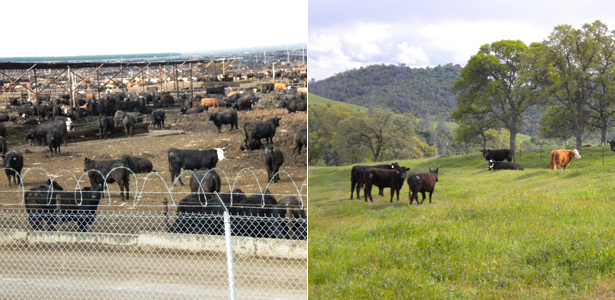
As I thought everyone knew, grass-fed beef is superior to feedlot beef in every way. And the wonderful thing in Uruguay is that most cattle are grass-fed. There are some feedlot operations, but from what I gather, they tend to be smaller than their North American counterparts, and duration of cattle poisoning shorter .

Poisoning? Yes. On a feedlot, cows stop eating grass, which their bodies are designed for, and are fed massive quantities of (genetically modified, herbicide resistant) corn, barley, soybeans, and other grains that seriously mess up their digestive systems. They also get loads of antibiotics and growth hormones. They spend the last six months of their lives wandering around in their own excrement, with not a blade of grass in sight. But getting fat, fast, which boosts corporate profits.

Feedlot versus pasture in California
Your preference? Photo source: https://www.theatlantic.com/health/archive/2011/12/feedlots-vs-pastures-two-very-different-ways-to-fatten-beef-cattle/250543/tps

In North America,

“Many are choosing to follow organic practices in their herd management, which are clearly healthier and more humane for the animals. The good news is that meat from those animals is free of antibiotics, steroids, hormones, pesticides, herbicides and other potentially toxic substances. The bad news is that it can take nearly two years to bring those animals to market on grass.

“Studies have shown that an animal’s diet can have an impact on the nutritional content of the meat on the consumer’s table. Grass-fed meat has been shown to contain less fat, more beneficial fatty acids, and more vitamins and to be a good source of a variety of nutrients. According to a study published in the Journal of Animal Science in 2009, eating grass-fed beef provides many benefits to consumers:

  1. Lower in total fat
  2. Higher in beta-carotene
  3. Higher in vitamin E (alpha-tocopherol)
  4. Higher in the B-vitamins thiamin and riboflavin
  5. Higher in the minerals calcium, magnesium, and potassium
  6. Higher in total omega-3s
  7. A healthier ratio of omega-6 to omega-3 fatty acids (1.65 vs 4.84)
  8. Higher in CLA (cis-9 trans-11), a potential cancer fighter
  9. Higher in vaccenic acid (which can be transformed into CLA)
  10. Lower in the saturated fats linked with heart disease”

Source: Grass-Fed vs. Feedlot Beef – What’s the difference?

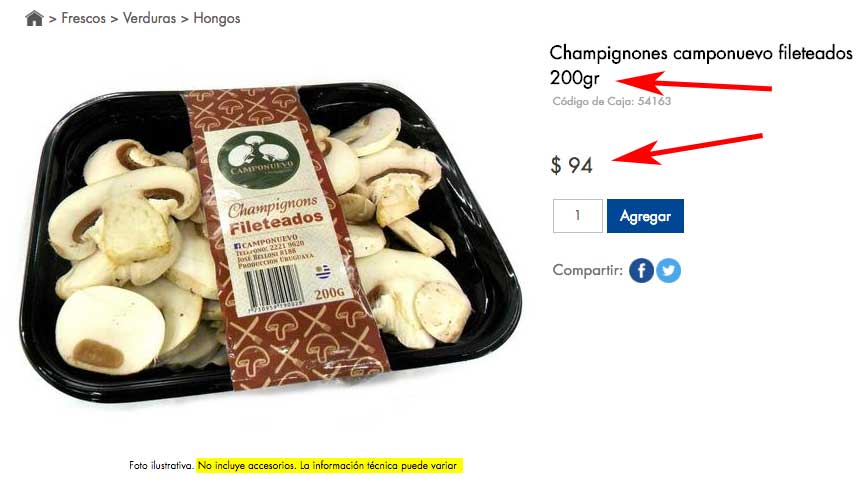
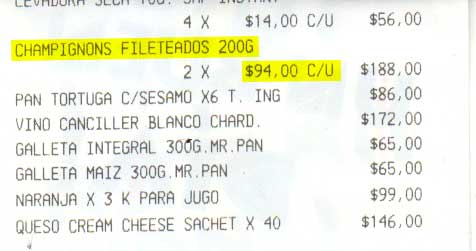
So what’s this got to do with Uruguay? Profoundly marching in the wrong direction, and proudly advertising the fact. Here’s the current flier from Tienda Inglesa:

Uruguay ads for feedlot beef

Unbelievable? I expect consumers here will swallow this whole, and embrace this “modern” idea as a good thing, just as dousing the entire countryside in glyphosate seems like a perfectly good thing to do.

They’ll figure it out eventually. Or not.

Fast house construction

I have often commented on how long construction takes in Uruguay. Simple houses can take the better part of a year.

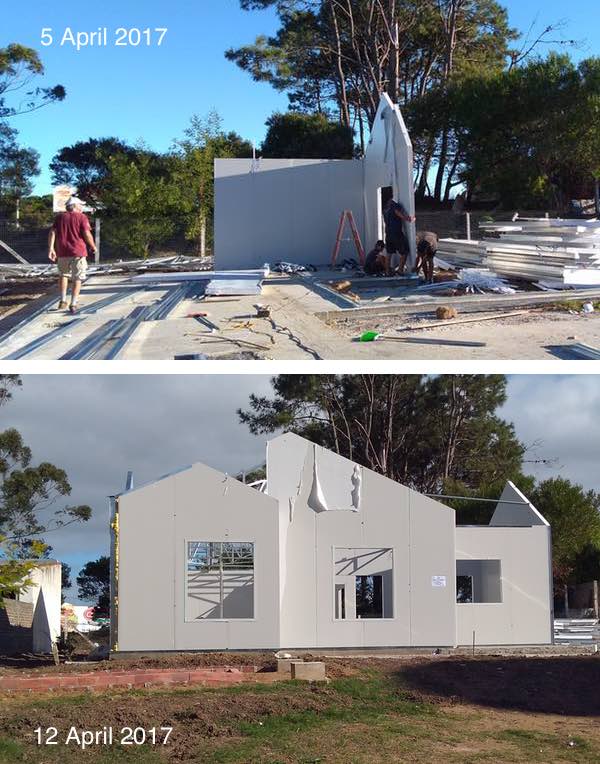
By contrast, using new technology, here’s the house Syd and Gundy are building as a rental.

super fast house construction with Isopanel

This is in fact a bit misleading because, being Easter week, the workers have only put in a few hours of work the last three days.

Isopanel – interesting stuff.

Return of the swimming hole

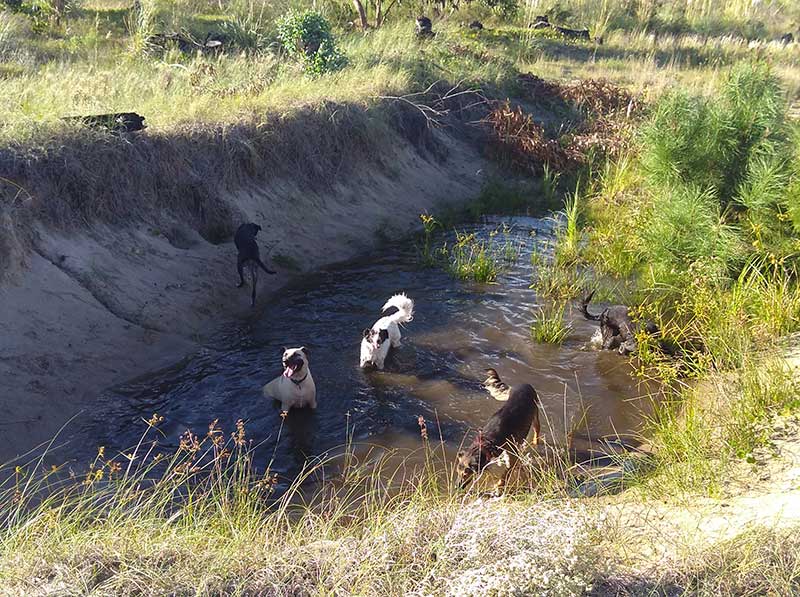
I took this photo two days ago. We had been avoiding this route for several days because the water level had gotten so low that it only invited the dogs to get filthy. But my neighbor — who has a swimming pool — estimated earlier that we had gotten 1.5″ of rain in the early morning storm. Naturally Syd and I were curious to see how that translated in the doggy swimming hole.

dog swimming hole, Villa Argentina, Uruguay

Just wonderfully, it turns out! Plenty of room to splash around, lie down, or sit for a few seconds, looking goofy, before chasing each other around or digging holes (an activity frowned upon at home).

Now I can only wonder how deep will this get when we have continued rain? Stay tuned.


Reaching for…

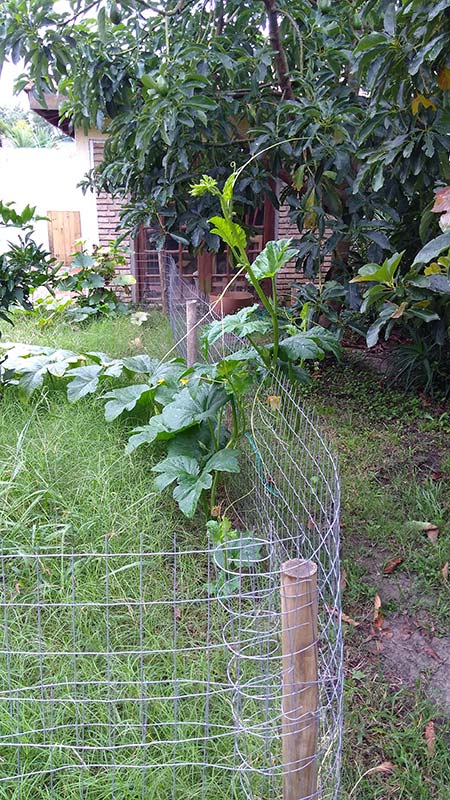
This morning, in my maybe-sorta dare-you-to-grow garden, an ambitious squash plant aspires to — what? A penthouse apartment in the avocado trees?

Ambitious squash plant, Uruguay

Most noteworthy about this image is what it lacks: shadows. After weeks of blistering sun, the temperature dropped dramatically overnight (90s – 70s F, 30s – 20s C). Unlike the last few weeks of forecast nonexistent thunderstorms, this time they got it right. We’re delighted, though reminded that *sigh* winter in Uruguay comes not far behind.


Worn out, burned out

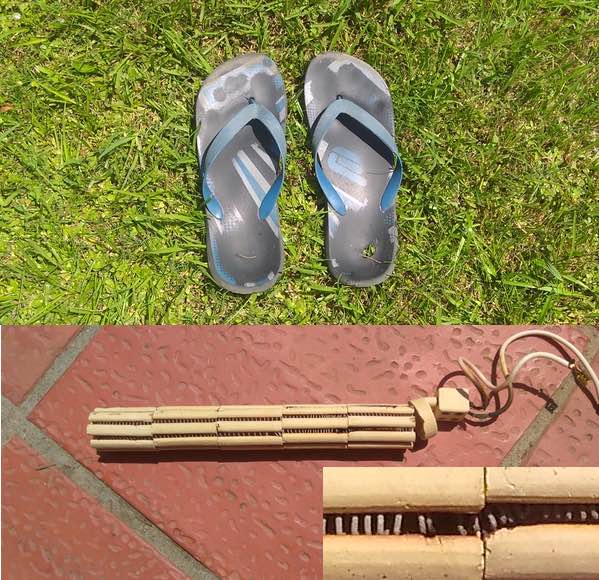
While waiting for the repair guy coming to replace the heating element (resistencia) in our water heater, I took a picture of my flip-flops. They’ve lasted at least a year and yes, the grass is showing through the right heal.

Worn out flip flops and burned-out water heater element

I often have to wait outside to wave people down, since my telephone explanations of how to get here are remarkably and consistently misunderstood. Today’s communications snafu also started on the wrong foot, as I didn’t really know how to answer an incoming call on my new smart phone. Seriously.

handwritten repair bill, Uruguay

Here’s the bill: visit, heating element, and cablingactually for the toll, since he came from Montevideo (it should have been 160 pesos, but then he probably charged it to everybody this side of the peaje).

1,000 pesos is around USD 36.

And if that 1,000 on the bill looks like 7,000 to you, you might share my fascination with Uruguayan handwriting.


The elementary school experience in Uruguay

Newcomers from California have posted a blog entry about their experience with rural Uruguayan elementary school. I’ve posted before about the umm, unusual school uniforms here. Here’s the explanation.

Elementary school uniforms in Uruguay
“The public school uniform in Uruguay has been like this since the beginning of the century, with every child wearing the white dust cover and the blue bow.  The reason for the uniform is to make it almost impossible to make fun or to comment about the quality, level of maintenance, or brand of the clothing underneath. It was a democratic and egalitarian effort to make every child look the same way with non-expensive clothes, and equalize opportunities. That is the spirit even today. The size of the bows, is just a tradition. Private schools do not follow this same tradition, but do each have their own uniforms.” 

We absolutely love the tradition. Our kids don’t feel embarrassed wearing them since all the other children wear them.  They do take them off as soon as we get home, but it’s nice not to have to worry about what they are going to wear at school.

I highly recommend reading the whole article: Escuela Rural on the Waystages blog (waystages.com/?p=106)


20190709 update: apparently a one-year wonder. This of February 2017 appears to have been their last blog entry, celebrated by their last meaningful Twitter post. Their Youtube channel ended shortly after their arrival in 2016. Their Facebook page went cold in November 2017. Well, best of luck to you wherever you are!

Boutique olive oil producer worth a visit

Guest post by Syd Blackwell

LOTE 8 – Viví Una Expeeriencia Única

View on Ruta 12, Dep. Maldonado, Uruguay
© Google

If you drive east on the interbalnearia (coastal highway) from Montevideo, then switch to Ruta 9 at Pan de Azucar, you will reach the start of Ruta 12, that runs north towards the tiny village (less than 100 persons) of Pueblo Edén, Uruguay. The vibrantly green hills and valleys along this route are, in my opinion, the most scenic of Uruguay. On one of these hills, just north of the village, you will find Lote 8, a unique experience in olive oil production.

Lote 8, olive oil producer, Uruguay

The operation, owned by an Argentinian family, offers tours, tastings, and, of course, the opportunity to purchase products. As recommended, we pre-booked a tour for our group of four, to ensure we would have the services of Martin, an English-speaking guide. We wished, as their brochure offers, “to enjoy a unique place where nature and passion transform its fruit into true art.” We were not disappointed.

Olive trees, Lote 8, Uruguay

The property is lovely; the vistas superb. Martin began his tour among the olive trees, where the fruit was still green and not yet ready to harvest. He explained two different methods of harvest, one with a finger-like device to strip olives from the branches, and one a shaking device to shake down olives. Matting below the trees catches the harvest.

Olive oil processing plant, Lote 8, Uruguay

Next, we followed the route of the fruit. First to a large grilled square in the floor where the harvest is dumped, and the conveyor that lifts it up to where the leaves and twigs are separated. Then the product moves through other machines that mix it with water, pulverize it into a slurry, and eventually separate out the valued oil. Finally, it is packaged, most in utilitarian bottles for Uruguayan supermarkets and such, and some in specially designed Mexican hand-blown glass bottles, suitable for gift purchases. Other products, such as soaps, candles, and chocolates, made with olive oil, are also available in the gift shop.

Lote 8 olive oil production plant, Uruguay

The buildings, the machinery, the layout, the total operation is just first-class. Great care is taken to produce this oil. Work also continues to add more features, more site beauty, to what is already remarkable. Step out of the processing room door and you look across a lily-pad covered pond, flanked by a bed of lavender, down and cross the grand greenness all around. This is a delight for visitors and workers alike.

Lote 8 olive oil, Uruguay

The main product, La Repisada extra virgin olive oil, has already won numerous international awards, some of which are on display in the gift shop. Each of us purchased items for personal use and future gifts.

We were totally delighted with our experience and would definitely recommend a visit. More information and contact email can be found on their website.


A special thank you to Karen Higgs, who suggested such a visit in her blog, Guru’guay. Also, if you tell them you read Karen’s article [link no longer exists], you are given a discount on your purchases!

All photos except the first by Syd Blackwell.

“How did an egg get in there?”

Stocking up at the butcher shop for the holidays, we decided to try a pollo relleno (stuffed chicken). We had a choice: salado or dulce (salty or sweet). We chose the former, hearing that the latter had things like pineapples inside it. The guy helping us could have, but didn’t, explain what the salado stuffed shicken contained. Perhaps I should have known (ya think?).

Pollo relleno - stuffed chicken in Uruguay

Susan’s comment after cooking and cutting it open:  How did a hard-boiled egg get in there?

Seems like I should have a clever which came first? comment, but I don’t.

Waterproofing: busy day

Since we’ve recently had painting done, we thought it time to try to address some persistent moisture problems on parts of the wall that couldn’t be painted. Inside, our new do-anything guy removed all the revoque (surface) of a section of wall, drilled lots of holes, and set bottles of Igol Infiltración, which eventually empty themselves into the surrounding brick and waterproof it. We hope.

waterproofing wall

Outside, despite being almost directly below a valley in the roof where the most water pours off, the owner/builder apparently made no provision for waterproofing the subterranean part of the sunken living room wall. Even though fixed in place, the pretty-but-shitty window on the right allows water into the wall as well.

exposed bay window foundation

Meanwhile, our Namibian tenant in the campo sought advice from a local South African with lots of building experience, and the two launched into solving water problems on the flat roof there. Typical of Uruguayan construction, the bottom of the drain pipe was slightly above the lowest part of the roof, leaving pooled water to soak through the inevitable cracks in the concrete.

Waterproofing the roof, campo

I helped somewhat, but mostly watched and listened, trying to sort out what they were saying to each other in Afrikaans.

Between the to-and-froing, I managed to take Benji walking with all his buddies, and saw this decent-sized spider casually making its way across our path.