No, I still don’t have my Goldmoney debit card. From Toronto, it went to London, Then Dubai.Then — drum roll, please — Miami. Now apparently in Buenos Aires.
Doesn’t exactly inspire confidence. If it’s ever actually delivered, let’s hope it works. Goldmoney, if you’re listening — this is pathetic.
I recently ordered a gold debit card from Goldmoney. The idea is that you own gold, but can sell gold grams to fund a fiat currency card (USD, EUR, GBP, etc). I imagined a scenario such as standing in line at Tienda Inglesa when the price of gold is $4,000/ounce and going up $10 every half hour, tapping instructions into my cell phone to fund the card, then spending the fiat moments later.
Alas, it’s not that fast. Currently takes about a day to transfer the funds (why?).
Why? Well, also why should a card from Canada be en route to Uruguay through Dubai?
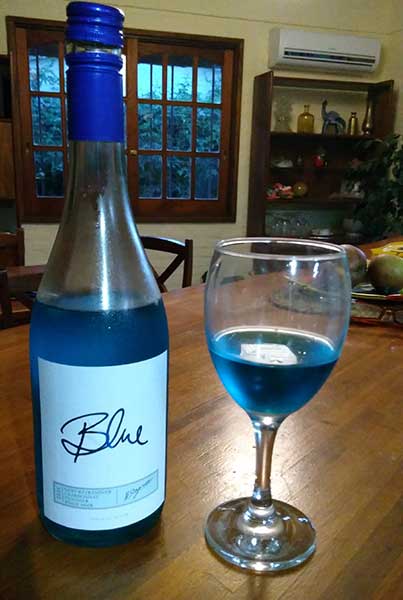
Well, of course I had to try it. And—? Since I’m not a wine reviewer, I’ll defer to the experts:
Wicked and extra-ripe. Whispers of fruit punch, acidic monster melon and aggressive lemon rind. Drink now through April.
Actually pleasant enough to drink, despite visual whispers of
this or this.
I shouldn’t have been surprised to see that Blue contains artificial coloring. But I was surprised to learn it comprises only 10%.
Aunque el 90% del color se obtiene de forma natural, se añadió un 10% de colorante, para conseguir un tono más turquesa, deseado por los responsables de la bodega. (source) — Although 90% of the color is obtained naturally, 10% of dye was added, to achieve a more turquoise tone, desired by those in charge of the cellar.
From the same article:
Young people and people who like to try new things are the target audience for the product, said the director of fine wines at H. Stagnari, Virginia Moreira. She added that the product was born for a personal reason: “In part, having four teenage children wanted to seek a change of habit to choose a natural wine instead of other stronger drinks.”
I hope they like it. I don’t expect I’ll be tempted to buy it again.
Three months ago, some guy sputtered up to our rusting mailbox and delivered someone else’s phone bill. Sombunall companies (phone, electric, and water are gubmint) deliver bills privately instead of using the government postal servicee (some irony there?). I don’t know which, since we get ours electronically (sometimes excessively). But two months ago, when the same bill arrived again, I went to tell them that I did not want this to happen again.
Which of course it did.
I did make an effort to find out to whom this bill should have been delivered, but didn’t get too far into that before hatching an alternate plan.
So here’s how I have chosen to advise the misguided mail carrier that the only bit of info he had right was the Manzana, or block. (No, you haven’t forgotten your high school Spanish: manzana does mean apple. I just live here, OK?)
Then came the presentation.
Style-wise, I’m of the school that says you can’t go wrong with duct tape. But if you think placing the offending bill across the opening where lazy doofus would cram it into mailbox is clever, you’re only revealing your northern-ness. It will not surprise me at all to see the next bill inserted behind this one.
While waiting for the repair guy coming to replace the heating element (resistencia) in our water heater, I took a picture of my flip-flops. They’ve lasted at least a year and yes, the grass is showing through the right heal.
I often have to wait outside to wave people down, since my telephone explanations of how to get here are remarkably and consistently misunderstood. Today’s communications snafu also started on the wrong foot, as I didn’t really know how to answer an incoming call on my new smart phone. Seriously.
Here’s the bill: visit, heating element, and cabling – actually for the toll, since he came from Montevideo (it should have been 160 pesos, but then he probably charged it to everybody this side of the peaje).
1,000 pesos is around USD 36.
And if that 1,000 on the bill looks like 7,000 to you, you might share my fascination with Uruguayan handwriting.
No, not selling weed. Seeds, paraphernalia, maybe growing supplies. I didn’t even bother to look inside. I was showing some visitors around.
Uruguay legalized marijuana — sort of — in 2013.
You can legally grow six plants at home, but you’re supposed to register with the government, an idea which for some reason weed users (and people who remember the military rule) don’t universally embrace. You can join a cooperative and grow up to 99 plants. But no weed is available through pharmacies, as planned, because many pharmacies oppose the idea. (Because marijuana is so unhealthy, don’t you know.)
Between 1850 and 1942, Big Pharma did not exist. Thanks @hemprojectsocial on Facespook.
Unlike Jamaica, Uruguay has decided not to sell marijuana, if and when it’s ever available, to non-residents and non-citizens. However,
Montevideo is now littered with shops selling weed paraphernalia to both locals and tourists. A biscuit firm is marketing alfajores – the country’s national snack, two chocolate biscuits sandwiching a layer of dulce de leche – at dope users suffering the munchies. Its yellow “Marley” packaging seems to be in almost every convenience store, complete with a lion waving a Rastafarian flag and a large dope leaf. [source]
Source: subrayado.com
Needless to say, I’ve never seen one. Must be a Montevideo thing. Reminds me of the Macarena: the U.S. nationwide song craze that no one outside the Washington Beltway had ever heard of. But I digress.
Uruguay’s laudable marijuana initiative will hopefully pan out. Meanwhile, it’s looking — to me at least — as a well-meant, and welcome, move, that can only come to fruition through a miracle: the government bureaucracy actually allowing human beings to thrive. Here, as everywhere else, they seem to revel in doing the exact opposite.
Classy may be too strong a word, but Tienda Inglesa has been for me the best of the handful of “large” (remember, Uruguay is small) supermarket chains in Uruguay.
Back in 2012, Tienda Inglesa sold LED lights imported by Renovables S.A., a wide-ranging and impressive Uruguayan renewable energy business. The owner, Rolando Ringeltaube, told me how carefully their company monitored quality control in China. And, he told me, LED bulbs should have a life of 20 years. Which, considering the history of incandescent light bulbs, seems an unlikely prediction. Still, they have to last longer than these mercury-laden compact fluorescents that seem to last about a year, no?
So imagine my surprise when an LED light bulb I bought there died after three weeks. They have a “no refund” policy, but thought about it a couple days, and gave me another. Which also died after three weeks. Once again, they reminded me of the “no refund” policy, but gave me a credit after a few minutes. Meanwhile, I walked to the lighting section to examine the packaging. Sure enough, they are now imported from China by Tienda Inglesa. No middle man. No quality control.
LED bulbs are great (10X more efficient than incandescent), but the Tienda Inglesa LED bulbs are now officially trash. Consider yourself warned.
Walmart wisdom™ comes to Uruguay.
Update 5 January 2017: the latest Tienda Inglesa garbage LED light, acquired 3 December 2016, has started overheating and malfunctioning today, after 33 days.
—Several years ago, getting a quote on a large order, I complemented the local lighting store on their prices, which were much better than another place I’d just been. The kid behind the counter said, ”Sometimes they’re more expensive. Sometimes we’re more expensive. There’s no real competition here.”
He used the word competencia.
And today his statement was again proven true (with a twist, twice!) with a phone bill address and delivery.
I can vividly recall, back when we lived in the USA, sorting and sighting (for straightness) dozens and dozens of the cheapest 2x4s at Lowe’s or Home Depot for various projects. Whatever words I might attach to that experience, “inspiring” would probably not be one of them.1
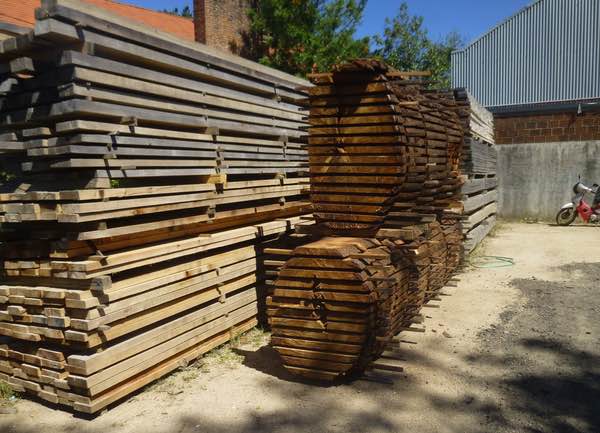
Going to the local lumberyard here is entirely different.
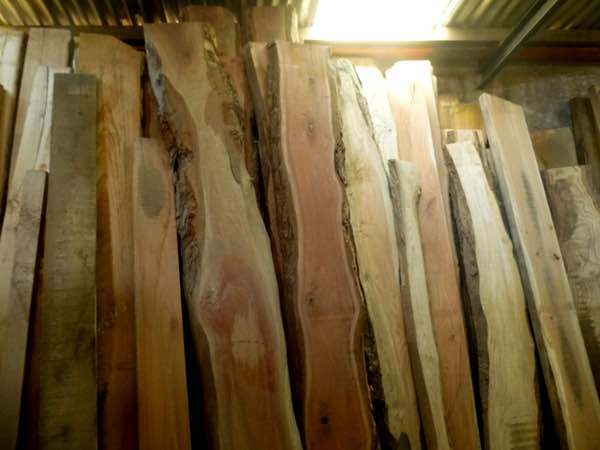
How can you look at entire logs sliced raw into thick slabs without starting to imagine things to make out of them?
Inside, you can wander around among the various wood products, including dimensional lumber, either comun (I think they use that term) or cepillado, planed. But then these gems of individuality.
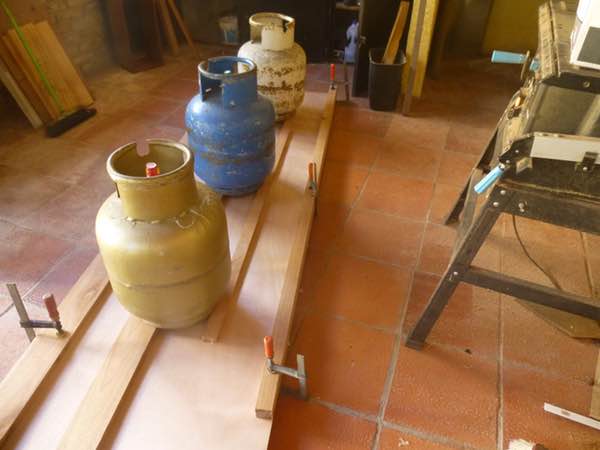
But I wasn’t there for inspiration, but rather 3mm plywood veneer to re-face an abused and incredibly cheap bathroom door, since we have friends arriving in a week who will stay in the casita. It’s not a standard size, so I couldn’t simply buy a new one. Note that it doesn’t have a frame — just little pieces of wood glued to the veneer. I think they’re a little more solid up north.
So, glued, clamped, and ya veremos (we’ll see)!
1 However, being in North America, at least I didn’t have to double-check them for accurate dimensions and right angles
In January, it will be ten years since I last lived in the United States, and one wonderful and immediate change was no more junk mail! Now all our utility bills are delivered electronically, which is great. There’s almost never anything in the outside mailbox.
But, yet to find and explanation: why they emailed yesterday’s bill ten times.


 or this.