The private workers actually left their work area very clean. Of course, the aesthetic appeal of the plants has been greatly reduced, but they’ll grow back.
Much of the waste, I expect, they left around the base of the plants, but that will return nutrients to the soil. On the ground in front is a piece similar to what they were packing into crates.
Meanwhile, near Syd’s place, the public workers actually did come back, and did remove the rest of the brush pile, and the other one around the corner!
But all the trash carefully removed from the brush pile remains in its own pile on the ground, just meters from an empty trash container. Because “not their department,” no doubt.
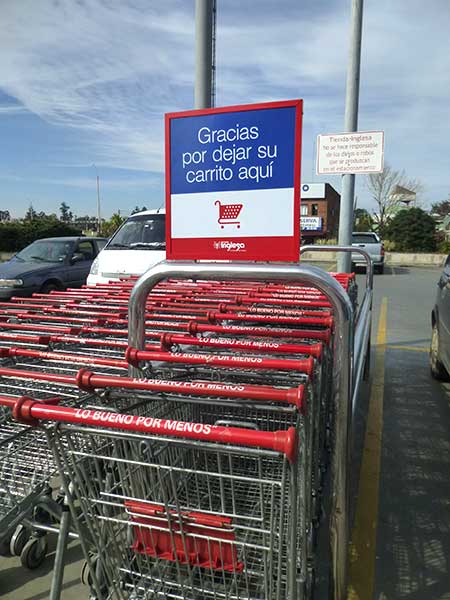
A new sign has appeared in the Tienda Inglesa parking lot in Atlántida.
In a northern setting, it wouldn’t merit a second glance (except for being in Spanish: ”Thanks for leaving your shopping cart here.”)
However, as I joked to the employee in the parking lot, you can tell the new owners are American.
Klaff Realty, LP, owners of the Safeway and Albertson’s supermarket chains in north America, bought Tienda Inglesa’s 10 stores in March for $120 million. The shift has been subtle but palpable: aisles opening up, less innacessible merchandise cluttering the tops of shelf units.
And now this — thanking customers for not simply abandoning their shopping cart anywhere in the crowded parking lot (often requiring the next person to move it before being able to park).. Wow! Efficiency! Innovation! Think of what could happen next.
Maybe they’ll instruct employees not to block entire aisles with shopping carts as they stock shelves during the busiest periods? Nah, unlikely.
Or teach cashiers that their little bar, referred to up north as a “separator” or “divider,” and sometimes saying “Next Customer,” has a function other than breaking the photo-electric beam that makes the conveyor belt move? Seriously, as we started to unload our shopping cart onto the Tienda Inglesa conveyor belt today, my wife reached for the divider to separate our groceries from the previous customer’s. The grumpy cashier actually grabbed it and put it back, insisting that its function was to turn the conveyor belt on and off.
Perhaps I should take a felt marker and start writing on them ”Próximo Cliente,” No, they’d probably consider that vandalism.
I do, however, find some inspiration in the gringo who got so tired of Montevideo restaurants listing unavailable menu items that he started carrying a Sharpie marker, and crossing them off the menu with indelible ink as they were announced nonexistent by the waiter. So wrong it’s just right!
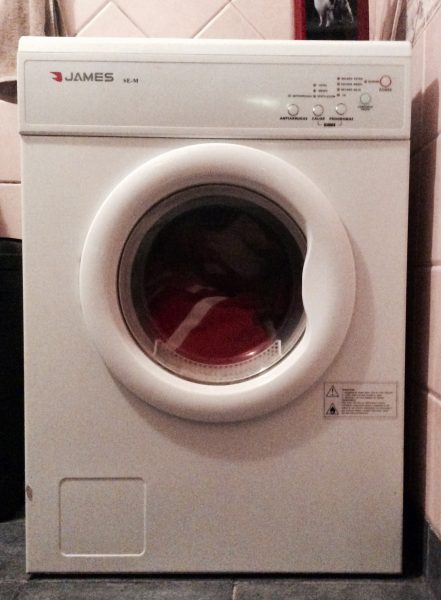
I’ve taken apart this beast several times, most recently to replace the belt, but when it ceased producing heat recently I felt a bit out of my league, and called the appliance repair people, for whom I had several phone numbers. But now one: I guess it’s now the appliance repair guy.
Whatever, from his high-speed mumbling on the phone Friday I got the idea he would be here Saturday afternoon. A bit after 5 PM Saturday, I called again. I can’t say for sure why, but this time the high-speed mumbling left a warm fuzzy feeling.
And a few minutes later, a 30 year-old car pulled into the driveway. Repairman, maybe older than the car, maybe not, with MSC (company name) jacket and toolbox comes through the front door (“Con permiso”). Removes top of clothes drier, starts extracting burned plastic bits, explains in high-speed mumbling that iit’s a burned connector. He’ll replace, but it happens again we’ll have to replace the heating element. Which I had assumed was the problem to begin with.
OK, it wasn’t quite that direct. In addition to having to ask him to repeat everything (something which, I’m happy to report, rarely happens to me by now), I was puzzled by “la resistencia.” Perhaps a bit of cognitive dissonance trying to conflate Latin American political history with appliance repair, then the shoulda-been obvious chimed in. “La resistencia” means the resistence heating element (think wire that, instead of conducting electricity, resists it, turning the electrical energy into heat).
Delighted at my own slightly-delayed ascertainment of the relatively obvious, I shared with him that English term is “element.” Of course, it’s not exactly: it would be “heating element,” or better, “resistance heating element,” Fortunately, my attempt to excuse my ignorance proved uninteresting and irrelevant, and with a brief feint of interest from him, that was done.
The clothes drier works again. Maybe not for long. But the appliance guy came to our house, and fixed the clothes drier, and it cost US$10 total.
So, thinking back to when I called Sears repair in the late 1990s, gave them the model number of my mother’s clothes drier, and said the belt was broken, and they showed (with no parts) to determine the model number and diagnose broken belt—for $49—so, just curious, what would this episode cost now in North America, Europe, Australia, South Africa?
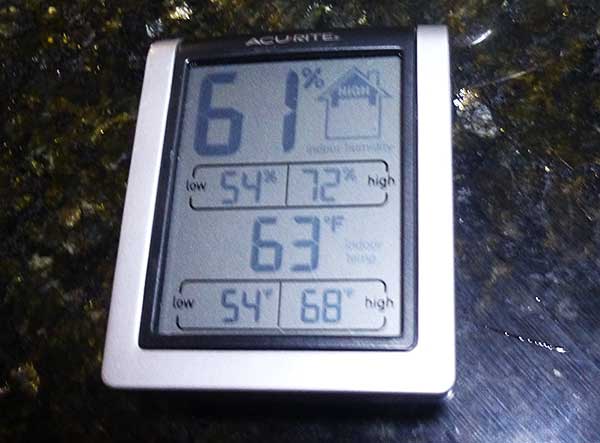
Some time ago, while a friend was in the Untied Snakes, I shipped to him from Amazon a little humidity monitor. Only a few ounces. He had offered to bring things back. Over the years my “need” for goodies from up north has diminished. But this seemed useful, and I’d never seen one here.
No sooner had it shipped from Amazon than there it was in Tienda Inglesa, similar model for more or less the same price. I didn’t buy it, because I didn’t need two. However, with our little unoccupied chacra house, I’ve recently been watching for mold, so carrying this one back and forth. Hey, maybe it would make sense to have two after all.
So this morning I went to Tienda Inglesa with a mission, and no, they don’t have them any more. I thought, well, this is typical of a very small market! The population of Uruguay is 1% that of the Untied Snakes. So people coming here from there have to be aware — hey, wait a minute, where I have experienced this before? Costco and Sam’s Club, where some stuff is always there, but other stuff you grab because it’s unusual and probably won’t be stocked again.
Hmm. Okay. No particularly profound economic observation here. I do see one similar in Mercado Libre (~eBay) for 50% more. Fair enough.
I’m reminded of my first trip back over the border after moving to Mexico in 2007, where high priority was some LED flashlights, which weren’t available locally. I stood in Tarzhay, befuddled by a seemingly endless selection, finally buying two or three. And returned to find LED flashlights — one or two models only, but hey — in Walmart in Morelia, Michoacán.
P.S. — yes, we have no Malwart in Uruguay, but Tienda Inglesa was recently purchased by whoever owns Safeway and Albertson’s. Entonces, ya veremos.
At some point, recovering from a stupidly self-inflected shoulder injury, experiencing rare back pain, and having heel pain — all on the right side — I decided to go to an osteopath recommended by several people.
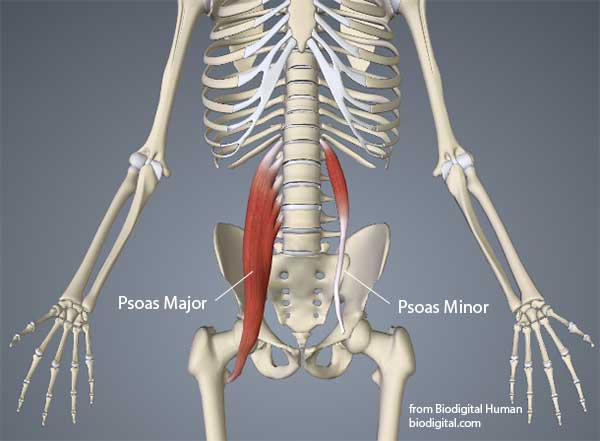
I didn’t particularly like her. On the third visit, she was inflicting more pain than usual, and I asked what she was working on. The psoas, she replied. Oh, I said, there are two of them, aren‘t there? — Yes, she said, one on the left and one on the right. Red flag! I remembered something from 15-20 years ago.
Not a good sign, I thought, when I, with no training, know more about anything anatomical than a practicing osteopath. Strike one.
But it got better (or worse). Her “office” is a tiny anteroom in an old Uruguayan house, with the “customer” seat a very slouchy thing under a bookshelf. So I was sitting upright on the edge of it instead of slouching underneath the bookshelf, for which she sort of ridiculed me, saying something about a straight back. There are people with straight backs? I asked. Yes, she said, you have a straight back. She went on to explain that it‘s more difficult to put a curve in a straight back than straighten a curved back. Well, sorry to bring you into the 21st century, but there’s something about a J-shaped spine being healthier than an S-shaped spine. Strike two.
There was a strike three, though I don’t recall now what it was. It’s been almost six months. Anyway, I never went back.
Update 14 June: the third strike was in fact the first: with my first step out of her office after the first session, I had pain in my back. I am still aware of sciatica issues now. Every day.
But I hung on to her prescription for orthopedic shoe inserts, and finally ventured into Montevideo last week to get them. I really don’t like driving into Montevideo, but there was a schawarma place nearby I wanted to try. Good enough excuse!
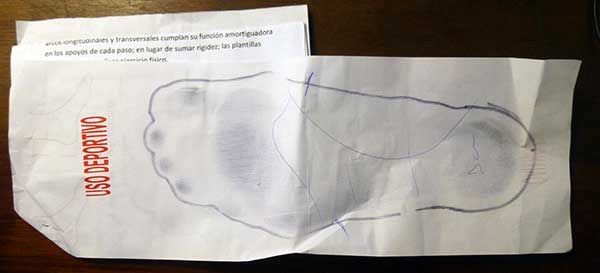
In the store, Bergantiños, after spending an inordinate amount of time facing a distinctly unremarkable oversize sepia photo of the store’s opening in 1973, I was ushered to a little cubical where, one foot at a time, I stood on an “imprinter” that recorded each foot. Wow, I thought, the same technology they used when they opened the store!
The prescription letter specified “sports use”
Am I finished? I asked. Oh no, have to wait for what sounded to me like the “foot studio.” And after another ten minutes, she led me into the back room, had me stand facing a mirror marked with tape to help me stand straight, walk back and forth a few times on a little platform the length of a bed, and stand on a scanner.
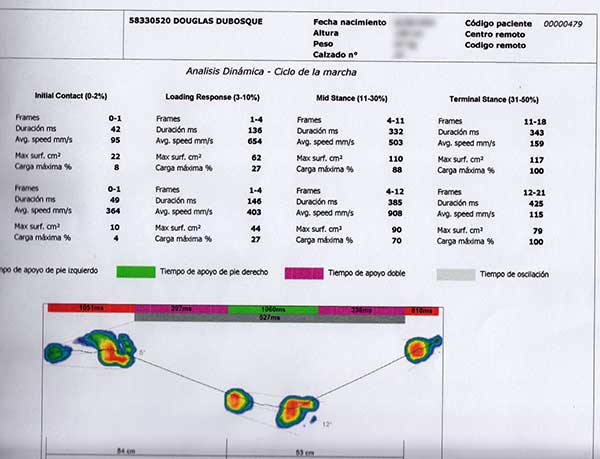
Then the technician came in, looked at the initial impressions, made some marks on them (see above), then got on the computer and starting matching colorful pressure images to the scan of my feet, spinning around the resultant shoe inserts in three dimensions in the program‘s CAD window. When I left, they gave me a folder with all my data neatly arranged.
This from when I stood facing the mirror, including the percentage of weight on the front and back of each foot.
This is the computer’s assessment of my stride, apparently averaging the several passes.
I told the tecnico that this was impressive technology, and he indicated that it was new within the last year. Whether that meant the technology itself or their acquisition was not clear, though I suspect the latter. Nonetheless, all pretty cool.
The inserts arrived yesterday. I like them! Total cost 100 bucks and change. Seems like a bargain when you consider this, from 2006: Do You Really Need an $800 Custom Insole?
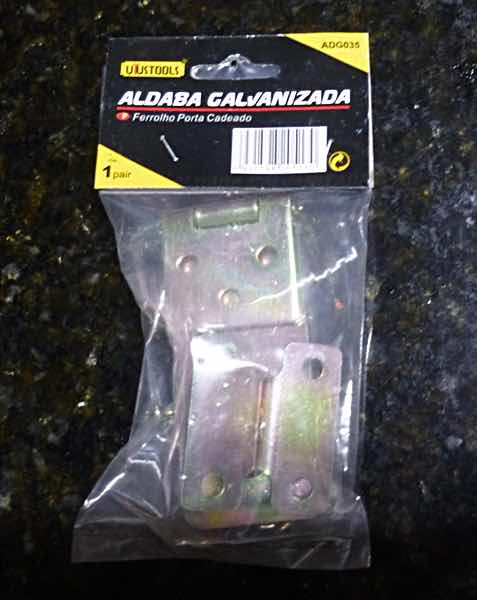
Unable to secure the pretty-but-pretty-malfunctional wooden doors of the barbacoa (which is an enclosed parillera, or cooking area), given the recent rains and humidity, I decided to abandon the door’s lock and install a hasp and padlock.
I didn’t know the word for hasp, so I looked it up: aldaba. (Fun Spanish fact: if a word begins with “al,” it came from Arabic.)
In the local ferretería, this word drew a blank look from the proprietor. I explained with my hands and a mention of candado (padlock). Aha! He knew exactly what I wanted and reached for it on a nearby display. It’ called [_____________], he explained, but the word went in one ear and out the other when I saw what he had just handed me.
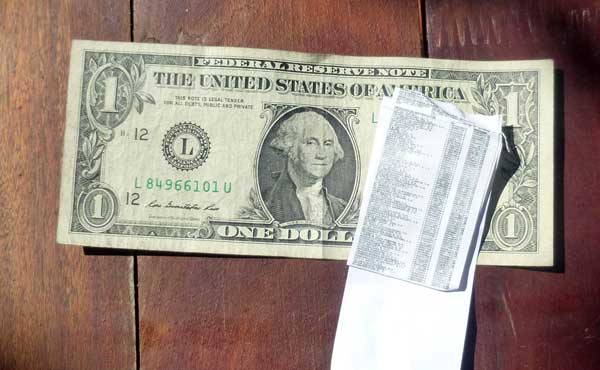
We bought a used gas barbecue grill without a functioning lighter. So I bought one of these for a few bucks. I was amazed how quickly it ran out of gas. Taking it apart, I see that, even though it has room for a regular lighter’s worth of gas, they’ve made the tank smaller. Because they can. Because you can’t see it. What a rip!
So I’m back to turning on the gas and throwing a match through grill. *POOOMP*
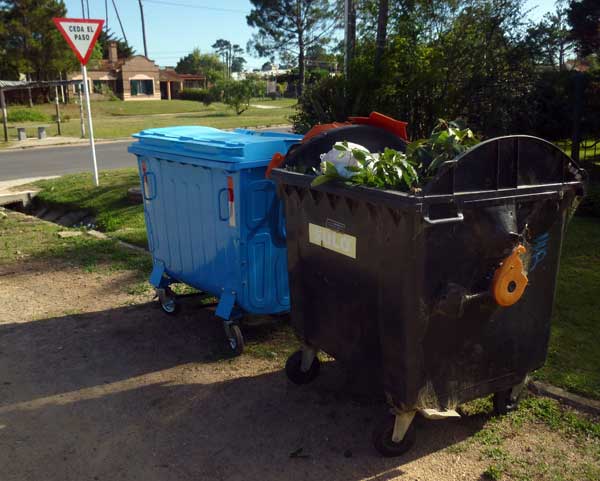
After losing the closest trash container to fire three times, and the next closest once, and both at the same time most recently, we were glad to see them replaced. In our case, however, replaced with other beat-up plastic bins.
Meanwhile, closer to the beach, new metal ones have joined the aging plastic bins. They still have plastic tops which will no doubt rot in the Uruguayan sun, but at least the whole thing can’t be burned to the ground!