Uruguay retrograde: feedlot beef

As I thought everyone knew, grass-fed beef is superior to feedlot beef in every way. And the wonderful thing in Uruguay is that most cattle are grass-fed. There are some feedlot operations, but from what I gather, they tend to be smaller than their North American counterparts, and duration of cattle poisoning shorter .

Poisoning? Yes. On a feedlot, cows stop eating grass, which their bodies are designed for, and are fed massive quantities of (genetically modified, herbicide resistant) corn, barley, soybeans, and other grains that seriously mess up their digestive systems. They also get loads of antibiotics and growth hormones. They spend the last six months of their lives wandering around in their own excrement, with not a blade of grass in sight. But getting fat, fast, which boosts corporate profits.
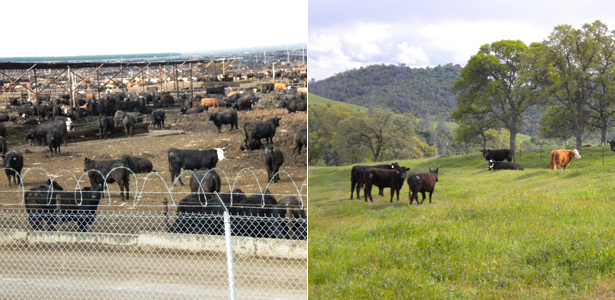
Feedlot versus pasture in California
Your preference? Photo source: https://www.theatlantic.com/health/archive/2011/12/feedlots-vs-pastures-two-very-different-ways-to-fatten-beef-cattle/250543/tps

In North America,

“Many are choosing to follow organic practices in their herd management, which are clearly healthier and more humane for the animals. The good news is that meat from those animals is free of antibiotics, steroids, hormones, pesticides, herbicides and other potentially toxic substances. The bad news is that it can take nearly two years to bring those animals to market on grass.

“Studies have shown that an animal’s diet can have an impact on the nutritional content of the meat on the consumer’s table. Grass-fed meat has been shown to contain less fat, more beneficial fatty acids, and more vitamins and to be a good source of a variety of nutrients. According to a study published in the Journal of Animal Science in 2009, eating grass-fed beef provides many benefits to consumers:

  1. Lower in total fat
  2. Higher in beta-carotene
  3. Higher in vitamin E (alpha-tocopherol)
  4. Higher in the B-vitamins thiamin and riboflavin
  5. Higher in the minerals calcium, magnesium, and potassium
  6. Higher in total omega-3s
  7. A healthier ratio of omega-6 to omega-3 fatty acids (1.65 vs 4.84)
  8. Higher in CLA (cis-9 trans-11), a potential cancer fighter
  9. Higher in vaccenic acid (which can be transformed into CLA)
  10. Lower in the saturated fats linked with heart disease”

Source: Grass-Fed vs. Feedlot Beef – What’s the difference?

So what’s this got to do with Uruguay? Profoundly marching in the wrong direction, and proudly advertising the fact. Here’s the current flier from Tienda Inglesa:

Uruguay ads for feedlot beef

Unbelievable? I expect consumers here will swallow this whole, and embrace this “modern” idea as a good thing, just as dousing the entire countryside in glyphosate seems like a perfectly good thing to do.

They’ll figure it out eventually. Or not.
Retrograde Uruguay

Mercury goes retrograde today, through 5 September, so beware travel plans, contracts, don’t buy electronics or vehicles, and expect communications to be fouled up. If you’re new to this, please do pay attention: read more here.

What does that have to do with my day in Uruguay? Well, Mercury, nothing, but the other — retrograde. Uruguay does sometimes does appear to be traveling backward through the universe. Take this latest marketing “innovation” at Tienda Inglesa:

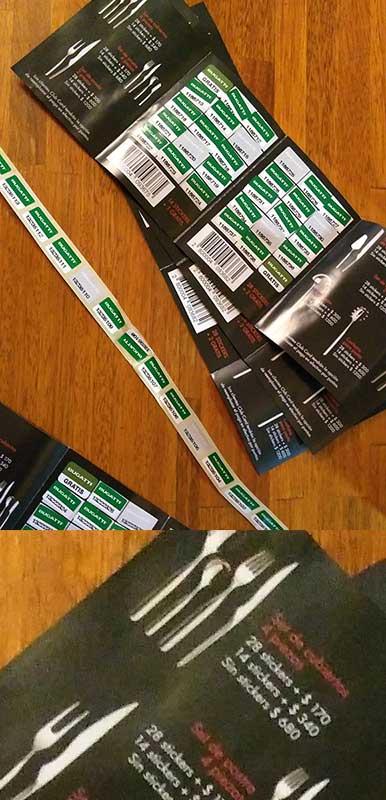
Uruguay checkout stamps - onward into the '80s

At checkout, you get little strips of stickers that you can put in little booklets — aha! If you grew up in the United States in the 1960s or 1970s, you probably remember S&H Green Stamps. You would lick them and stick them into little booklets to redeem for merchandise from their store or catalog. Still can, in fact, even though they ended in the 1980s.

Well, at Tienda Inglesa, this little trip down memory lane is  only good for a discount on one brand of cutlery.

But it gets “better:” the little strip of stickers has to be counted out by the cashier. But every fifth sticker is gray, so this can be quick. You know, 5, 10, 15, 20…? No, in fact on our most recent visit, the cashier counted them out by twos. I kid you not.

Of course, this un-streamlines checkout considerably. In addition to the grueling process of counting, occasionally a customer in front of you will require an explanation of how the whole new-fangled thing works.


So, while we’re waiting for our stickers to be counted out by twos: you know what a checkout divider is — the little rectangular or triangular thing that makes checkout more efficient by separating customers’ items? You did know that? Congratulations! Perhaps not 1 in 100 Uruguayans does. In addition to having  always only one, and even when printed with Proximo Cliente (next customer), the cashier uses it simply to block the “electric eye” that starts and stops the checkout conveyor belt, and might get quite huffy if you try to use it as a checkout divider.

So it was with some pleasure that on that most recent visit, before watching the by-two sticker counting, we were able to get our hands on the checkout divider, and use it as a checkout divider. What a concept!.

So what did the Uruguayan behind us do? He waited until every single item of ours was off the conveyor and the checkout divider had stopped the conveyor, before he would put a single item on the now-empty belt.


I suppose you could make this stuff up. But you’d have to be in a retrograde state of mind, no?


¡Exito!

Several years ago, I bought a countertop water filter (and was amazed I hadn’t earlier). Offered at a discount at an “eco” or something expo I went to with Syd and Gundy, it seemed like a good idea. And it was.

Thanks again Syd, for your loan of a couple thousand pesitos cash to buy the Dvigi filter!

Anyway, got the thing home, and none of its half-dozen adaptors fit our faucet. Recall that Uruguay is a small country and not a powerhouse for standardization. Drove into the Dvigi “office” in Montevideo with the faucet spout (or whatever it’s called) and confirmed they had nothing that fit. Gave them back all their adaptors, left with a clunky rubber-hose-clamp device we’ve used for three years. Which shoots minuscule streams of water at the wall, which encourages mold growth, which — no it’s just a porquería getting worse over time.

Meanwhile: the kitchen faucet in the casita (little house), despite local retooling — an interesting concept — just ain’t up to snuff. So I had this idea: move our kitchen faucet to the casita (sans filtro) and buy a new faucet with a diverter valve that actually matched its threads.

Looked in all the local shops for a solution. Nothing. Mentioned it to Syd. He said, well the place in the Costa del Oro  with the big faucet sign has been good at solving problems for us.

I went there today. All female employees; not quite what one expects in a plumbing supply company. Explained situation and — BAM! — solution.Un milagro  (a miracle), I said. The girl helping me laughed at that (yes, I can say girl safely; today is my 63rd birthday).

This may seem trivial if you live elsewhere, but in a place like Uruguay it seems totally awesome.

Now to find a plumber who will actually show up to install it (OK, unfair: I know a couple).


Budweiser beer in Uruguay

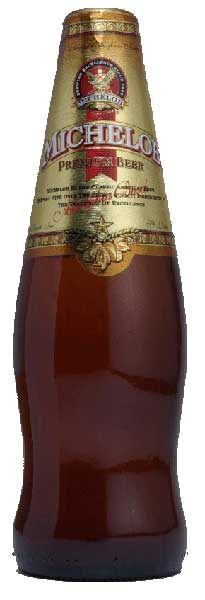
I am neither a connoisseur nor regular consumer of beer, though I like it. In my callow (whatever that means) youth , I consumed various American too-cold soda-water-fizzy beers. I remember Pabst and Schlitz being shit, and maybe I favored Budweiser because my father did, and maybe settled on Michelob as the “good stuff” (cool bottles).

Michelob beer bottle

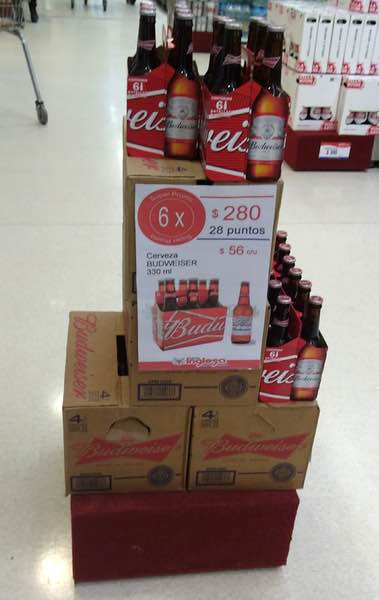
Fast forward, and here in 2017 the shit Budweiser from the U.S. (not the supreme Budweiser Budvar) is on display in Tienda Inglesa.

Shit Budweiser beer on sale, Uruguay

A standard six-pack of 12 ounce (.33 l) bottles rings up at just about USD 10.

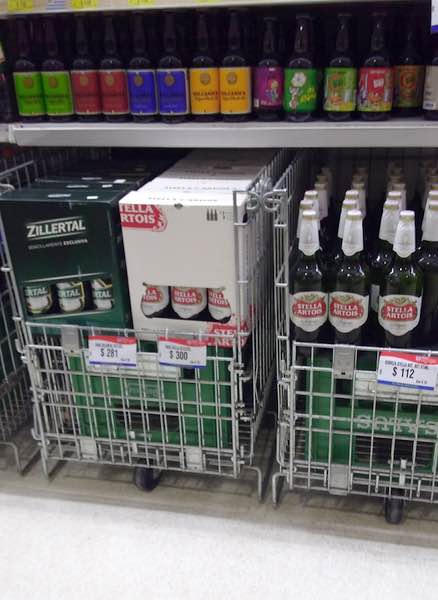
Beer, Uruguay

A few meters away you can buy a 3-pack of Zillertal (.97 l each).

Almost 50% more of a superior beer for a peso more.

So who would want Budweiser? Maybe someone who thinks it’s a bargain because they advertise it in shopping points?


Barbershop decor

Last time I had a haircut — many months ago — it was by the Uruguayan husband of a German woman Katerina, who has a successful shop in Atlántida (calle 1 y Ciudad de Montevideo). He did a very nice job, and I was glad to make my (overdue) return.

But this time, the girly space had expanded to an additional room on the side, and he was waiting in what was clearly the man cave barbershop.

barber shop, Atlántida, Uruguay

This is the view from the chair. You’ve got to admit it’s awesome!


Moving money for cheaper

Living in one country and getting money from another can be expensive. The last time I did an international bank wire transfer, the originating bank charged USD 25 and the recipient bank USD 35. Since anything over USD 10,000 becomes a hassle, I have usually wired something less than that.

I have from time to time looked into alternatives, but they have always ended up being even more expensive.

Until now. I don’t know when it changed, but with Western Union I just picked up USD 500 cash locally for a fee of USD 5. It took, as promised, four days to get from my bank in the US to Uruguay. Had I charged it to a credit card, the fee would be USD 15 and the transfer instant. The maximum transfer without signing up for their FX service is USD 5000.

And I could have sent it in Uruguayan pesos as well. Sweet!

Western Union logo

Of course, I can’t quite make sense of their slogan, but who cares? It works. The service, not the slogan.


UPDATE: after 9-10 transfers, they suddenly cut me off for life, after informing me money was ready for pickup. No reason offered other than “know your customer,” no appeal. What a truly shitty company.

Free international shipping

I’ve posted several times about buying stuff from China with free international shipping (including a 99¢ money clip I used today). The latest is more of the same, with a couple of international twists: first, it came from India, not China.

Piezo lighter delivered to Uruguay from India for free

Here, exactly:

India map

Secondly, I thought of such a thing because a Romanian friend staying with us for a couple weeks in April, after watching me throw matches into the BBQ grill to get it lit (zzzzzht-toss-dammit! zzzzzht-toss-dammit!; zzzzzht-toss-FOOOMP!), wondered if there was somewhere in Uruguay to buy a sparking lighter (piezoelectric; no fuel) to take back to his father in Romania.

Recognizing that such a thing would be, if not as exciting, probably a better approach for me, I thought about trying to find such a thing in Montevideo. Half a day at least. Chance of success? Under 50%, I figured.

Twenty minutes later I had ordered one on eBay for USD 7.

From India. With free international shipping. 27 days to arrive, and it works great!