Expo Cannabis 2017

Uruguay “sort of” legalized marijuana at the end of 2013. Being a place where free-market is generally considered a bad thing, and government somehow a creator of wealth, the experiment has proceeded with predictable ham-fisted bureaucracy. The government controls all production, licenses growers and buyers, limits the amount they can buy in a month, etc. At present there are maybe 16 pharmacies (all in Montevideo AFAIK) where one can buy marijuana, and they have had their bank accounts closed because of the ham-fisted and arrogant United States federal government. This echoes the contradiction between state and federal laws in the U.S.: marijuana is legal in California and Nevada, but if you transport it across the border you’re committing a federal offense.

However, there is good news: Hemp Planting to Triple in Uruguay. And the Expo Cannabis has gone from rinky-dink three years ago (according to Syd) to quite impressive.

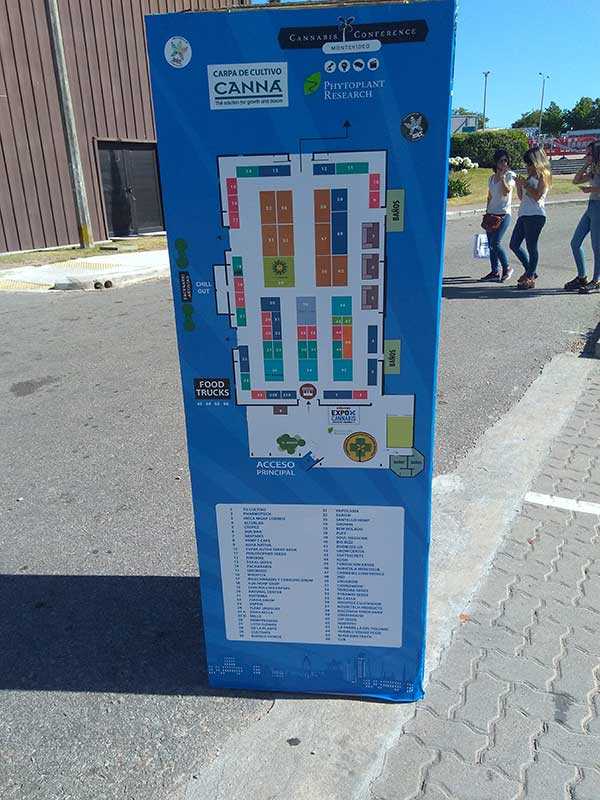
Expo Cannabis 2017 display map

As you might guess, most of the crowd was younger than yours truly.

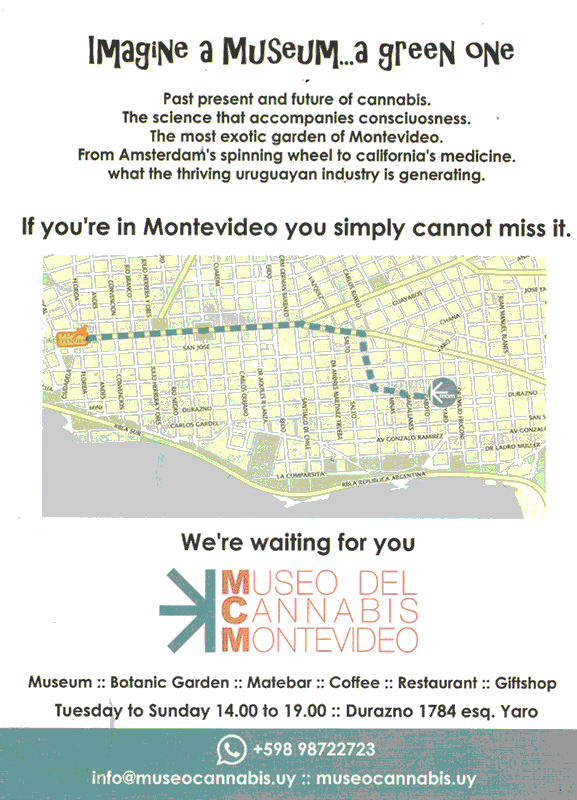
The first display inside the door showed a variety of products including hemp oil, and dog care products that Syd really wanted to buy. Not for sale? It took me an embarrassingly long time to realize the display was for the Museo del Cannabis Montevideo.

Flyer for Montevideo, Uruguay Cannabis Museum

Nearby, a display of plants.

Examining marijuana plants, Expo Cannabis in Montevideo, Uruguay

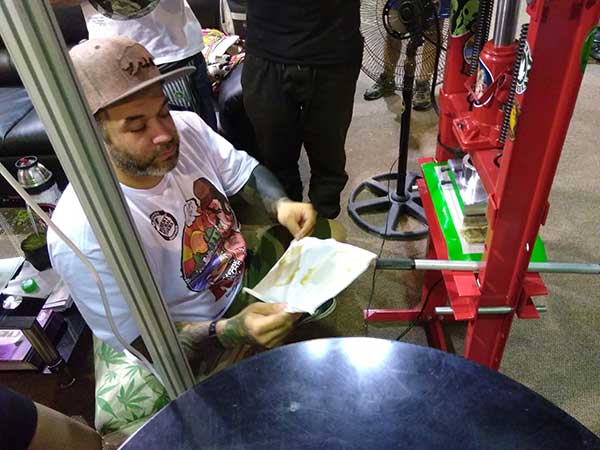
We quickly noticed a number of booths had hydraulic presses. We were a bit mystified, then watched a demonstration of extracting cannabis oil with heat and pressure — far safer than using toxic solvents, which then have to be boiled off.

Extracting cannabis oil

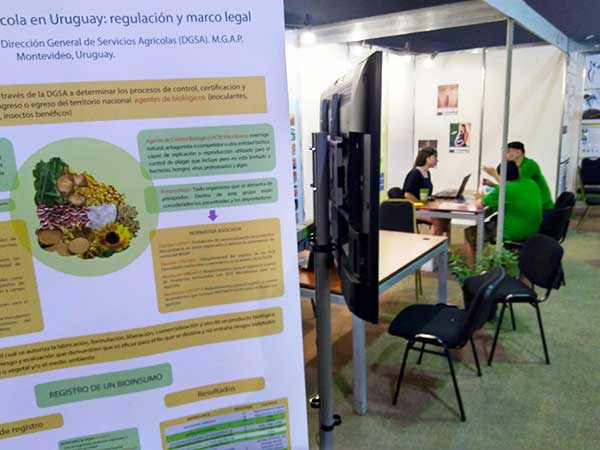
Many booths were selling seeds and growing apparatus, and the government was there with a booth where you could register with the authorities. Several booths centered on medicine and healing, as did a number of the presentations/panel discussions.

Uruguay marijuana sign up

I started asking questions about seeds when I saw “AUTO“ in some of their names (autofloreciente). Fascinating stuff.

handouts from Uruguay Expo Cannabis 2017

My only regret is that I didn’t ask more questions, because in the car on the way back, discussing what we had seen, we had plenty more.


The electrician’s ladder

Time to replace the ceiling fan in our bedroom, a job I was not going to do myself — too high. The electrician brought a four-part folding ladder that wasn’t tall enough, and neither would my extension ladder work. By itself.

improvised ladder, Uruguay

Since I had just started a massage in the next room when he arrived shortly after 2 PM (having said he’d be there at 10 AM), he poked around in my workshop, found rope and wire, and assembled this. My ladder is on the left; his is folded over it. Rope, many pieces of wire….

Hey, it worked!

But how did he transport a ladder on a motorbike?

carrying a ladder on a motorbike, Uruguay

Easy! Notice the tool box balanced in front of him as well.


German week!

It’s German Week in Tienda Inglesa!

Tienda Inglesa German week display

Germany must have changed since I lived there. I don’t remember hot dogs, much less American Hot Dog Sauce, which appears to be mustard, for which the Germans do have a word, senf. Pretty sure I never encountered BBQ Sauce either.

But that was a long time ago.


Business as usual

One of the pleasures of having live in Uruguay a while is not having to set up your life here. Having to buy furniture and appliances in Uruguay brings little joy. In fact, shopping in general brings little joy: selection is limited, quality dubious, and prices in general exorbitant.

But, with little pressure, and various changes and upgrades, should be better, no? We plan to furnish and perhaps rent our little country house, which gives us an opportunity to buy a better stove for our house in Atlántida, and means moving beds around, so maybe we can buy a better mattress (for the record, I find no fault in our existing one). Also, if we can find a reasonably priced washing machine, that would be nice to provide to a country renter as well.

So, today we were off to “close” Montevideo, half the distance to “far” Montevideo, first checking out stores in Costa Urbana Shopping, the newest mall, which straddles the Ruta Interbalnearia.

Cosat Urbana Shopping, Montevideo

We wandered into Multi Ahorro, where a salesgirl provided all kinds of useful information and advice. I made notes. Then we walked into Divino across the way, a large mostly-furniture store.

The first thing we noticed was that the mattress measurements didn’t correspond with what we are putatively trying to replace. It may be that the bed we bought, from an American, had originated in the United States, hence weird metrics, but perhaps measurements changed here at some point? After all, we bought it eight years ago; he and his wife had been here seven before that.

So, why not ask an employee? Well, perhaps because the first one walking toward us abruptly seated herself at a computer with her back to us. Wandering past her toward a group of three employees, I watched them kid around with each other, and then walk away. Well, one walked past us, studiously avoiding eye contact, though we were clearly potential customers and clearly needing some attention.

In the end, a total of seven floor employees managed to completely ignore us, happy with their little chats and kidding around.

Welcome to Uruguay!


On the way back from dog walking, I stopped by the shop of Daniel, our herrero (blacksmith), with a little challenge. We have this pot we use almost daily: Susan boiling eggs, me making oatmeal. But the handle, though connected, moves, and I have not been able to remove the screw that attaches it.

 I’m pretty strong, but the reluctant screw yielded quickly to Daniel’s efforts, which then included straightening the sheet-metal mounting point, reaming it (or something), re-mounting the handle, and — voilá! — good as new.
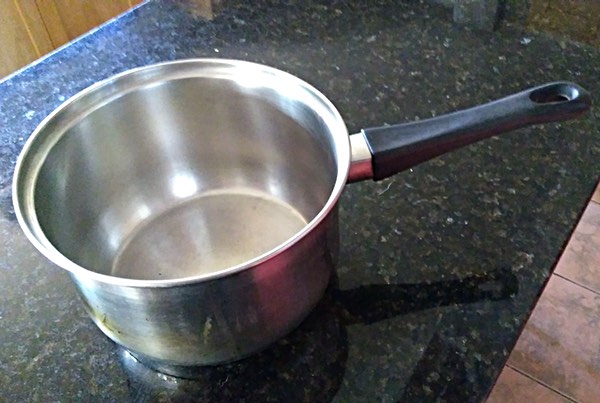
Pot, kitchen, Uruguay

Granted, Daniel just made our new fence and gate, but I expect, given our history, the upshot would have been the same nonetheless: no thought of charging me for this service.

Welcome to Uruguay!
Freaky numbers

A few days ago, walking dogs, Syd handed me this handwriting gem from his and Gundy’s excursion to the weekly feria (open air market) in Atlántida.

Strange Uruguayan handwriting

OK, not as impressive as his last contribution, but still begs the question — who teaches kids in school to make backwards 9s, or lollipop 9sAnd if not taught, how do they learn?


But the freaky numbers today had nothing to do with nines. Or fours.

They were the number 200.

I have an ongoing routine with the carnicería (most of whom I know by name, and all of whom know me by name), where I ask for 454 grams (one pound) of bacon. The owner, Javier, holds the record for coming closest, cutting off a chunk that weighed 447 grams or so.

Javier also has one of the most impenetrable accents I’ve heard in Uruguay: his speech sounds more like a weed eater cutting through thick grass than a human language.

Whatever: I didn’t stop there today, because though we “needed” bacon, I had not long ago visited a new carnicería that slices bacon, far more fun to cook than my hand-cut slices. Back to them in a sec.

On my way back from buying organic produce from out neighbor Pilar in the country, I stopped at the feria in Estación Atlántida for the first time, because I forgot to get Roquefort (ROAK-aye-fort) cheese Thursday, when Syd was collecting weird nines, also at the Atlántida feria. I found a guy selling cheese and sausages and hod-knows-what else out of a 60-year-old Bedford (English) truck. I asked for 200 grams of Roquefort.

He dropped on the scale two little plastic-wrapped chunks. 200 grams, exactly. I have never — ever — gotten a round number when buying cheese. I was impressed!

So on to the new carnicería, a large space where the slicer is in the back, and scale in the front, and where, last and first time I visited, I asked for 200 grams of bacon (panceta) and ended up with 400+. So this time I just said 200-300 grams, and the guy shuffled back to the slicer. And finally shuffled back, and deposited the sliced bacon onto the scale. 200 grams, exactly.

Exactly.

What is Universe saying?

Syd’s suggestion

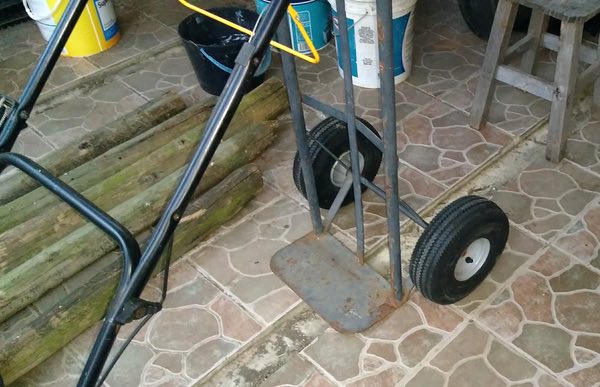
As I mentioned in my last post, my best efforts were for naught when it came to re-installing the tire after I installed an inner tube on the hand truck/dolly. The tire I inherited simply did not behave like the ones in YouTube videos. I’m pretty strong, but it just wasn’t happening.

Because Syd mentioned the gomería (tire shop; translates as “gum,” unh huh) on Ruta 11, I stopped by there this afternoon. They don’t know me — I went maybe there once six years ago — and the place was crazy busy. No sign of an office. How long would I have to wait before someone noticed me — and then how long before they could get around to it? I was in no hurry, and would happily have left the hand truck there for, well, whenever.

But a kid (anything under 35 is a kid at this point) noticed me. I quickly explained in Spanish that I’d installed an inner tube, but no way could get the tire back on.

Whatever he was doing, he stopped. Tried to do the job by himself with big-ass tire pry bars they have (an order of magnitude larger than the screwdrivers I have), called over another worker to help him, and it took them a couple of minutes, working together, to fight the tire back onto the rim. Nice! Wasn’t just my incompetence!

In the process (don’t ask me how) the other (non-tube) tire lost all its air. No matter. He filled both, passed the rig back to me.

How much do I owe you?, I asked.

He simply waved me off.


Please remind me of this the next time I complain about business in Uruguay.

Hand truck in my garage, Urguay

Gratis

No complaining today about doing business in Uruguay!

I asked our butcher to save some bones for the dogs. Usually I end up with 6-8 kilos. But today they only had 2.5 kilos .

bones, Uruguay

Not enough to bother charging me for, apparently.

Nice!


Uruguay retrograde: feedlot beef

As I thought everyone knew, grass-fed beef is superior to feedlot beef in every way. And the wonderful thing in Uruguay is that most cattle are grass-fed. There are some feedlot operations, but from what I gather, they tend to be smaller than their North American counterparts, and duration of cattle poisoning shorter .

Poisoning? Yes. On a feedlot, cows stop eating grass, which their bodies are designed for, and are fed massive quantities of (genetically modified, herbicide resistant) corn, barley, soybeans, and other grains that seriously mess up their digestive systems. They also get loads of antibiotics and growth hormones. They spend the last six months of their lives wandering around in their own excrement, with not a blade of grass in sight. But getting fat, fast, which boosts corporate profits.

Feedlot versus pasture in California
Your preference? Photo source: https://www.theatlantic.com/health/archive/2011/12/feedlots-vs-pastures-two-very-different-ways-to-fatten-beef-cattle/250543/tps

In North America,

“Many are choosing to follow organic practices in their herd management, which are clearly healthier and more humane for the animals. The good news is that meat from those animals is free of antibiotics, steroids, hormones, pesticides, herbicides and other potentially toxic substances. The bad news is that it can take nearly two years to bring those animals to market on grass.

“Studies have shown that an animal’s diet can have an impact on the nutritional content of the meat on the consumer’s table. Grass-fed meat has been shown to contain less fat, more beneficial fatty acids, and more vitamins and to be a good source of a variety of nutrients. According to a study published in the Journal of Animal Science in 2009, eating grass-fed beef provides many benefits to consumers:

  1. Lower in total fat
  2. Higher in beta-carotene
  3. Higher in vitamin E (alpha-tocopherol)
  4. Higher in the B-vitamins thiamin and riboflavin
  5. Higher in the minerals calcium, magnesium, and potassium
  6. Higher in total omega-3s
  7. A healthier ratio of omega-6 to omega-3 fatty acids (1.65 vs 4.84)
  8. Higher in CLA (cis-9 trans-11), a potential cancer fighter
  9. Higher in vaccenic acid (which can be transformed into CLA)
  10. Lower in the saturated fats linked with heart disease”

Source: Grass-Fed vs. Feedlot Beef – What’s the difference?

So what’s this got to do with Uruguay? Profoundly marching in the wrong direction, and proudly advertising the fact. Here’s the current flier from Tienda Inglesa:

Uruguay ads for feedlot beef

Unbelievable? I expect consumers here will swallow this whole, and embrace this “modern” idea as a good thing, just as dousing the entire countryside in glyphosate seems like a perfectly good thing to do.

They’ll figure it out eventually. Or not.

Retrograde Uruguay

Mercury goes retrograde today, through 5 September, so beware travel plans, contracts, don’t buy electronics or vehicles, and expect communications to be fouled up. If you’re new to this, please do pay attention: read more here.

What does that have to do with my day in Uruguay? Well, Mercury, nothing, but the other — retrograde. Uruguay does sometimes does appear to be traveling backward through the universe. Take this latest marketing “innovation” at Tienda Inglesa:

Uruguay checkout stamps - onward into the '80s

At checkout, you get little strips of stickers that you can put in little booklets — aha! If you grew up in the United States in the 1960s or 1970s, you probably remember S&H Green Stamps. You would lick them and stick them into little booklets to redeem for merchandise from their store or catalog. Still can, in fact, even though they ended in the 1980s.

Well, at Tienda Inglesa, this little trip down memory lane is  only good for a discount on one brand of cutlery.

But it gets “better:” the little strip of stickers has to be counted out by the cashier. But every fifth sticker is gray, so this can be quick. You know, 5, 10, 15, 20…? No, in fact on our most recent visit, the cashier counted them out by twos. I kid you not.

Of course, this un-streamlines checkout considerably. In addition to the grueling process of counting, occasionally a customer in front of you will require an explanation of how the whole new-fangled thing works.


So, while we’re waiting for our stickers to be counted out by twos: you know what a checkout divider is — the little rectangular or triangular thing that makes checkout more efficient by separating customers’ items? You did know that? Congratulations! Perhaps not 1 in 100 Uruguayans does. In addition to having  always only one, and even when printed with Proximo Cliente (next customer), the cashier uses it simply to block the “electric eye” that starts and stops the checkout conveyor belt, and might get quite huffy if you try to use it as a checkout divider.

So it was with some pleasure that on that most recent visit, before watching the by-two sticker counting, we were able to get our hands on the checkout divider, and use it as a checkout divider. What a concept!.

So what did the Uruguayan behind us do? He waited until every single item of ours was off the conveyor and the checkout divider had stopped the conveyor, before he would put a single item on the now-empty belt.


I suppose you could make this stuff up. But you’d have to be in a retrograde state of mind, no?