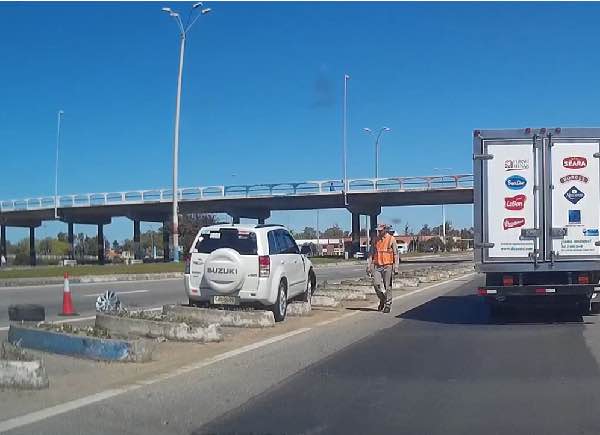
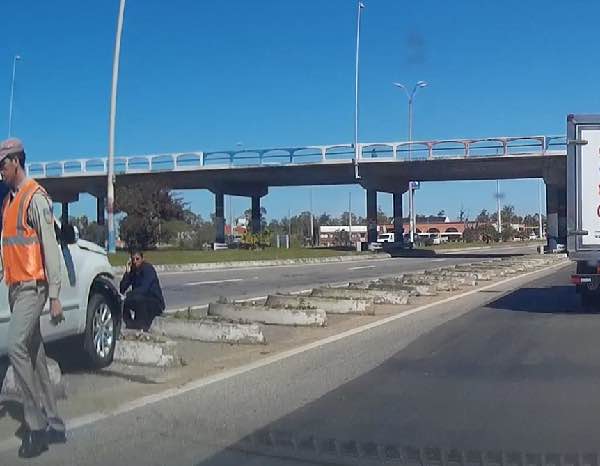
And remain oddly invisible, even in broad daylight.
Well, the town has decided to work on drainage, and lo and behold, with foliage gone we have plainly visible frogs! And of course Benji doesn’t quite know what to make of it.
We normally don’t spend a lot of time in art galleries.
Yesterday was an exception.
The current show features five contemporary ceramic artists,
each with a unique “voice,” as the introduction states.
The gallery has a skylight, which casts dramatic shadows.
The setting, an old building with exposed brick and very old beams, is quite lovely. Not a bad place to spend an hour when you have no choice.
And we had no choice. We were waiting for legal papers. Specifically, a power of attorney to sell some property in Mexico.
What’s that got to do with an art gallery?
All the pictures above are from the ground floor of the Mexican Embassy in Montevideo. When we arrived, the receptionist remember who we were, and why we were there. The consul was gracious and welcoming.
The Mexican Embassy in Montevideo: warm and welcoming.
Now, I have nothing bad to say about the US Embassy personnel in Montevideo. They were in fact surprisingly accommodating when I recently renewed my passport.
US Embassy in Montevideo. Not warm and welcoming.
But one can’t help but notice the contrast, even without surrendering all personal possessions and passing through several bomb-proof doors for the privilege of entering.
Construction symbolically started on July 4, 1966. US Independence day. At that time, the diplomatic pouch from Washington, DC, sometimes included fine wires that could be inserted between teeth, in order to apply an electrical charge to the gums. No, it wasn’t for oral hygiene.
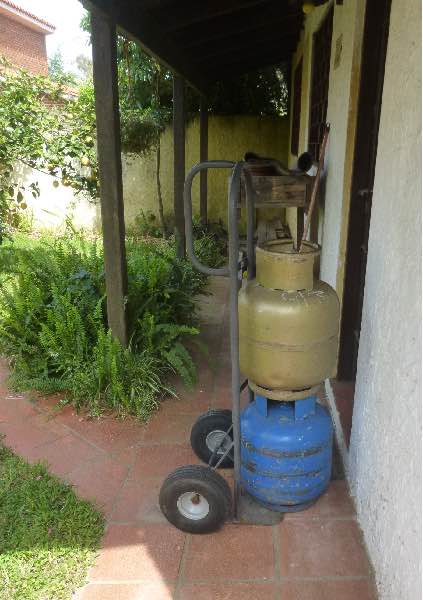
Electricity tends to be expensive in Uruguay, and most people where we live use gas, called “supergas,” for cooking. It’s not a good choice for heating, since it adds humidity, which, combined with temperature, is a fine recipe for unhealthy mold growth. For that reason, we chose to ignore the gas plumbing in the incomplete house we bought, and instead deal with the regular replenishment of garafas (carafes? um, thanks Google Translate).
Which replenishment has been an issue of late, because whoever delivers or refills or produces these things has apparently been on strike. I really don’t care which. Despite being pretty conversant in the language, one plus of living here (as when I lived in West Germany in the 1980s) is that a lot of (verbal/propaganda) nuance escapes me. I’m not big on “news.”
Anyway, turns out we have a lot of them, these steel pressurized containers.
The reason why is a little interesting. We bought a house with a casita (little house) for our 22-year-old son to occupy. We bought a gas heater, not trusting him (wisely) to restrain himself with electric heat which, given our “intelligent option” from UTE, the government electric company, basically triples the electric rate at peak times — 5PM-11PM, when residential heat is really nice in the winter — but makes it relatively cheap to operate an electric clothes dryer, which we really like, the other 19 hours of the day. So we needed another garafa. Then, some rather strange Americans — oy vey, whole other story — were selling shit, including several garafas for USD 50. At a time when a “new” (bear with me) garafa cost more like USD 75-80. No brainer. Why this idiot woman wouldn’t simply sell them back to the supplier baffled me. But hey.
OK (you’ve now borne), turns out you can “buy” these garafas, but you can’t sell them back. In other words, you can’t waltz into your local gas dealer, say, thanks, it’s been great, but I’m leaving and want my money back.
You’ve purchased the right to exchange gas tanks ad infinitum. You don’t actually own a specific tank, as we did in Mexico when my son got into glasswork. You own this right to exchange that which you cannot sell.
And now you barely have the ability to exchange. Hence, I feel great accomplishment that I went to Parque del Plata Norte and Marindia (opposite directions) this morning and came home with this: two exchanged 13 kg gas bottles..
When we began to walk with Syd’s dogs, Syd pointed to an area that would flood, come winter. That seemed unlikely at the time, but sure enough —.
For the last few months (it’s spring now) the dogs have joyfully frolicked in the water there, Benji settling in like the water dog. Yesterday he not only did that, he also rolled in it. Unfortunate, because the “pond” is drying up, and becoming mud. And, given cows that sometimes graze in the area, rather smelly mud at that. Cleaning a dog that smells of cow dung is not my favorite thing, so …
… today I took him to the beach instead. Our usual walk is about three kilometers (a bit under two miles). Depending on the hour, sunlight level, and wind, we walk one direction or the other, but one thing is certain: during the half kilometer on the beach, I will be throwing a stick for Benji, into the waves, the entire time.
But only if he drops the stick directly in front of me, or very close. Which he does. Sometimes he actually throws it in my path.
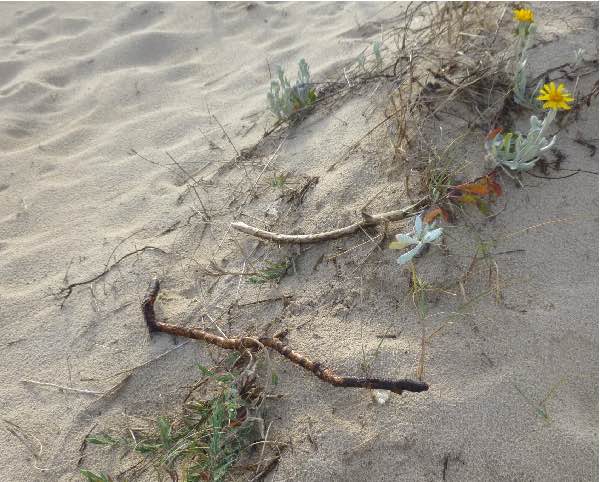
And good sticks are not always available. Much of the crap that washes up ends up breaking. So, when I get a good stick, I like to leave it in the dunes at the end of the walk. I took a picture a few days ago at the east end; thinking it remarkable that one in the foreground had been with us for at least four walks (good stick!).
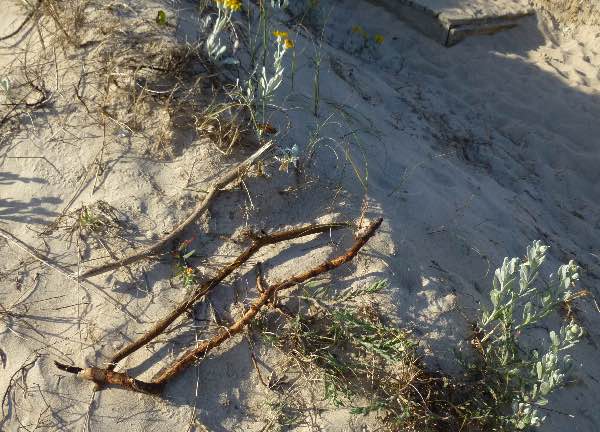
Today we started again at the west end (afternoon; bright sun behind), and I was amused to find a collection of three sticks, obviously mine, at the west end, the buried boardwalk.
Here one has joined the collection at the east end.
For some reason, brings to mind T. S. Eliot, “I have measured out my life with coffee spoons.”
It’s a perspective thing — the bucket is over half full.
I haven’t determined exactly how I’m going to incorporate fish waste into my close-to-totally-disorganized garden, but it will have to be dog-digging-proof. I have decided to make a substantial fence. But deciding is short of doing, and we happen to have a puppy who likes to dig — and meanwhile no fence.
Beyond remembered tales of American Indians dumping a fish head or carcass below each corn plant, my fish-in-the-garden story is this: shortly after arriving in Mexico in 2007, I attended an organic gardening class by a massively overweight American woman who happened to be very good at growing things. Actually, exceptionally good. She was also an outstanding cook and baker, and, unh huh, liked to eat. She had a plastic-lined pit in which she made compost tea from fish, and shared her secret source. There was, she said, at the end of a short two-block street that ended at the railroad tracks in Pátzcuaro, a place where they processed fish from the lake. You had to knock on an unmarked door, have containers, explain your request, and then, Hod willing and goods delivered, back out the two blocks, because there was no way to turn your car around.
Sorry, that’s above my pay grade.
She also explained how they cultivated contacts in the daily mercado for composting. They had to they dress down, relate to the locals, develop trusted relationships in order to get the valued vegetable waste. Wow. Heavy social investment.
Reference: there is no way a home gardener can get enough compost from home vegetable waste. You need organic materials from somewhere else.
Anyway, visiting a project of ours on Calle Independencia near the cemetery in Pátzcuaro, I discovered something amazing: garbage trucks appear there every afternoon. Guys with hand trucks and 55-gallon barrels go into the market and bring out the waste. I showed up day after day, with a plastic tub like the one I bought here, and soon they wanted to know before they went into the market: was there was anything in particular I favored? Onion greens? Carrot tops? It was deliciously ironic.
But it got better.
One day, a little truck pulled up. Fish waste. From the fish place. You know, the one where you had do a little ritual of obscure door-knocking and reverse-driving. I said to the garbage kid (remember, I’m an old fart, so everyone is a kid), fish is OK in the garden, eh? and he enthusiastically agreed and personally took my plastic tub to the truck and proudly filled it with fish heads and bones and guts, and placed it in the back of my several-years-old Toyota 4Runner.
Fortunately, I had a plastic-rubber floor liner. Because, in his enthusiasm, the kid had maximally-filled my plastic tub. And despite my caution, over the first tope — speed bump — I heard the flop of a fish carcass. On the next another. No matter. I could always hose that stuff off.
The problem arose — as today — when I realized that I had arrived home shortly before dinner time and actually had to do something with this treasure. In Mexico, it involved feverishly turning over my extensive compost pile, inserting fish waste, re-covering and weighting down plastic sheeting so our animals couldn’t get into it. It worked. And apparently fertilized magnificently, but by then we were the hell out of Mexico. Another story that I probably won’t tell here.
Meanwhile, here, a couple concrete blocks over the bucket this evening. Tomorrow? Stay tuned 😉
Thanks for reading this. Gardening is weird at times, no?
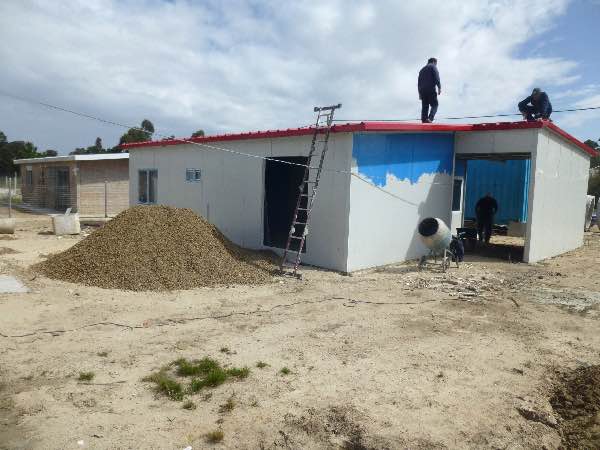
Friends are buying a lot and want to build a rental house. Recently they visited a construction expo in Montevideo and became fascinated with prefabricated houses imported from Australia. Today we went with them to view a couple of them.
The prefab house in the foreground is built to the same plans as the single-brick house in the background. The one in the foreground is less than a month into construction, and will be complete in less than two months from start. The one in back took two years.
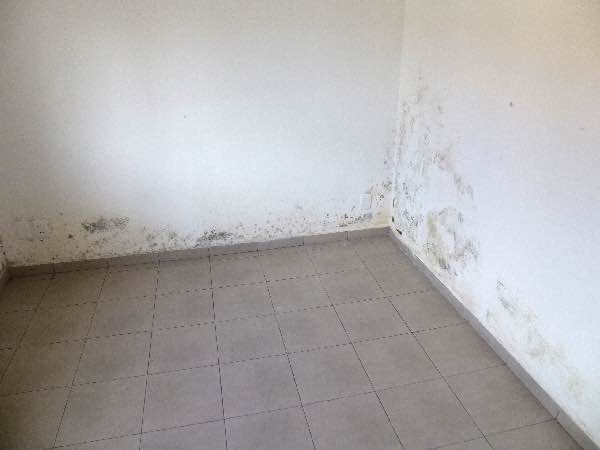
Additionally, the prefab is extremely well insulated. The vertical wall elements are filled with flammable styrofoam, but isolated from one another. In other words, each is its own cell, so even if one caught fire inside, it would not easily spread. Meanwhile, in the “wet” (traditional) construction house, which has never been occupied, the excessive moisture and lack of ventilation has created (typical) mold problems. Again, before people have even been living — and breathing — in that space.
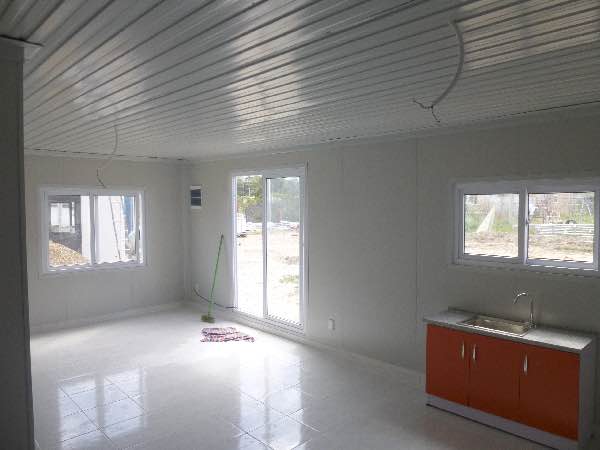
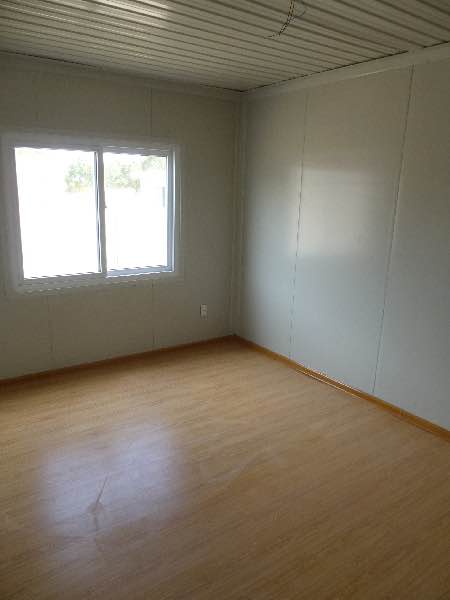
I don’t have comparative costs, but two months versus two years, excellent insulation versus no insulation and moisture problems — should be a no-brainer, eh? Well, there’s something lacking in the warm-and-fuzzy department in the interiors of the prefabs.
The “wood” floor doesn’t really remediate the shiny walls and industrial ceiling.
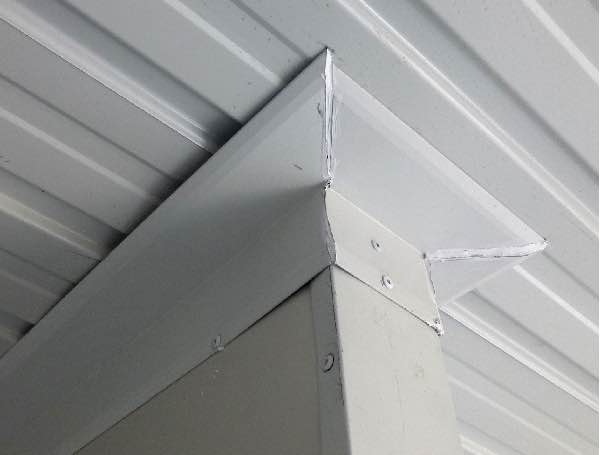
And then the details ….
In the end, though, you must consider that this is “cheap for rental” construction. This could be done with an impressive crown molding, but in this case the owner doesn’t give a shit (no offense, Joe). In fact, there’s supposed to be a video on their site, but I didn’t find it on a quick perusal (tonight’s pizza night; I’m on duty). One could easily do a lambriz (thin tongue and groove) ceiling which would be much more simpatico.
You can make the walls much more attractive with textured paint. All a question of cost. Still, pretty exciting stuff, Isopanel.
We really appreciate the opportunity, every other week, to buy fresh-as-you-can-get-it organic produce at bargain prices. Here Ricardo has just harvested a variety of acelga (Swiss chard) for us. Acelga is arguably the vegetable in Uruguay — if you order ravioli or canelones con verduras in a restaurant the verduras will be acelga. You can get it year-round. It took us a year or two to realize this was our desirable spinach substitute, since spinach is only occasionally available. And needs much more washing.
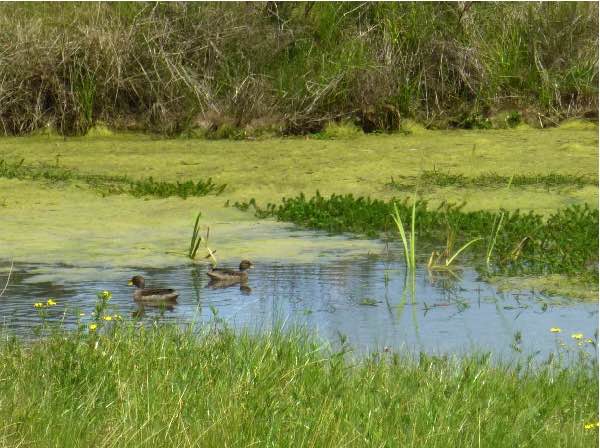
So then off to our chacra nearby where the in-places knee-high grass needed cutting. A couple of wild ducks flew into our tajamar, but decided the noise of the lawn mower was offensive, and left. I had seen one on my previous trip. Other posts about the pond we created. It’s an interesting experiment in “letting nature do its thing.”
Then there was the twice-monthly (because “bimonthly” can mean either twice a month or every two month; thanks English language) Atlántida-area English-speakers’ get together. 23 people showed up. Many lively (and funny!) discussions. Nationalities included Uruguay, US, Canada, England, Holland, and Germany. On other occasions we’ve had South Africans, Argentines, and no doubt others I can’t think of right now.
Beautiful weather the last few days, but I’m on dog-walking hiatus because he managed to slice open his foot on one of the multiple garbage dumps where we walk with Syd’s five dogs.
So this photo is from a few days ago.
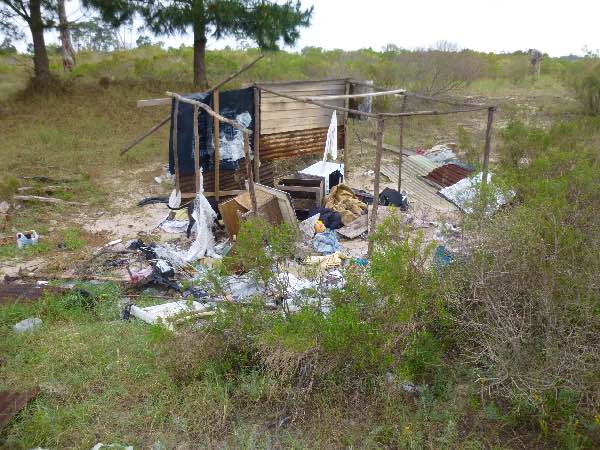
According to Syd, someone spent a winter in this structure. It was intact when first I saw it.
Other trash sites include old furniture, TVs, and just about anything else you can imagine, including many things that could have been put in trash receptacles nearby.
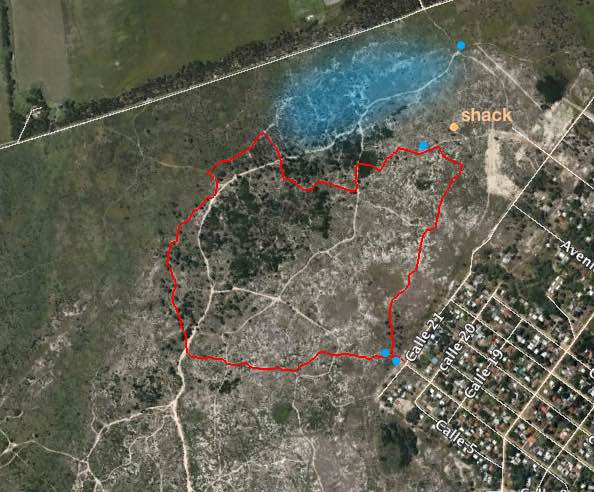
Blue dots represent trash locations; Syd probably knows more. Light blue area is generally littered. And yes, there is a pile of broken TVs and other appliances just meters from the streets that have trash receptacles, and no, not all the trash predates the receptacles.
An Uruguayan friend in nearby Parque del Plata told me that he and his wife spent a considerable amount of time cleaning up the corner lot opposite them, where neighbors left their trash, when the trash containers arrived. (OBTW there wastrash pickup before the containers.) Shortly after, he watched a man in his 50s walk past the trash container to dump his trash in the open lot. When confronted, the guy said, this is the way I’ve done it all my life. He was eventually trained out of that habit. It took about a year.
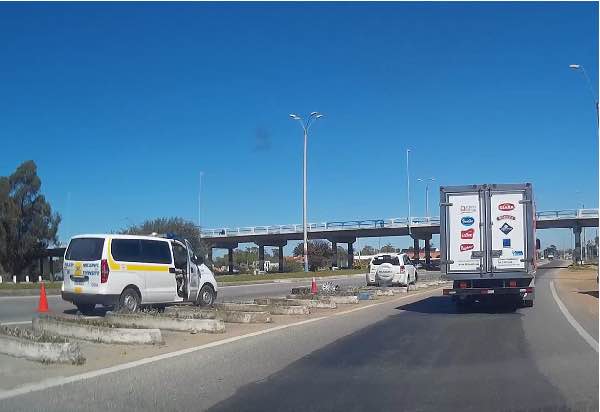
For anyone who has dealt with driving in Uruguay, there is nothing here particularly unusual: a pedestrian wandering into a highway, curious interpretations of the meanings of those lines in the road, red lights that don’t apply to city buses.