Went into Baipa for the first time since September 12, 2011. I remember the date well because we had guests from Punta del Este with whom we had a meal, visited the incredible vivero (nursery) Pacha Mama, and then introduced them to the this-could-be-Europe bakery Baipa. I told them it would be a year before I’d permit myself there again. 22 months: I’m feeling righteous 😉
So, invited to their place, we were instructed to bring goodies from Baipa. While waiting for my number to be called (welcome to Uruguay, please take a number), I told my wife to decide what she wanted, which turned out to be a bit of a challenge, given the sheer bulk of some of the other customers. Seriously, so big around that one could block the view of an entire display case.
Regulars, no doubt: or addicts. No doubt I”ll see them or some similar the next time I go to Baipa—which will not be before July 14, 2014.
I hear a yell from my wife upstairs, and look to see Rodrigo, who left for New Zealand over 18 months ago, strolling up the driveway! Seems he likes surprises; he told no one but his brother (since he needed a ride from the airport) that he was arriving. Serious noise at his parents’ house: what are you yelling about, his mother demanded of his sister, who saw him first.
New Zealand gives out 200 work permits per year for Uruguayan kids; he left last year ahead of the others. Great joy to see him back.
Elsewhere in the news, we had chivitos today. Big deal? At Marcos, yes. Big. When we moved to Uruguay, I promised myself I would not have a chivito more than once a month. This is my first (I think) this year. What’s a chivito? Watch (note: since posting, blocked in Uruguay; requires VPN…or just have fun searching chivito on your own!)
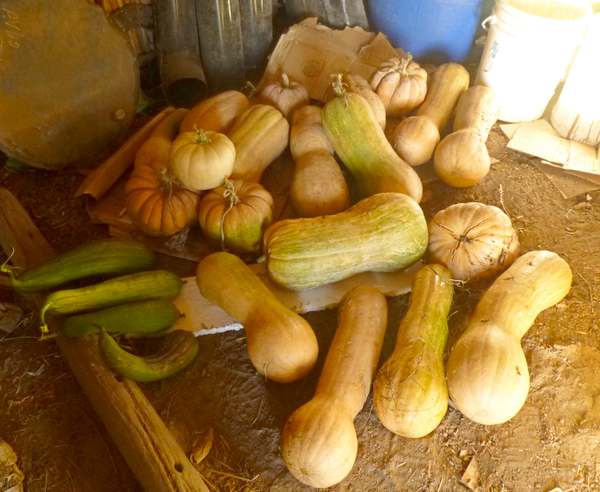
The younger brother of our albeñil (mason/contractor) said the yellow squash and pumpkins should be brought in before the last rain, so I did last week. Except for the six in the foreground I found today. Yes, you would think they’d be hard to miss.
These all came from volunteer plants. I know of about a dozen more smaller, green squash still on the vine.
The green ones lower left are loofahs, which I did plant, from a loofah I bought at Tienda Inglesa that had plenty of seeds inside. When they dry out completely, the skin will crack off easily. I hope. I tried to speed the process using heat on the first I picked. Wrong.
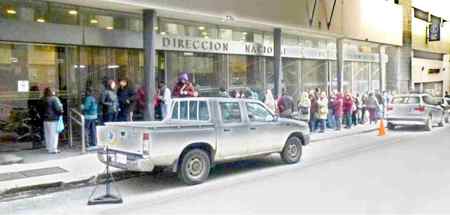
Thinking they opened the door at 8:00, and got there early. At 9:00, after over an hour and a half of standing in the cold, windy street, we were rewarded with number eight.
TA DA!!!
Presenting an official translation of a document which it was not good for the notary to have seen, and not good enough for the notary to have described, I was assured that everything now is in order for a final decision on my son’s (home with broken ankle) 42-month-old, 75+ page residence application.
Umm, except they also said that last August, only to discover in October that “just one more document” was needed. Which had been requested by the uppy-ups in a letter from the previous January, and managed to remain completely invisible in the file during our reviews in May, June, July, and August.
Three months from now, we will be able to check on the status using the computer at their office (not online; why would you want to check conveniently?). If/when approved, we can then go early in the morning to wait in line to get a number to wait my turn to get approval to make an appointment to wait in line at the office that issues cédulas (ID cards).
Please arrive 3 hours early to get in line to get a number to wait your turn to find out that “just one more thing” is needed for you residence application.
It seems that everywhere you go in Uruguay, you take a number. And wait: the bank. The hardware store. The vegetable stand in the féria (street market). Welcome to Uruguay: please take a number. Though it takes some getting used to, in general the system works well.
When we started our residency process, there was a number dispenser on the wall of the residence section. When you went in, you took a number.
One day it was empty, and you had to wait in line at the reception desk, to be given a number based on which of the two number dispensers you would have previously used (the office has a residence section and a gratuitous-paperwork section). Often as not, you could explain by simply pointing to the appropriate empty number dispenser.
Then one day they only gave out numbers at 12:45 for the residence section that opened at 1:00. With no room for a line (the reception desk meanwhile giving out numbers for the gratuitous-paperwork section), a crowd gathered, more or less keeping track of who was before whom before piling into the reception desk line at 12:45 .
Now they give out only 100 numbers a day, starting at 9:00, and open the residence section at 11:00. Why not give out numbers at 10:45 for a section that opens at 11:00? Well, because the inevitable long line for residence-section numbers blocks the main entrance, hence access to the gratuitous-paperwork section, which opens earlier than the residence section.
And to think: I never saw a line at the (now empty) number dispenser on the wall of the residence section. I have pointed out before that many things seem to be improving here (and will post one again tomorrow). Unfortunately, the bureaucracy at Migración is not one of them.
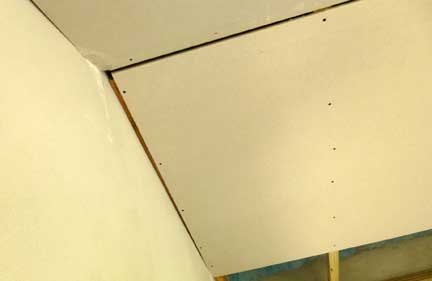
Ahh, I know what you’re thinking. In fact, this apparently sloppiness involves a remodel job in our very crooked little farmhouse. The piece to the right is the ceiling; the top piece slants up to it. It will all look just fine tomorrow. Oh no, that’s Labor Day: Thursday. Or Friday.
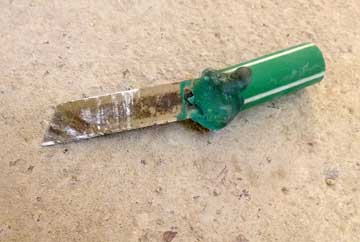
As I watched Martín cutting sheetrock (yeso, pronounced jeso), I marveled at this knife. Turns out he bought a cheap one (made guess where?) that fell apart after three days. So he melted a piece of thermofusion water pipe around the blade to make a handle.
When we lived in Mexico, I thought the Mexicans were the ultimate do-anything-with-nothing people. Compared to the Uruguayans, though, they’re like USA-Americans hopping into their Dodge 350 to go to Home Depot to buy yet another specialized electric tool….
Uruguayans apparently find nothing annoying, unnecessary, or unusual about waiting 15 or 20 minutes for an ATM (even where it replaces what used to be two ATMs).
You could always go into the bank to withdraw money, but that’s a minimum of 30,000 pesos (USD 1,600; 28% more than when we first arrived). Inside the bank, you would take a number, and often wait 45 minutes or more before getting to the counter.
That, of course, only if you happen to be there at the right time.