Pizza on the barbecue grill

We attended and 18th birthday party last night. We were told there would be pizza, but I couldn’t have guessed how — cooked not in an oven, but on the parrilla / traditional grill. I explained parrilla — well, sort of — long ago. The fire is one one side, and the coals are raked under the grill, which typically can be raised or lowered. Doing an asado with meat this way takes hours, but with pizza it’s hella more efficient than trying to to do them in the kitchen oven.

bbq-pizza
The coals weren’t that color at all. Bad camera! I should have taken a picture with my iPad :0

Pizza after pizza was delivered to family and friends at the big outside table: Hawaiian, mushroom and cheese, gorgonzola, mussels. All delicious. The combination of the nearby fire, hot pizza, and wine did a nice job of making the chill go away.

Our host, Marcelo, told me that he had tried doing pizza on the grill and it turned out a mess. So here’s the secret: put the plain crust over the embers until one side is done, then remove, turn over and add toppings, and cook over embers again.

As they prepared to leave, the cooks gave out the quintessential Uruguayan marketing tool: refrigerator magnets. Yes, this is what they do for a living!

bbq-pizza-magnet

PS — can you guess the only business that doesn’t give out magnets? See here.

The 30-mile salad

My wife recently asked, where’s your camera? which means come take a picture of this. (In case the concept of camera confuses you, yes, I do have a phone, but a a clamshell unit that can only sync the results of its .3 MB camera through Windows OS, which we do not use.)

food-color

And though I probably would have opted for white or yellow onions in a baked dish, I must say the red onions make it more photo-worthy. The light yellow is winter squash from our garden. Onions, carrots, green peppers, and tomatoes, were I to source them, most likely came from within 30 miles of here.

If you are familiar with the 3,000-mile-salad of northern North America, and the fragile nature of the truck-based food transportation system in the USA (Syd can fill us in, perhaps, about Canada), the thought that fresh produce grows nearby feels kind of warm and fuzzy. No, it’s not all organic, but organic is available: we paid 90 pesos/kilo* last Saturday for organic green peppers at the local féria organica at Pilar’s chacra. We then stopped at Tienda Inglesa, where they sold for 158 pesos/kilo* — and not organic.

Not perfect, but not bad. And we get lettuce and cucumbers as well year-round, also local.

*USD 1.36/lb vs USD 2.39/lb


Today’s walk: three observations

Actually yesterday.

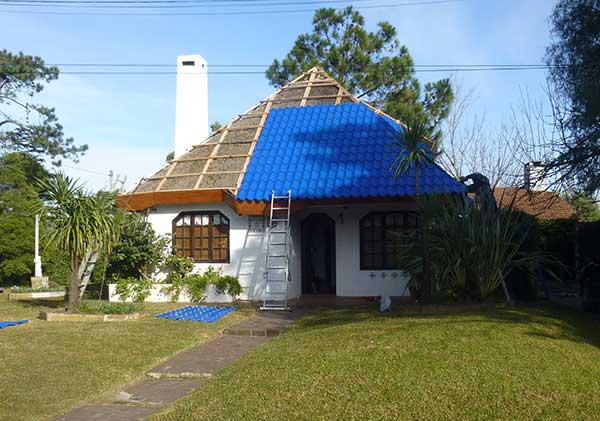
  1. An interesting roof enhancement. Probably to be finished with stamped metal sheets. The spacing of the whatever-you-call-them horizontal slats appears to large for plastic imitation-clay tiles.
Wood framing for a second roof over quincho, Atlántida, Uruguay

2. Well, this is moving at a decent clip.

construction

Compare with the photo I posted on March 7:

constr-1

Granted, a “dry” construction house could have been completed in this span of time, but this seems fast compared to another construction on the same street, which I’ve documented.

3. Duneshrooms, next to the dead snakes.

duneshrooms

Syd has collected some edible mushrooms recently during dog walks in Villa Argentina, at the base of eucalyptus stumps. Which seems a reasonable place to expect mushrooms to grow. But here are some growing out of — what? I have never seen mushrooms in the dunes before. And OBTW a meter away (top) are the dead snakes.

Two dead snakes, where snakes shouldn’t be, then two clusters of mushrooms where mushrooms shouldn’t be. OK, maybe not massively weird, like elongated skulls and impossible stone construction (I’m foreshadowing: we’ll be exploring in Peru and Bolivia in July). But, a little weird nonetheless.

Slow construction in Uruguay

Slow construction finally finished in Atlántida, Uruguay

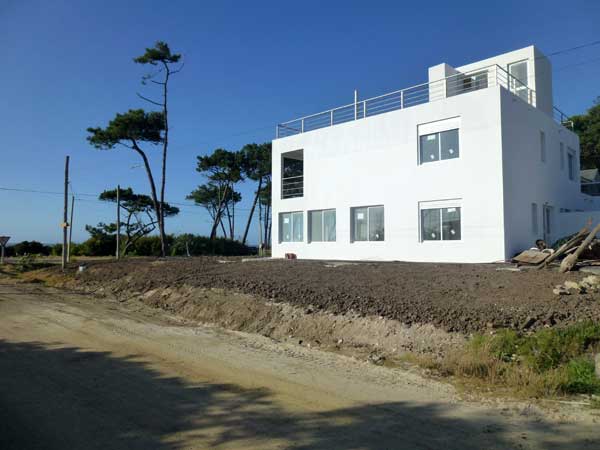
This attractive duplex on the Rambla (beachfront road) appears to be nearing completion after what seems to me an inordinately long time. I remember specifically because the owners, Argentines, rented the  El Nido Beach Hotel last summer, whether to house workers or run as a business I don’t know.

Anyway, as I have documented nearby in the past, by the time the place is ready for occupation the high season will have passed. Rents here are massively higher than the rest if the year, from 15 December through 15 March. So if you wanted to rent in the high season, you’d want to have it ready in December. Should be able to build a house in a year, no?

But then again I have no idea why they built it.

Quincho

quincho

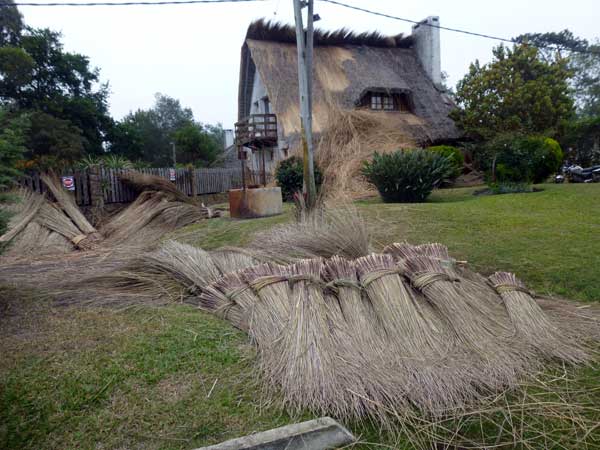
For six years, I’ve walked past this house whose past-prime quincho roof has reminded me of a mangy dog. It’s finally getting groomed, to stretch a simile. It appears the back half is nearing completion, and the facing side is being torn off.

What’s the deal with quincho? Glad you asked. Denise (“day-NEE-say”)  has answered your question exhaustively (and perhaps exhaustingly; we have different styles) here.