It’s not often I get up early, but I was awake this morning and thought, if I leave by 6:15, I can watch the sunrise on the beach. I looked at my clock (which involves picking it up and pushing the button to light it) and saw that it was exactly 6:15. Two minutes later we were out the door.
I had spent the morning up to my eyeballs in accounting. When we sat down to Sunday brunch, we were both noticing that the day wasn’t very bright. Clouds? The respite from the hot sun was welcome.
It wasn’t until I finished my omelet that I remembered: the Ring of Fire eclipse!
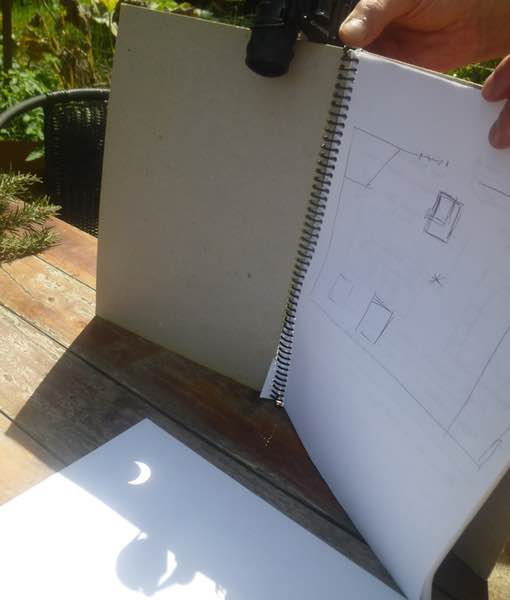
Alas, we missed the best part, but here’s what we did see, projected through a binocular lens.
Ironically, yesterday I made a little device for a friend to do first- and last-light shadow observations for a small group of pilots who are somehow convinced the earth is flat (pilots!). For those of us who are NASA-brainwashed, we at least have Occam’s Razor: the simplest explanation is that a spherical object is passing between this spherical planet and the sun. I’ve asked him to get the explanation of the flat earthers. If past experience serves, it will no doubt involve physics that can’t be duplicated or observed in any other aspect of the physical universe.
During my brief interaction with flat-earthers, I made a graphic for them.
A couple years ago, after one of their distinctly non-native mango bushes died, Syd and Gundy gave us the other. The first couple winters, I built a custom greenhouse around it. But it has never produced fruit. Sure, lots of flowers, and lots of tiny starts, then they simply disappear.
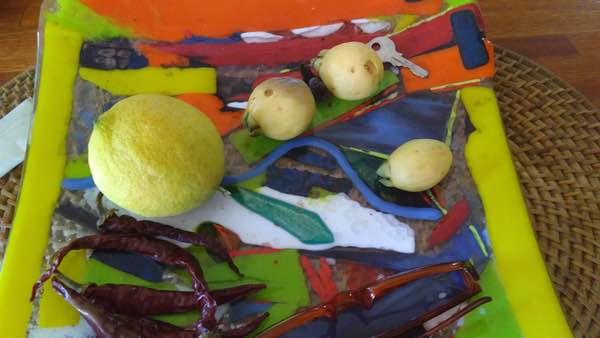
But this year, it has produced a few tiny, very dry, somewhat tasty fruits. As you can see, something got to a couple of them first. The lemon is normal-sized.
Our son did the glass piece in 2008
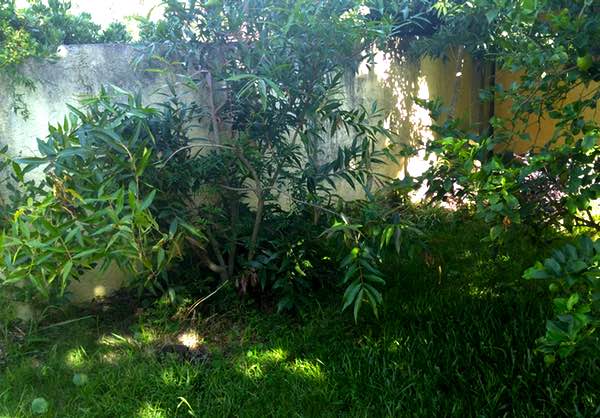
The mango bush/tree is completely uncontrollable, as was the anacahuita (small leaf shade tree) next to it that had become so ungainly that I cut it down a few years ago. After two years, a new shoot appeared out of the stump. I carefully pruned it, until one day it became clear it was not connected to the stump, and had virtually no root system. So I pulled it up and got rid of it.
I’m not convinced that the mango bush-tree is the best use of this space.
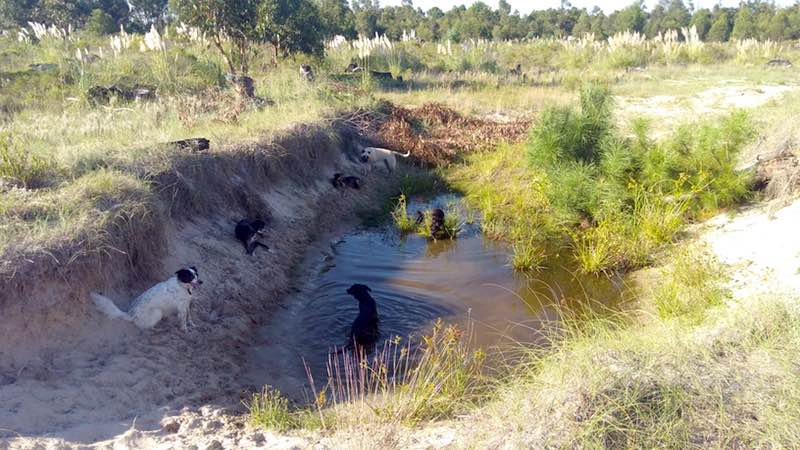
Several months ago, Ralf and I (if I remember correctly), wandering far from the usual paths, encountered a little pond, apparently where someone at some point dug sand for construction. We’ve been fortunate to have decent rain this summer, so on this very hot and muggy day the dogs loved the stop. From left to right: Leah, Kiya, Sofia, Jordan (front), Benji, and what looks like a black lump in some grass, Lorena.
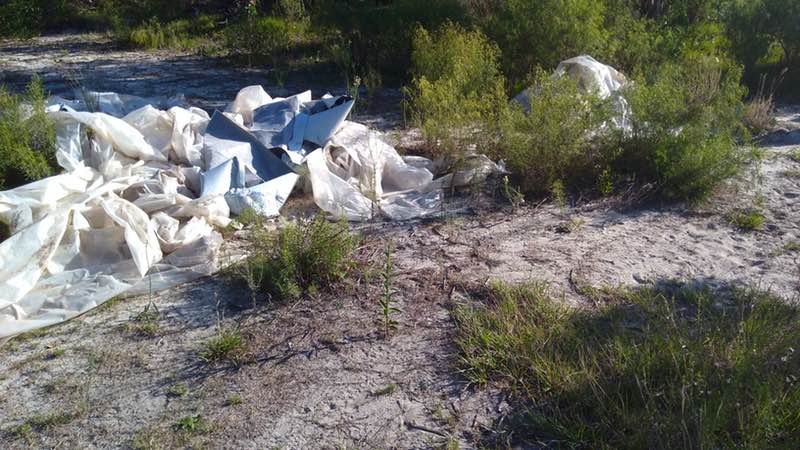
Further along, from one day to the next — in the middle of nowhere — appeared a pickup truck load of construction trash. Yes, even with abundant trash collection containers everywhere, some troglodytes decided the best way to deal with their trash would be to drive into a large empty area and start a trash pile there.
Which reminds me of a story. In nearby Parque del Plata, when the trash containers first appeared a few years ago, my friend Carlos and his wife embarked on the project of cleaning up the trash-dump empty lot diagonally across from them. They filled the “dumpster” over and over, until finally the lot was clean. Then Carlos spots a middle-aged man carrying a bag of garbage to the container. No, right past the container, to the middle of the lot, where he drops it on the ground. Carlos screams at him to use the trash container.
“But this is the way I’ve always done it,” he says.
Welcome to Uruguay.
Carlos, who is Uruguayan, tells me they did eventually “toilet train” that troglodyte.
First, I wore a dark shirt. Most days I wear T shirts, and since yesterday was hot and muggy, I chose one with the thinnest material — which happened to be dark blue. Of course, I had no reason to anticipate what was coming. Have you ever seen a beekeeper’s outfit? No doubt you remember what color it was. Hint: opposite of dark.
Second, I did not immediately identify the insect that was buzzing me. This happened a couple months ago, and then I also did not identify the molester, but that passed with no harm.
Third, I did what most people would do without thinking: I swatted at it with my cap, then with a branch from a bush. I knocked one to the ground and stepped on it. It looked like a honeybee, and there are hives nearby. We’ve walked right by them at times.
When the first sting came, I kept walking. I had the urge to run, but I was with two other people. Gotta keep cool, right (as if swatting at bees with a branch from a bush is cool)?
This morning, over twelve hours later, I awoke with my right eye swollen almost half shut. I might have gotten as many as three stings in the right temple area, definitely my left ear and perhaps another on the neck nearby, and up to three on my left shoulder and back.
So this morning I did some research. When bees start hassling you, they’re telling you to go away, which is a good idea. When you wave your arms around, they take the motion as a threat because they use vision primarily to detect motion. And then —
Once embedded in the skin stingers also release tagging pheromones, potent chemical signals that attract and arouse other bees. When released near a colony, these pheromones can provoke a massive defensive swarm from the females guarding the nest. “The chemical signal says, ‘Here, sisters, here is where I found a chink in the armor of this big attacking predator,’” Schmidt says. “It really arouses them.”1
So more bees will be drawn to sting in the same area as the first stings. And the dark color (bees see red as black btw) reminds bees of dark-furred animals they have evolved to recognize as a threat.
What I should have done:
worn a white shirt
not automatically swatted
gotten the hell out of there
and, after being stung, gotten the hell out of the as fast as I could
I enjoyed a dollop of local honey (this area is big into bees) in my oatmeal this morning, after getting up early and walking Benji on the beach at 7. I think that will be my dog-walking routine for a while. Once stung, twice shy.
As far as I can see, there’s no telling why a dog chooses to dig a hole. Kiya (pronounced KEEsha) decided on one particular spot in the trail, and has been working on it sporadically for months. Benji, who has only two speeds — ON and OFF — spotted Kiya taking a break yesterday and charged into the hole at full speed, half of him disappearing under the exposed root you can see.
Alas, I didn’t catch his entrance.
While certainly enthusiastic, he lacks Kiya’s finesse. She first excavates, then backs up a bit to clear the hole. Benji’s approach is more bull-in-a-china-shop. Kiya doesn’t seem to mind. Or even notice, for that matter. When it’s time, she’ll start another hole somewhere else, equally for no apparent reason.