Dealing with it

The connection between Bangladeshi refugees and Uruguay

When we left for Argentina, I unplugged my wife’s computer backup power supply. The switch jammed, so it had to remain plugged into the wall or go beep every five seconds until the battery ran out. Out of respect for lightning, that’s what it did.

Weeks later, I got around to disassembling it, and discovered that the button got its ‘spring’ from two little plastic hooks, one of which had become displaced. I fixed it.

This morning, faced with the same problem, I took it apart once again and simply tore out the plastic switch. New rules for the UPS: take a pen or finger and push white microswitch directly.

I spare you a closeup of the bar code label indicating country of origin, because after all everything is made in China.

But as our friend Patrick in Colonia explains, the Chinese make top-quality goods for consumers in first world countries. They make second-rate, but more affordable, goods for developing countries.  Then they make crap of such low quality that Bangladeshi refugees would refuse it. And that’s what they ship to Uruguay.

If that’s a complaint, it’s not limited to expats. Uruguayans say the same, in different words: lo barato sale caro – the cheap stuff ends up being the most expensive.

Forty five, schmorty five

I called the guy who installed our Ñuke wood stove (two years ago) to clean the stove pipe. He finally showed up.

First he cleaned the stove. Then, unable to cleanly remove the bricks of the upper combustion chamber, he broke them in order to gain access to the stove pipe from the bottom. His cleaning tool: 1/2″ flexible black pipe with some wires stuck in the end.

He couldn’t get it past the second elbow. So they’ll have to clean it from the top. And replace the bricks. Some day.

I asked them why they didn’t use 45° elbows originally, which would have worked a lot better.

They were supposed to be, he replied.

As someone (was it me?) once quipped: How do you say ‘quality control’ on Latin America? – You don’t.

Chimney sweeps

They didn’t come last Saturday. Weather or something.

Today showed up mid-afternoon. Cleaned inside Argentinian Ñuke wood stove, scraping off chucks of oxidized metal – a.k.a, rust – broke bricks to secondary combustion chamber because something wasn’t removable to allow access to stove pipe. Their weapon, a half-inch black flexible pipe with wires stuck through the end (read: brush) unable to clear second bend in stovepipe, advertised as 45 degree elbows but instead 30 degrees.

Investigated rooftop; decided they’d come back tomorrow to replace broken bricks in stove (how?) and next week to clean chimney from (precarious) above.

Ya veremos – (now) we will see.

Sorry if a bit incoherent. Es lo que hay –  that’s how it is.

Hospital elevators

We went today to visit Mauro of the motorcycle accident in the hospital, who sports a large and ugly scar from having his spleen removed – Frankenstein-style stitches from his navel up (to remove the spleen – ?). He’ll be there another few weeks.

We had to take a couple elevators to find him. The elevators are the type with a single, automatic door and buttons you push to go to the desired floor. You know, like in a hotel – ? Seen them before?

An additional feature in each elevator is a chair with a person in it to push the buttons, taking up perhaps 20% of the floor space. As a result, a wheel chair would not fit in the elevator.

But, a full time job for a few more people. Welcome to Uruguay!


Later: told Santiago* about the elevator operators, adding es Uruguay.

Soy Uruguayo, he replied – ¿Me lo vas a decir a mi?

Or roughly, Hey, I’m Uruguayan – YOU’RE going to tell ME about it?

*masseur: 1-hour+ ~$30

Paying bills

How to pay bills in Uruguay:

Electric, water, telephone:

  1. Set up automatic debit through your Banco Republica account in pesos.
  2. Forget to fund the account one month, at which point automatic-debit contracts cease.
  3. Go to individual offices, take a number, wait – nah.
  4. Take bills to supermarket, pay at cashier when you check out.

Property and vehicle taxes:

  1. Go online, enter property ID numbers, transfer money from bank account.
  2. Or, spend an hour or more in a dreary government building
    • where the main entertainment consists of guessing how many thousands of people have rubbed against the concrete columns painted flat white a dozen years ago, in order to make them so filthy looking.
  • That, or staring blankly with the ‘waiting is our second national sport’ look of resignation.

In some regions, like swanky Punta del Este (nya nana na na na!) they have only the latter choice since their departamento lacks an online payment system.

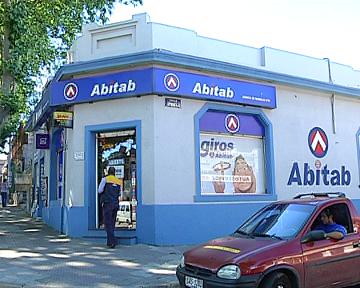
And then there’s Abitab.

You can pay bills at the ubiquitous Abitab, buy concert tickets, wire money, and probably a half dozen other things, but since paying all our bills there for six months yielded not a single ‘Abi’ on my points card, I had decided Abitab was the last resort, refuge of computer illiterates and credit-less souls.

Once our son was set up in Gato Dumas in Montevideo in March, the school gave us a sheet with payment options – bank transfers through three banks, or Abitab. Since any in-person dealings at the bank have the same tenor as the government building above, and being wary of an online transfer (because what a nightmare undoing a mistake!), I went to Abitab, expecting a blank stare, and lackluster and/or indifferent service, and a struggle.

What a surprise: school name, student name and ID number, tap tap tap and up comes the total, late fee included (oops: duly noted): fast, friendly, professional.

Who’d a thunk?

Abitab, Uruguay

Rejas redux

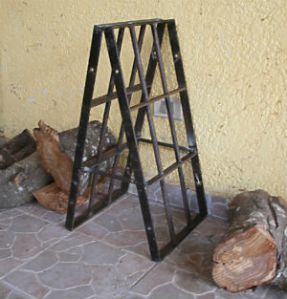
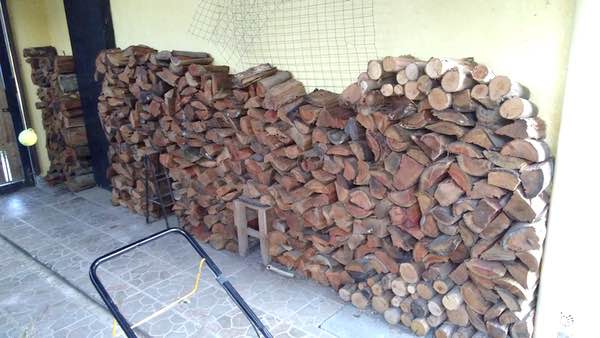
Anticipating our first delivery of firewood (a ton of red eucalyptus), I took a couple of the rejas to our local metal guy Daniel. A few spot welds later, I can stack firewood (leña) without fear of blocking the only electrical outlet (tres en linea) in the carport – vast improvement over the rickety wooden frame I used previously.

Whenever the firewood gets around to arriving, that is.

In Spanish, esperar means to wait, and to expect, and also to hope. To a northern North American, that seems hopelessly imprecise. To someone in Uruguay who ordered firewood two days ago for delivery today, its level of precision seems about right.

LATER THAT SAME DAY 😉

Eucalyptus colorado, Uruguay

This is a coincidence. Surely.

It took me a while to figure out that something was wrong.

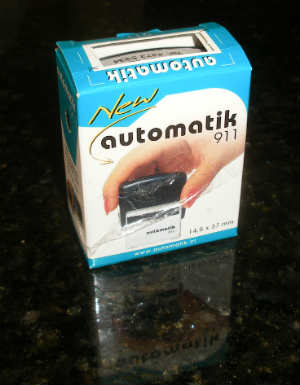
Tienda Inglesa has another promo/giveaway going on. These tend to be semi-annual events, which involve filling out endless dozens of ‘raffle tickets’ with the same information. After a couple years of this, I splurged on a rubber stamp.

stamp

Name? Address? Document number? Telephone? Ka-chunk.

Back from the store, along with groceries, my wife unloads a tacky little Disney sticker book, El Mundo Magical, and little envelopes which have to be torn open (what a waste of paper!) to find stickers that need to be peeled (waste of paper!) and stuck in the right place. Glitzy little tacky shit.

Meanwhile, I am locked and loaded for a barrage of raffle tickets, but my rubber stamp sits silent. Don’t tell me….

I expect the next ‘event’ will be around Christmas. Hopefully, we’ll be back to normal, and my ‘automatic 911’ will be just the ticket.

Amazing service, but for one detail

I took a laptop body (no monitor; long story) to the local computer repair place. The worn-out power receptacle, they had told me, would ridiculously cost maybe a hundred bucks to procure. So this time I said I didn’t care what it looked like, that I wanted una solución Uruguaya. In other words, just make it work, as cheaply as possible. Any connector; I don’t care: it’s just a question of connecting two wires, on either side, no?

He indicated it might take a week, this being Semana Santa.

Less than 24 hours later, he calls to tell me it’s ready. Can it be?

I pick up a decidely funky, but perfectly aceptable, altered machine, and pay 500 pesos – 25 bucks. Can’t complain, if the thing works again and gives me a Linux play machine. ¿Sirve? I ask. It works?

Sí. (You expected a different answer?)

Back home, there’s a storm, but all high-rolling thunder, no ground strikes. I start to set it up, and it boots going beep- beep- beep- beep- beep like it’s got a stuck key. I plug in the monitor, and just then the electricity goes out.

But the neighbors’ lights are still on. I check the breaker box. Main breaker tripped; can’t turn the power back on. Unplug the monitor, try again – works fine. By now I’ve also unplugged the laptop and video cable. Plug in the laptop to power – no problem. Start to reconnect monitor and OUCH! nasty shock from the video cable. Ain’t right.

So somehow the process of replacing a plug and socket has resulted is sending 220 volts through the video output?

Five minutes before his closing time, I deliver it back to the shop. This doesn’t sound like it should end well.

Addressing complexification in Uruguay

A bank far away wants confirmation that we live in Uruguay: an original utility bill with our names on it. Easy?

1

Utility companies in Uruguay will not allow two names on an account, even for a married couple.

No problem – put one bill in wife’s name.

2

Standard addresses outside of cities do not exist. Our house has no number, only a name – which we could change at will. Our street does not have a name – it has two, one of them a number. Some mail arrives addressed to our town; some to our section of the town. We receive mail with at least two different postal codes.

3

No two utility companies address their mail the same way. In fact, the water and electric bills have such different addresses that you would be nuts to assume they would arrive at the same place.

4

When I took three bills to the Post Office to ask how mail should be addressed, the postmistress looked at each in turn and said, yes, that’s correct, even though at least two bore no similarity. Had I pointed out that early in our stay, one of the bills arrived with handwritten notes from the PO telling the carrier where to deliver it, she no doubt would have replied, yes, but he knows where you are now.

5

Official property designations include numbers for padrón, manzana (yes, as in apple), and solar. Some of these numbers appear, in varying forms, on the bills. Some have no reference.

By now, you want to suggest, why don’t you ask one utility to modify their address? Well, chances are you haven’t tried to do that, and I wasn’t eager for an exercise in futility. But I did, in February, go to OSE, the water company and issuers of the most cryptic address, and to my amazement and delight the 20-something behind the desk said no problema and changed it, advising me that the new address would appear on our March bill.

6

It didn’t.

7

Returning to the same 20-something in April, he tells me it is not possible to change the billing address in the system. Had I pointed out that he himself claimed to have changed it six weeks before – sorry; not the best use of my time.

I photocopied the architect’s plans, in which he specifies every bit of data that could be used to identify the property, stuck it in an envelope with notations and the two bills, and mailed it off to far away.

Ya veremos. We will see.
PELIGRO GAS INFLAMABLE

gas tank delivery truck, Uruguay

The obstructed store to the right is the Supermercado de Carnes – yes, the Supermarket of Meats.

Uruguayans are the world’s largest consumer of beef per capita. ‘Meat consumption in Uruguay is on the rise reaching 94.7kg per person per year in 2011,’ says the Meat Trade News Daily. Just five years ago, the per capita annual consumption was reported as 54 kilos, and five years before that 40.

At some point, enough is enough – and too much is too much.