Tools, or toys?

Our friend Patrick informs us that the Chinese make first-rate goods, which they sell in Europe, Japan, and the USA. Then they make second-tier stuff for developing countries where people can’t afford the best. Finally, they produce such wretched crap that Bangladeshi refugees would refuse it. And that’s what they sell in Uruguay.

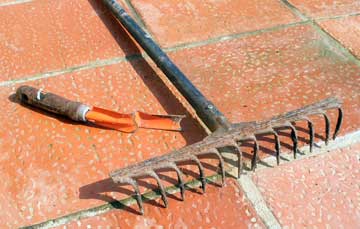
Lo barato sale caro. What’s cheap stuff ends up being expensive – because you have to buy it over and over again. Here’s a weed trowel that lasted maybe 15 minutes before bending in half, and a stamped metal ‘iron’ rake. Note that it’s barely more than a foot wide. I didn’t think to include my turning fork, where one tine, one day, simply bent at a 45° angle to the other three. In dirt.

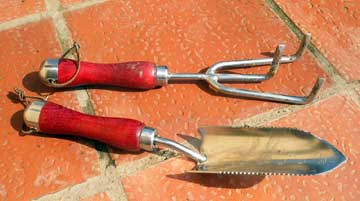
So imagine my amazement when I found these gems at Tienda Inglesa!

Solid, stainless steel (though stainless steel can be all over the map on terms of quality), a bit under ten bucks each. Paid with shopping points on our Tienda Inglesa tarjeta de puntos.

I haven’t really put them to the test yet, but I am (drum roll, please)…

…cautiously optimistic.

Amazing what a little paint can do

It’s been over two years since I bought a $140 Chinese-made bike (now $159; here’s what it looked like before losing front and tail lights, derailleur and gears). It was falling apart before we got it home; went from 18 speeds to one (we live on the beach; no problem). Its primary redeeming feature has been no incentive to lock it up. With rusty 28″ wheels, it was uncomfortably big for most people here, and hardly looked worth stealing. In fact I wouldn’t have really cared if someone did take it.

The other day a valve stem broke. In pursuit of a new inner tube, I asked the bike guy about getting aluminum replacement wheels for the ugly rusty ones. The problem – this is a bike thing, not a Uruguay thing – is that 28″ aluminum wheels are not the same size as 28″ steel wheels, so I would need to replace tires and another tube as well, which just seemed wasteful.

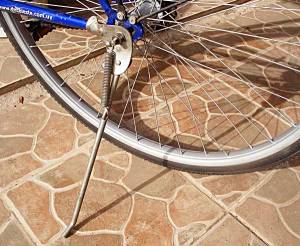
But here is a Uruguay thing – take the rims, minus axles but with spokes – and send them to Montevideo to be sandblasted, painted, and oven-baked. At the same time, swap the kickstand for a safer rear-wheel model. And of course replace the inner tube.

For $40, I have a bike that looks worth stealing again.

(Now where’s my cable lock?)

Bulk, recycled, cheap – what’s not to like?

In an obscure and unmarked store I would never have stumbled upon, you can buy several things not generally sold, such as pure bleach, not the expensive and watered-down Agua Janes, so ubiquitous that the recycling station has a separate bin for its distinctive orange bottles. The real stuff costs a fraction of the diluted.

They also sell detergent that is not watered down, again unlike the crap sold in the supermarket.

It comes in recycled 1.5 liter soft drink bottles (notice the variety of caps). In the beginning, I only had one bottle with the white  at the bottom, and with the latest batch it apears to be normal. I know next to nothing of the chemistry of detergent to guess what it signifies, but regardless we use ‘Deter’ for dishes, clothes, and other duties as assigned.

When you buy it by the funda (wrapped quantity), it’s cheaper. In this case, a little over a dollar  (23 pesos) for 1.5 liters. A single 2-liter bottle of bleach cost 39 pesos, or just under US $2.

Battle of the stones

If it’s Monday, May 21, then it must be last Thursday, May 18, the holiday in honor of Artigas’ victory in the town of Las Piedras (‘the stones’) outside Montevideo in 1811, in which he vanquished the forces of the Spanish Viceroy – which outnumbered his troops until 200 defected and fought for him instead. He apparently exclaimed ‘Curad a los heridos, clemencia para los vencidos’ (Cure the injured, mercy to the vanquished), so that his followers wouldn’t hack the remaining Spaniards to pieces, as the vanquished most assuredly would have had they prevailed.

So today I don’t have to wonder if the chimney sweep who came two weeks ago, broke the inside of our wood stove, and never came back, will return. I don’t have to wonder if the refrigerator guy will have fixed the shelf he promised to deliver about the same time.

Mercy to those whose freedom he fought for, for no doubt one of these days – or weeks – they’ll deliver on their promises.

Dealing with it

The connection between Bangladeshi refugees and Uruguay

When we left for Argentina, I unplugged my wife’s computer backup power supply. The switch jammed, so it had to remain plugged into the wall or go beep every five seconds until the battery ran out. Out of respect for lightning, that’s what it did.

Weeks later, I got around to disassembling it, and discovered that the button got its ‘spring’ from two little plastic hooks, one of which had become displaced. I fixed it.

This morning, faced with the same problem, I took it apart once again and simply tore out the plastic switch. New rules for the UPS: take a pen or finger and push white microswitch directly.

I spare you a closeup of the bar code label indicating country of origin, because after all everything is made in China.

But as our friend Patrick in Colonia explains, the Chinese make top-quality goods for consumers in first world countries. They make second-rate, but more affordable, goods for developing countries.  Then they make crap of such low quality that Bangladeshi refugees would refuse it. And that’s what they ship to Uruguay.

If that’s a complaint, it’s not limited to expats. Uruguayans say the same, in different words: lo barato sale caro – the cheap stuff ends up being the most expensive.
Forty five, schmorty five

I called the guy who installed our Ñuke wood stove (two years ago) to clean the stove pipe. He finally showed up.

First he cleaned the stove. Then, unable to cleanly remove the bricks of the upper combustion chamber, he broke them in order to gain access to the stove pipe from the bottom. His cleaning tool: 1/2″ flexible black pipe with some wires stuck in the end.

He couldn’t get it past the second elbow. So they’ll have to clean it from the top. And replace the bricks. Some day.

I asked them why they didn’t use 45° elbows originally, which would have worked a lot better.

They were supposed to be, he replied.

As someone (was it me?) once quipped: How do you say ‘quality control’ on Latin America? – You don’t.

Chimney sweeps

They didn’t come last Saturday. Weather or something.

Today showed up mid-afternoon. Cleaned inside Argentinian Ñuke wood stove, scraping off chucks of oxidized metal – a.k.a, rust – broke bricks to secondary combustion chamber because something wasn’t removable to allow access to stove pipe. Their weapon, a half-inch black flexible pipe with wires stuck through the end (read: brush) unable to clear second bend in stovepipe, advertised as 45 degree elbows but instead 30 degrees.

Investigated rooftop; decided they’d come back tomorrow to replace broken bricks in stove (how?) and next week to clean chimney from (precarious) above.

Ya veremos – (now) we will see.

Sorry if a bit incoherent. Es lo que hay –  that’s how it is.

Hospital elevators

We went today to visit Mauro of the motorcycle accident in the hospital, who sports a large and ugly scar from having his spleen removed – Frankenstein-style stitches from his navel up (to remove the spleen – ?). He’ll be there another few weeks.

We had to take a couple elevators to find him. The elevators are the type with a single, automatic door and buttons you push to go to the desired floor. You know, like in a hotel – ? Seen them before?

An additional feature in each elevator is a chair with a person in it to push the buttons, taking up perhaps 20% of the floor space. As a result, a wheel chair would not fit in the elevator.

But, a full time job for a few more people. Welcome to Uruguay!


Later: told Santiago* about the elevator operators, adding es Uruguay.

Soy Uruguayo, he replied – ¿Me lo vas a decir a mi?

Or roughly, Hey, I’m Uruguayan – YOU’RE going to tell ME about it?

*masseur: 1-hour+ ~$30

Paying bills

How to pay bills in Uruguay:

Electric, water, telephone:

  1. Set up automatic debit through your Banco Republica account in pesos.
  2. Forget to fund the account one month, at which point automatic-debit contracts cease.
  3. Go to individual offices, take a number, wait – nah.
  4. Take bills to supermarket, pay at cashier when you check out.

Property and vehicle taxes:

  1. Go online, enter property ID numbers, transfer money from bank account.
  2. Or, spend an hour or more in a dreary government building
    • where the main entertainment consists of guessing how many thousands of people have rubbed against the concrete columns painted flat white a dozen years ago, in order to make them so filthy looking.
  • That, or staring blankly with the ‘waiting is our second national sport’ look of resignation.

In some regions, like swanky Punta del Este (nya nana na na na!) they have only the latter choice since their departamento lacks an online payment system.

And then there’s Abitab.

You can pay bills at the ubiquitous Abitab, buy concert tickets, wire money, and probably a half dozen other things, but since paying all our bills there for six months yielded not a single ‘Abi’ on my points card, I had decided Abitab was the last resort, refuge of computer illiterates and credit-less souls.

Once our son was set up in Gato Dumas in Montevideo in March, the school gave us a sheet with payment options – bank transfers through three banks, or Abitab. Since any in-person dealings at the bank have the same tenor as the government building above, and being wary of an online transfer (because what a nightmare undoing a mistake!), I went to Abitab, expecting a blank stare, and lackluster and/or indifferent service, and a struggle.

What a surprise: school name, student name and ID number, tap tap tap and up comes the total, late fee included (oops: duly noted): fast, friendly, professional.

Who’d a thunk?

Abitab, Uruguay

Rejas redux

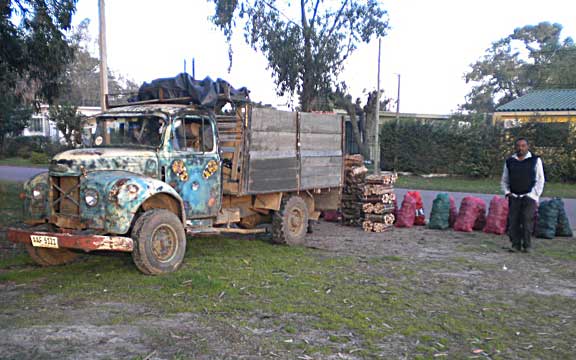
Anticipating our first delivery of firewood (a ton of red eucalyptus), I took a couple of the rejas to our local metal guy Daniel. A few spot welds later, I can stack firewood (leña) without fear of blocking the only electrical outlet (tres en linea) in the carport – vast improvement over the rickety wooden frame I used previously.

Whenever the firewood gets around to arriving, that is.

In Spanish, esperar means to wait, and to expect, and also to hope. To a northern North American, that seems hopelessly imprecise. To someone in Uruguay who ordered firewood two days ago for delivery today, its level of precision seems about right.

LATER THAT SAME DAY 😉

Eucalyptus colorado, Uruguay