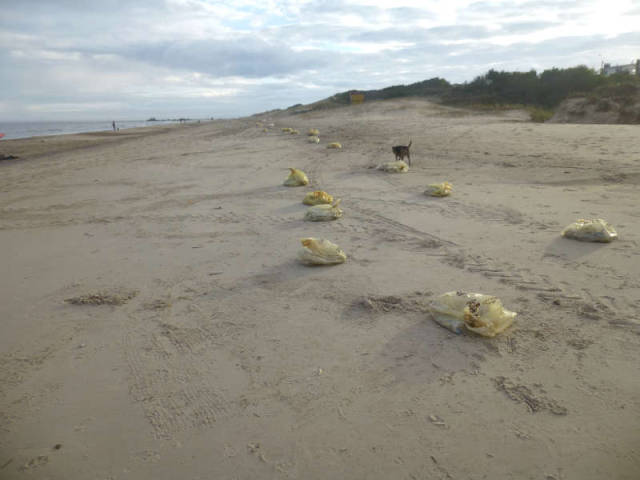
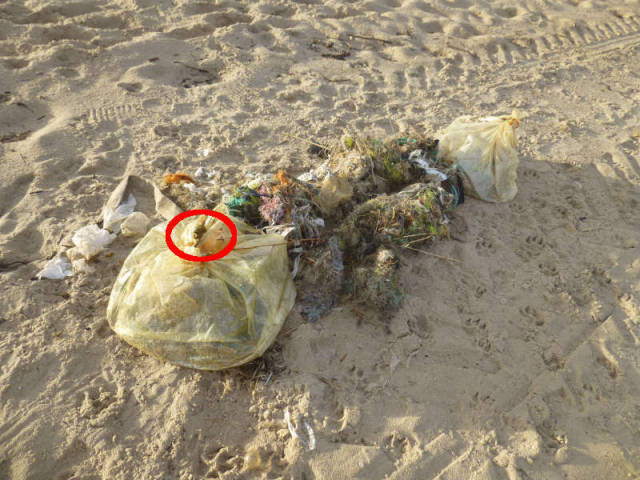
By far the biggest DTOTB (Dead Thing On The Beach) we’ve ever seen. Interesting that a week or so ago I paused for some while watching a flock of birds diving for fish 100 meters offshore. From time to time I saw what looked like a fin. From this sea lion? It was about the same location.
I haven’t been back to the beach since (that’s now our alternative, not main, dog walk) to know current status. As it was, I made a point of walking upwind of it. I’m not that curious.
First order of business today was to follow handwritten notes, taking me back 21 generations to where I left off. The story starts here.
It’s actually not so bad: lots of links through similar (or identical) names, mostly up the left (paternal) side. Yesterday I had to go back 41 generations.
Following more endless trails into the past, I was struck by a name: Gurguit Barbtruc (Welsh:Gwrgant Farfdrwch) was a legendary king of the Britons as accounted by Geoffrey of Monmouth. He was the son of Belinus and was said to have found a home for the Irish people.
Gurguit was a peaceful king who followed in the manner of his father and grandfather. Yet, when the king of the Danes refused to pay tribute to Belinus’s son, Gurguit took a fleet and invaded Denmark, killing the king and reducing the country to subservience.
On the return voyage, Gurguit came across a fleet of thirty ships of men and women, called Basclenses, under the leadership of Partholoim. They had been exiled from Spain and sought a new land to live in. Gurguit did not allow them to settle in Britain but he gave them the isle of Ireland to settle, which was (according to this fanciful legend) uninhabited until then, and thus the Basclenses became the Irish.
Gurguit died peacefully and was buried in the Caerleon, a city he built up from the time his father founded it. Guithelin succeeded him to the kingship.
And who are these people?
Prasutagus was king of a British Celtic tribe called the Iceni, who inhabited roughly what is now Norfolk, in the 1st century AD. He is best known as the husband of Boudica.
Boudica was a queen of the BritishIceni tribe who led an uprising against the conquering forces of the Roman Empire in AD 60 or 61. According to Roman sources, shortly after the uprising failed, she poisoned herself or died of her wounds, although there is no actual evidence of her fate. She is considered a British folk hero. (Wikipedia)
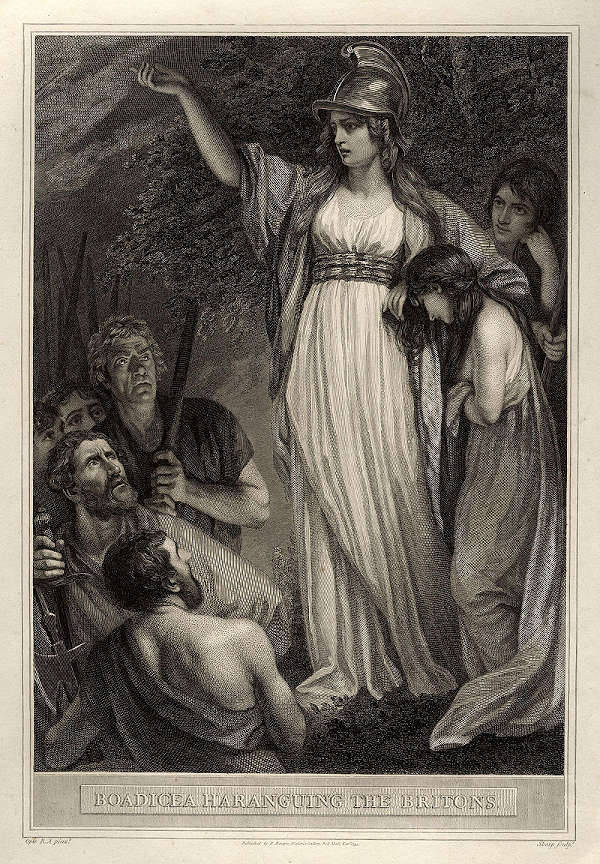
Here she is haranguing the Britons.
These people keep coming up, so I looked into them.
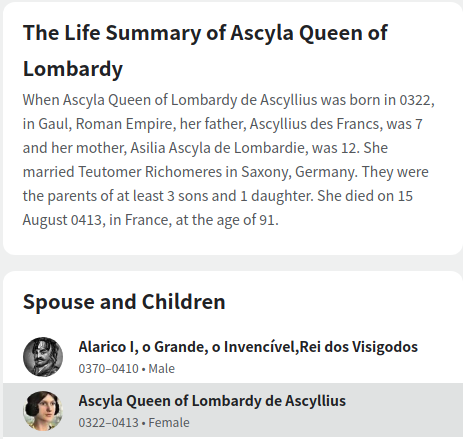
Alaric I was the first king of the Visigoths, from 395 to 410.
Alaric began his career under the Gothic soldier Gainas and later joined the Roman army. Once an ally of Rome under the Emperor Theodosius, Alaric helped defeat the Franks and other allies of a would-be Roman usurper. Despite losing many thousands of his men, he received little recognition from Rome and left the Roman army disappointed. After the death of Theodosius and the disintegration of the Roman armies in 395, he is described as king of the Visigoths. As the leader of the only effective field force remaining in the Balkans, he sought Roman legitimacy, never quite achieving a position acceptable to himself or to the Roman authorities.
He operated mainly against the successive Western Roman regimes, and marched into Italy, where he died. He is responsible for the sack of Rome in 410, one of several notable events in the Western Roman Empire’s eventual decline.
So far, so good. Now see if you spot anything a little, um, strange about her writeup on the same site (familysearch.org):
Nothing to see here. Move along!
Pharamond, also spelled Faramund, is a legendary early king of the Franks, first referred to in the anonymous 8th-century Liber Historiae Francorum, which depicts him as the first king of the Franks (Wikipedia)
When Queen Argotta Justin de Valentina was born about 0376, in Gaul, Roman Empire, her father, Grenobald des Cimbres, was 26 and her mother, Mrs. Genebald, was 18. She had at least 11 sons and 9 daughters with Pharamond King of France. She died in 0438, in her hometown, at the age of 62, and was buried in Gaul, Roman Empire. (familysearch.org)
One cannot help but wonder: did she think her husband was legendary?
What about his second great-grandfather, Malaric 1? Did he think Pharamond was legendary?
When Malaric I King of the Franks at Toxandrie was born in January 0295, in Gaul, Roman Empire, his father, Ragaise de Toxandrie King of the Franks, was 25 and his mother, Eva Blesinde Margolis de Alemanie, was 23. He had at least 3 sons and 1 daughter with Ascyla La Gauloise Hija des Francs. He died in January 0360, in his hometown, at the age of 65, and was buried in Gaul, Roman Empire. (familysearch)
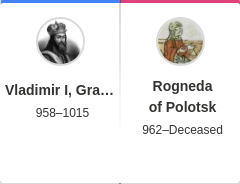
And at last, Russians! Hailing from Veliky Novgorod.
And Grim Shaggy Cheek, the stuff of sagas.
Carrying along, we add Poland and Bohemia (Czech) royalty, including Boleslaus I, The Cruel who, despite killing his older brother in order to become Duke is considered an OK guy, Wikipedia tells us.
Elsewhere it’s fun to watch the names change in four generations (1481-1585): Whitier-Whittier-Whitear-Whytear.
Samuel Wardwell is an interesting find. He was hanged during the Salem Witch Trials after retracting a confession. But were the witch trials faked as part of an agenda? You decide. (Warning: Miles W. Mathis is almost certainly an intelligence operation, so might want to read his initials as Masterful With Misdirection.)
Sarah Hooper has an interesting connection to the Mayflower, which I wrote about about here (amusing now to think I considered that ancient history!).
And the really good news? I’m through with this. For now.
One last note: interesting that my mother’s line ends with her parents, and my father’s mother’s line ends on her mother’s side. But after all this, that’s OK.Honest.
Switching from my paternal great-grandfather to my paternal great-grandmother, the hits keep coming. I notice right off two lines from the other side. This first appears twice already on this side.
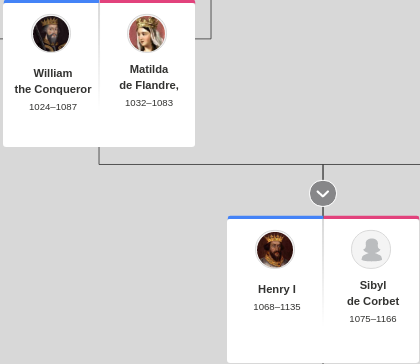
And again, it’s off to the races! Richard III of Normandy.
His lineage goes back to Gotfrid and NN (no name) as well, and Clodimir IV who was my last post, as well as to this one through three lines.
It also goes through the Trinovantes, whom I also noticed on GGF’s side. And Toxandries. A lot of the same faces, in fact, and one line that also goes back to this guy and beyond.
There are interesting Jewish lines that go back a ways. These come through a train of people living over 120 years, and, well, figure some of their ages. (Or don’t: 784 years, 1,007 years, 91 years – died in childhood! – 969 years, 696 years.)
Then we get back to this beauty.
I was getting a little tired of seeing the same lines over and over, but I persisted and found a Chinese line!
That’s Adishir Babigan Xerxes and Tashiti Arta Xerxes (born Ducta, according to MyHeritage, missing here). According to Wikipedia, Uldin, also spelled Huldin (died before 412) is the first ruler of the Huns whose historicity is undisputed.
Here’s a rare bit of inter generational problem-free lineage from another Jewish line.
And you were probably wondering when I would get to this.
The promise of this blog is that any writing will be short. Well, I guess it’s time to break promises, and I trust you’ll find it interesting. This is part 3. The story starts here.
The question we left with was, can it get any weirder? You decide. Britain, France, Athens, Ukraine, Troy, Persia.
It’s tempting to try to find a spouse for Meesh Moosh, but let’s not get sidetracked.
A couple more Persians.
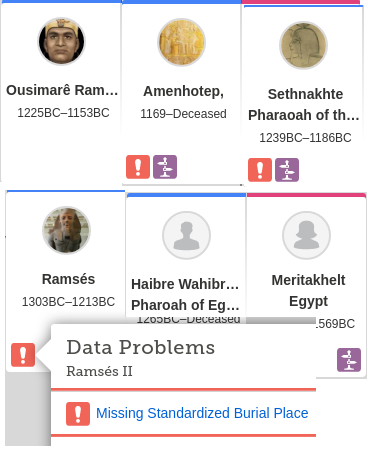
And of course what trip down memory lane would be complete without a handful of pharaohs?
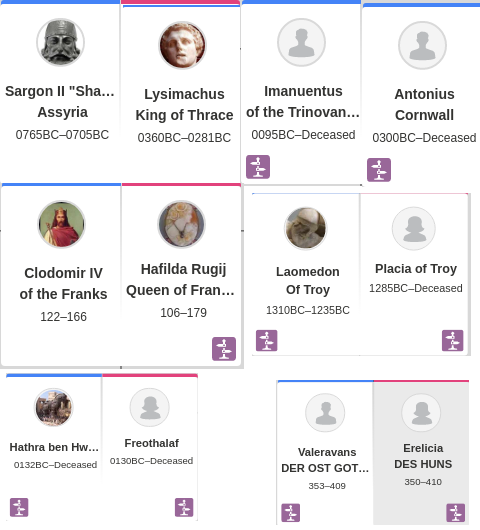
Some more family characters: Sargon, Clodomir IV of the Franks (notice Chlodomor de Francie in first image above), Antonius Cornwall that sounds like a Roman in Britain, Goths and Huns marrying.
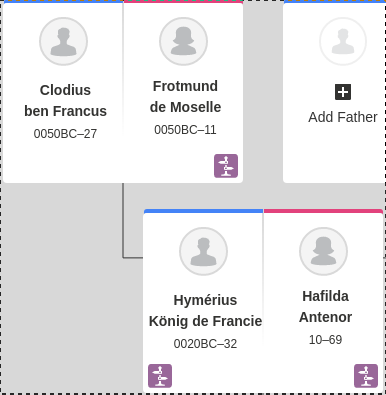
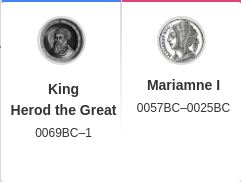
This is a fun one: Clodius ben Francus, a Jewish name, with distinctly German sounding Frotmund de Moselle, a French location, their son being König, which is German for king, of France.
In case there’s not enough weirdness, here we go again.
The promise of this blog is that any writing will be short. Well, I guess it’s time to break promises, and I trust you’ll find it interesting. Also, this platform allows only ten images per post, which will explain my break points. This is part 2. The story starts here.
Did I mention this line gets weird?
Perceus of Mycanae is a mythical character. So is Myles, King of Laconia.
Iolaos and Megara also appear to be mythological.
Is that a face? I don’t know. But by now you’re thinking, show me some faces! OK.
And aha! I knew it: descended from a Roman Emperor (actually birth date 317).
Here’s a nice find.
And going back a bit further. Another dubious 100+ years old, but at least it has dates.
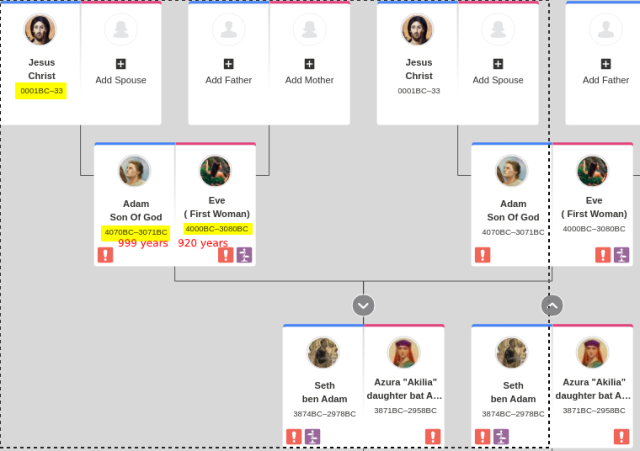
It is preceded by Eber, Sala, Arphaxad son of Shem, son of Noah son of Lamech, son of Methuselah, son of Jared, son of. No, let’s just do it this way: Mahalaleel – Cainan – Enos – Seth – Adam and Eve. Both of whom are listed as deceased, you will note.
And the lineage of Adam and Eve? It appears elsewhere, with images.
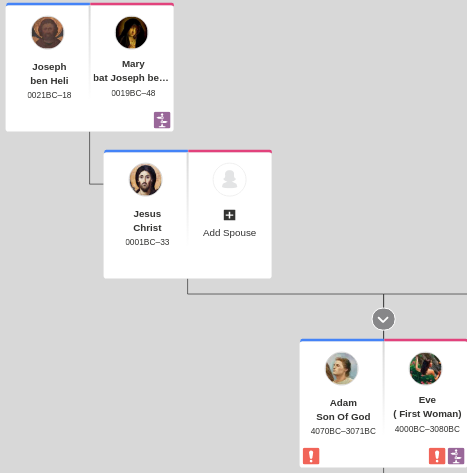
Jesus, doncha know. I think it’s safe to say that this line has drifted into la la land.
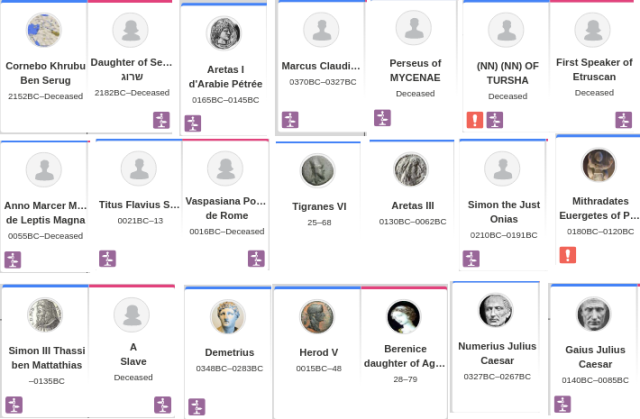
Exploring the ancient Hebrew and Roman lines is truly tedious. Here are a few highlights. Again mythical Perseus appears, as does First Speaker of Etruscan, Simon III married to a slave, and that last one.
Yes, it appears I have a clear line of descent from Julius Caesar.
The promise of this blog is that any writing will be short. Well, I guess it’s time to break promises, and I trust you’ll find it interesting.
From time to time, I dig into genealogy to see if I can find something new. Revisiting familysearch.org, I realize my rudimentary family tree has grown in my absence. How? Why? No clue.
The maternal lines go back only to my grandparents.
My surname (paternal line; somewhat obscure French) has been my main interest, but it only goes back to 1832. The family history of seven Huguenot jeweler brothers fleeing France would have put them there long before that. (In a strange coincidence, when I moved to a small town in the Taunus mountains of West Germany in 1981, with my first piece of mail the postal worker asked if I was related to the recently deceased shepherd who kept his flock on the hillside opposite, with the exact same surname.)
My middle name, Clayton, I can trace back only to 1719.
So that, I thought, was that: the interesting stuff stops with my 5th great-grandfather.
But I started following the line of his wife, Abigail Powell (b 1717). Soon I was tumbling back to the 14th century, 13th…until it stops with Pierrede Rode, 1020-1080. Wow.
I started following Marmaduke Constable (1275-1378: 103 years old?). The first line breaks into the 10th century, though a grandfather being born the same year as his grandson does raise an eyebrow.
(Reassuring to note that people born over 1,000 years ago are deceased.)
Another line and we start hitting kings and queens.
That line only goes back to 778, but along the way we’ve picked up six kings, a princess, and a queen. Not bad, even if I’d never heard of them. And some great names too: Eudo I Munby Mumby Mundebi has a certain ring to it.
Another line goes back to Eadwulf I, king of Northumbria (670-717), and adds five more kings and a lord.
A line starting with Flocwald of Asgard adds my first ancestors who lived before the birth of Christ. I can’t be sure which are kings but hell, Cerdic, Alfred the great…at this point I think it’s safe that they’re basically all royalty, else why would they be remembered?
Here we get our first taste of red flags. I will consider that these types of red flags render a line unreliable (a lot have red flags for “no standardized” birth or death place, but otherwise their dates work). This is going back 73 generations.
Another line ends with the King and Queen of the Picts, but Wikipedia names the first King of the Picts as Vipoig (died c. AD 341). I don’t think too many people in the 4th century lived to 91 (but what do I know?).
Another Irish line.
Another: 0ili0ll Oaisfhiaclach ‘crooked teeth’ Macconnla 77th high king of Ireland. But he’s listed elsewhere as living two centuries earlier, which corresponds with the dates of his son the long-hair dude. BTW I was always told my crooked teeth resulted from my mother’s large teeth and father’s narrow jaw, but maybe it goes back further?
One line goes back to Gotfrid, the Duke of Alemannia in Bavaria. Somewhere along in here we’ve got Normandy, Bayeaux, King Ludwig I….
Fascinating to watch progress on the neighbors’ project. The roof is metal-clad plastic-foam panels with enough structural strength to stand on, as you can see. The contractor told me the roof would be done in an hour, which was pretty much true for the full-length panels. They are gently sloping toward the background. But now they have to intersect the existing roof.
So roof work grinds to a halt for a few hours as they cut away part of that. How will they proceed now? I have no idea. It’s almost as if they’re making it up as they go along.
The beach was quite filthy today, with a mix of organic stuff—shells and some kind of eggs—and the ubiquitous plastic.
For some reason (it not being tourist season), beach cleanup crews had been at work, as evidenced by the bags everywhere waiting for the tractor that will carry them away. So of all of that expanse of beach, where do you suppose my dog decides to take a shit?
You’re right if you said on top of one of those bags, and not only that, exactly where someone will reach to pick it up.
You may recall a few weeks ago when I unraveled the mystery of the amphitheater. I was puzzled that I only noticed the obvious drain when looking at it in a satellite photo.
I’m even more puzzled now, after returning to inspect it.
It’s huge! Probably five meters across and three high.
So of course I had to go through it. This is the view from the other end. I didn’t even notice the painting on the walls until I loked at the photo. Obstacles and debris had my full attention.
And here’s that pedestrian bridge and its highest. I couldn’t really determine if there was anything to prevent a person from falling off the side. There might have been some wires.