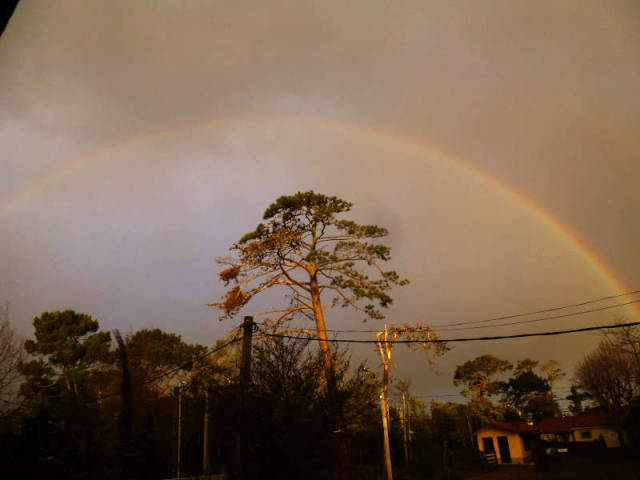
View out the front door a few minutes ago.
An inquisitive old fart with a camera
View out the front door a few minutes ago.
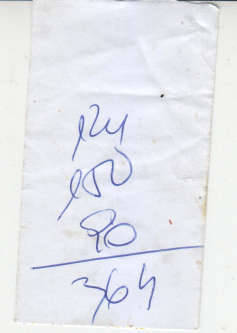
I found this at the bottom of my bag after going to the feria. Ah, Uruguayan handwriting.
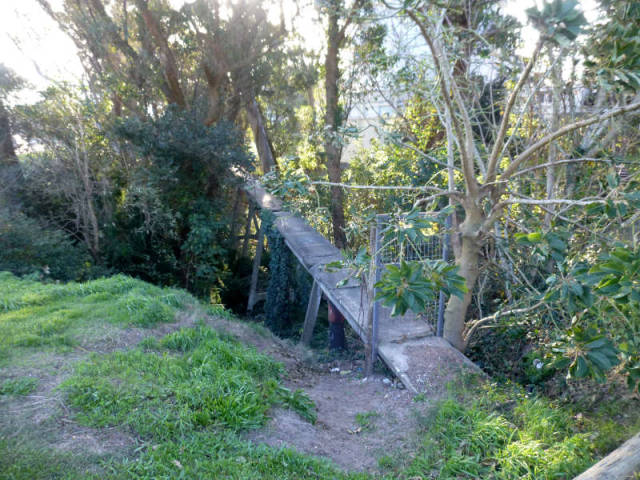
Our normal dog walk cancelled, I took Mocha on the beach all the way into town. There I was reminded of this strange fenced-off footbridge, part of its deck missing.

From the road you can see it through the trees, ending across the road from the iconic (no longer hotel) El Planeta, built in 1939 in six months, offering central heating and hot water throughout. De luxe for 1939 Uruguay!
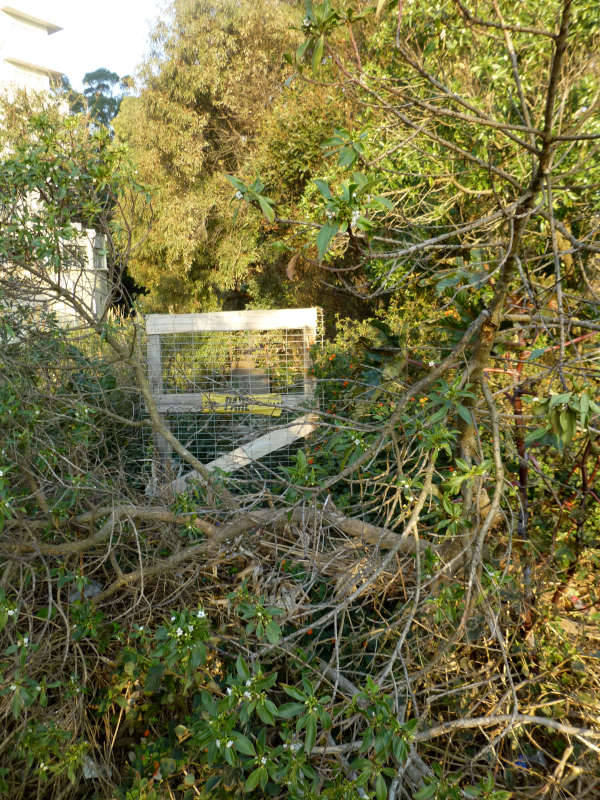
At the far end of the footbridge there’s a pile of branches, and it’s again fenced off.
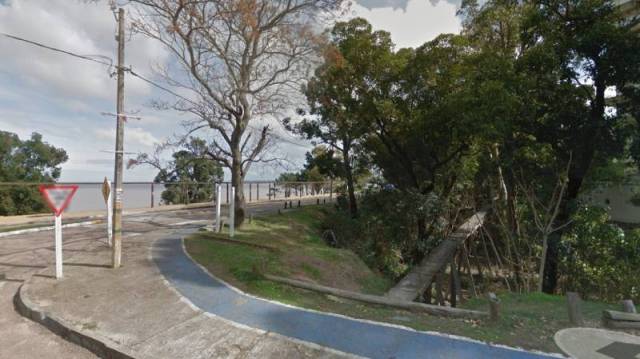
You can see how close it is to the road (and you can see that, in 2015 per Google Street View, you could freely access the bridge, which never occurred to me). So why would someone choose the footbridge instead of just using the road?
Which gave me an idea.
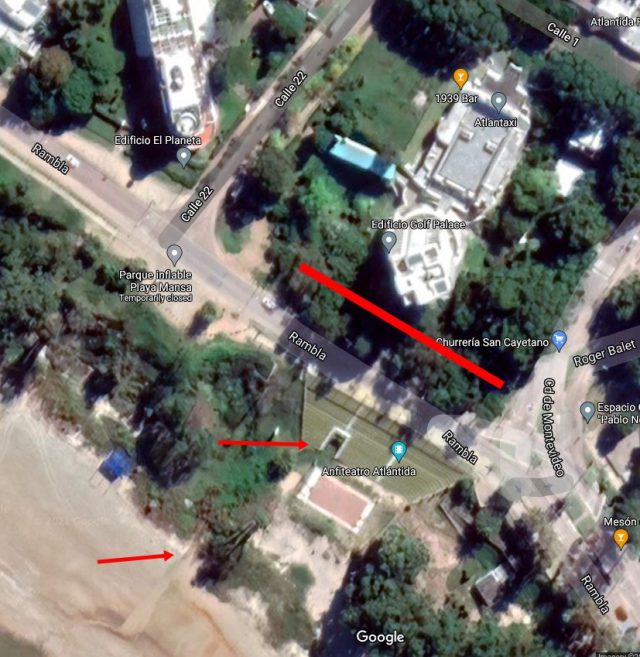
What if the road was added later? The red line represents the footbridge. From above, the amphitheater looks a lot like a dam. And there’s apparently (I have never noticed it) a huge drain, and signs of drainage onto the beach (arrows).
[Update: I did go back and explore the tunnel]
Later—more time later than I’d like to admit—I found a diagram of a proposed harbor that was never built.
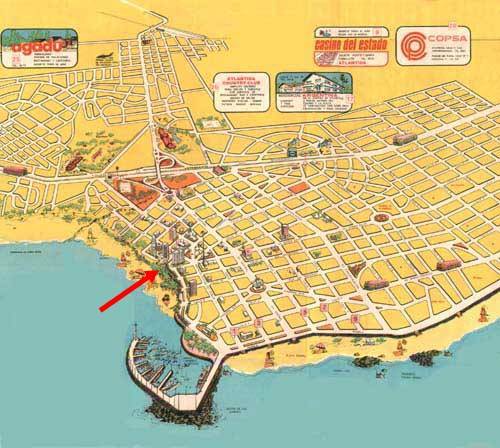
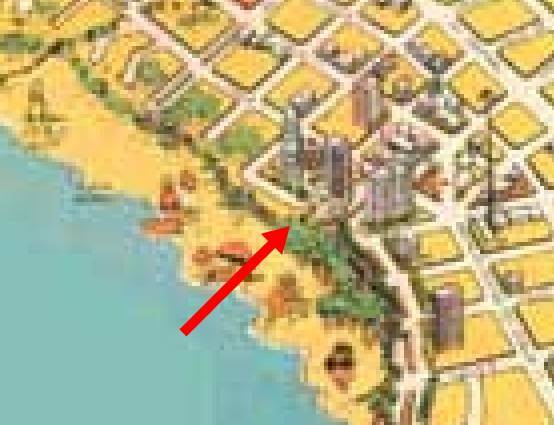
And there I spotted a break in the Rambla (beachfront road). Notice how there is no Rambla above the arrow.
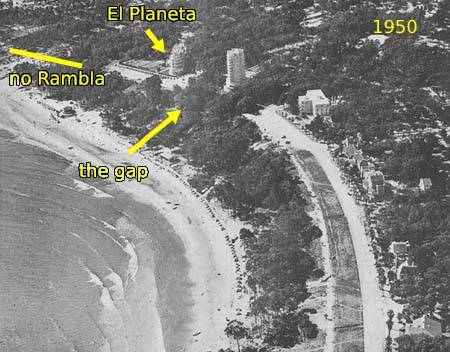
And here—ta da!—is an aerial photo from 1950 confirming it. Mystery solved!

Construction continues on both sides of us, and both strange. Workers have just finished the molds for huge concrete beams atop the 42m² addition. I finally got curious and asked about the plans.

The large opening in the foreground will have a sliding glass door (facing a bush and a wall). The two distant walls are to be glass. Since this is looking roughly northwest in the southern hemisphere, and the backyard is open, this structure might be concisely described as a solar oven. I expect there may be an overhanging roof.

But at least I get it. I also get that the neighbors on the other side are making some sort of grand entrance.

Walls that might be planters, two large columns (or something), and indented area (to the right). All very curious. But I’m not going to ask just yet. Too much fun trying to imagine where this ambitious project might go next.

I have lived in ten houses in the last 35 years, four rented and six owned. Today was the first time in 67 years on this planet that I have had to change a refrigerator light bulb. I had never even considered the idea before. I thought, Isn’t that strange? until I realized that, at 11-½ years, this is the longest I’ve lived in one house continuously since age 15. And in the last 35 years, of course, with an average of 3.5 years, by far.
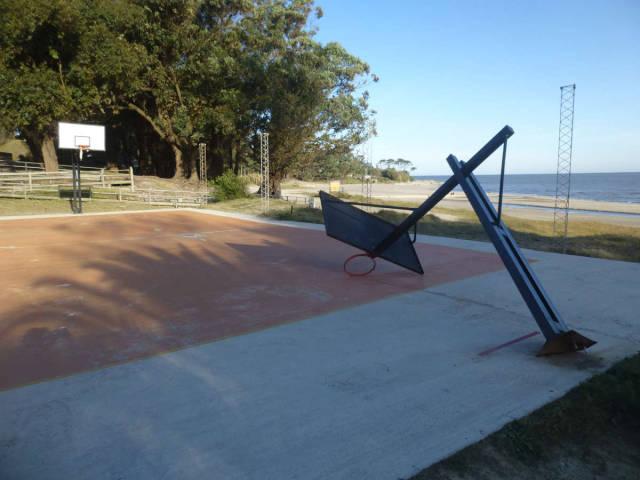
Ah, that engineering thing: when you build a basketball (big thing now in Uruguay) court without taking into account the coastal wind load.
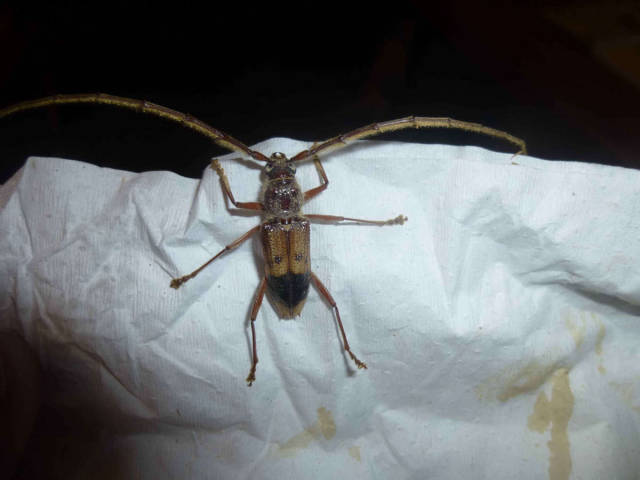
A bug our dog found in the firewood near the stove. I was able to get it outside before he initiated an asymmetric play session with it.

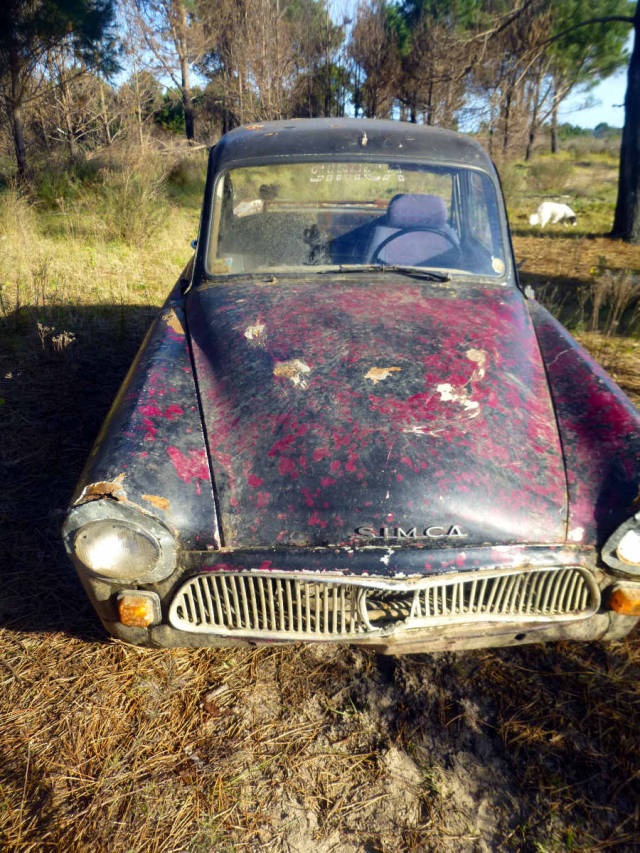

I don’t think the Simca we saw parked in the woods today is en route to restoration. This model was the best-selling car in France in 1956.
_____
Simca (Société Industrielle de Mécanique et Carrosserie Automobile; Mechanical and Automotive Body Manufacturing Company) was a French automaker, founded in November 1934 by Fiat and directed from July 1935 to May 1963 by Italian Henri Pigozzi. Simca was affiliated with Fiat and, after Simca bought Ford’s French activities, became increasingly controlled by the Chrysler Group. In 1970, Simca became a subsidiary and brand of Chrysler Europe, ending its period as an independent company. Simca disappeared in 1978, when Chrysler divested its European operations to another French automaker, PSA Peugeot Citroën. PSA replaced the Simca brand with Talbot after a short period when some models were badged as Simca-Talbots.
During most of its post-war activity, Simca was one of the biggest automobile manufacturers in France. The Simca 1100 was for some time the best-selling car in France, while the Simca 1307 and Simca Horizon won the coveted European Car of the Year title in 1976 and 1978, respectively—these models were badge engineered as products of other marques in some countries. For instance the Simca 1307 was sold in Britain as the Chrysler Alpine, and the Horizon was also sold under the Chrysler brand.
Simca vehicles were also manufactured by Simca do Brasil in São Bernardo do Campo, Brazil, and Barreiros (another Chrysler subsidiary) in Spain. They were also assembled in Australia, Chile, Colombia and the Netherlands during the Chrysler era. In Argentina, Simca had a small partnership with Metalmecánica SAIC (better known as de Carlo) for the production of the Simca Ariane in 1965.
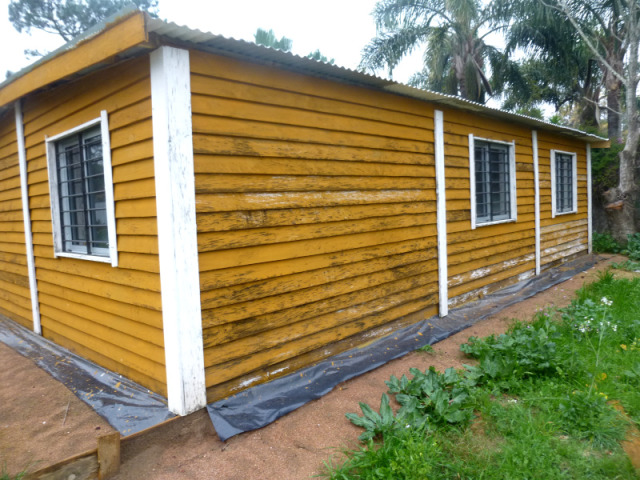
Here’s the back of that brand new house I presented on June 8th. Lovely.
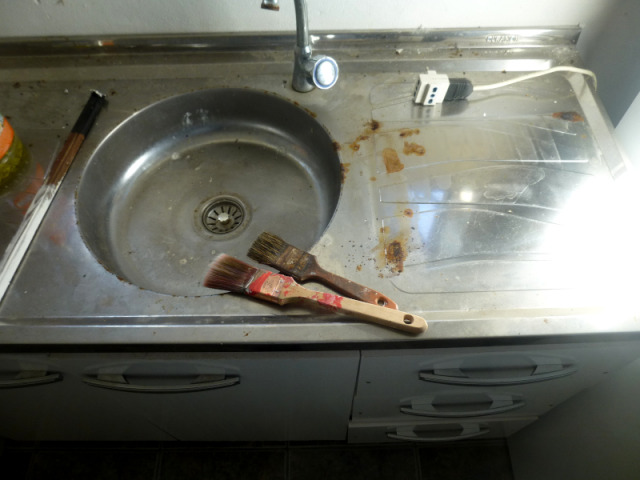
Here’s a “stainless” steel kitchen sink that’s a few years old, barely used except for a few months. No complaints: we let friends stay in our place in exchange for taking care of what they thought it needed, including a kitchen sink, and we knew this was very cheap. But still. Those dots to the left of the paint brushes are rust as well.