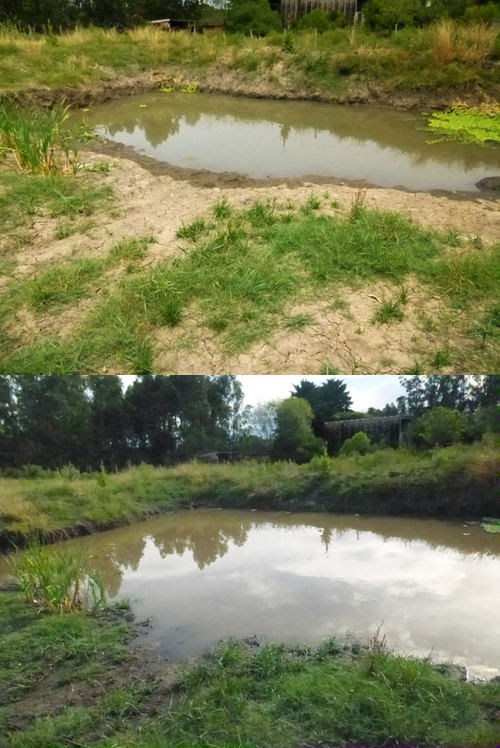
…when that day includes a lot of rain. This first summer we’ll learn whether the tajamar will retain enough water to stock it with fish. Apparently after disturbing the soil to create the pond, the initial seepage of water through the (already almost impermeable) soil seals it further, so that subsequent water loss is almost entirely through evaporation.
With the camera I have, very difficult to see subject in bright light
I have not spent much time in the campo lately, and was fully expecting to see the baby tero-teros.
Instead, I was not greeted by noise. The teros, near the tajamar (pond), remained quiet until I approached to check the water level.
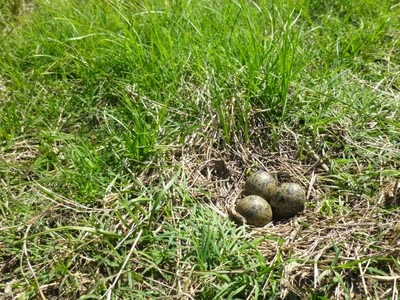
Here’s the nest. Empty. No eggs, no shells, nothing. I don’t know what transpired, but apparently we won’t be seeing little teros this summer.
Meanwhile, the water level has subsided in the tajamar with our recent suffocating heat. The grasses I planted to the left are high and dry, but hanging in there (and I learned that the second type of mystery floating plants, which I did not add, were put there by my neighbor Mañuel).
I try to keep my blogs short, so that if one is boring, at least, well, it’s short. But since we’re on the subjects of teros and water, I must relate a revelation: an Uruguayan guy about my age told me that when he was a kid, visiting his grandfather’s estancia (big country place), the teros hung around the water, in the thousands. When they took flight, they formed a cloud that blocked out the sun. With the advent of “modern” (i.e., unsustainable) agriculture, they adapted: so now you see them only in pairs, far from water, near streets, even on Avenida Italia in Montevideo. I never dreamed they could exist in a crowd.
Your classic car that is approximately the opposite of restored, proclaiming it’s retrofitted with a Mercedes 220 diesel engine (cool for me, actually; I drove a gas 1960 Mercedes 220 when I was 17 in 1971—aah, we won’t got there for now). I don’t understand the details of engine mounts and such, but it strikes me as typical Uruguayo to pull off such a feat.
Windows left open; apparently not concerned about spontaneous theft.
Really, the more I look at this snapshot the more I wish I had hung around to interview the owner: what mods did you do to marry a Mercedes engine block to a Ford Falcon transmission?
Let’s not forget the real reason for the season: to sell shit. In this case, remote-control dinosaurs. Alas, this ain’t e-gadget-obsessed Tokyo. I waited in line at Tienda Inglesa Atlántida in back of, and in front of, shopping carts laden with slabs of meat, chorizo sausage, cheese and baguettes, the ubiquitous gallons of Coca-Cola poison, plenty of beer, potato chips, plates and glasses for vacation dwellings, deli sandwich packs, a head of lettuce and some tomatoes (RIGHT ON!), but… …not one remote-control dinosaur.
While even the impoverished in the north remain enslaved by consumerism, here the holidays mean time with friends and family. Granted, shoppers in Tienda Inglesa Atlántida aren’t the social equivalent of the unruly crowd waiting for free toy handouts at a Salvation Army in Pittsburgh. Nonetheless, there exists in Uruguay a family “glue” that will trigger a touch of nostalgia in USA-Americans of a certain age.
Personally, though their presence makes my life a little more difficult, and a lot louder, I really do wish for our seasonal visitors a really enjoyable holiday time with their family and friends, playing with a soccer ball or fishing during their endless hours on the beach. I think they understand that a remote-control dinosaur adds little to that experience. I hope so, anyway.
When the others left for the States, I launched into cleaning the casita (little house), where my son lives, which was appallingly dirty. He was housebound for four months while his shattered ankle healed, and hadn’t quite lost the habit of doing nothing, and going nowhere.
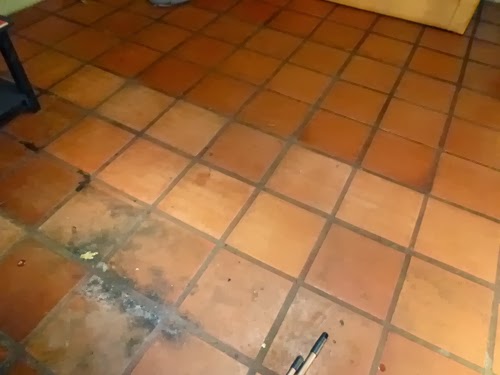
The unglazed tiles in the foreground will come clean, but it’s a hands-and-knees scrub brush job. The second two rows have been scrubbed but not mopped, the next three have one coat of some sort of treatment, and the remaining have two coats.
Much work, but rewarding to see the place look half-decent, at least a little.
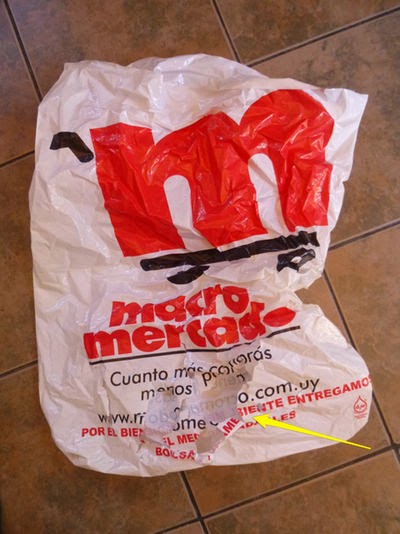
I’m cleaning the casita and was glad to find in a bathroom drawer this large bag from Macro Mercado, because there’s a lot of crap in the casita that needs to go away and a big bag helps. Problem is, the bag, advertising its biodegradability, has already started to go away itself….
Yesterday was contacted by a third cousin through the Clayton (my middle name) side of the family who’s into genealogy. Turns out my many-greats grandfather William Clayton accompanied William Penn on his second trip to America in 1699.
Beats the Huguenot DuBosques’ arrival from France by a long shot…a cool little piece of knowledge that made the day more interesting.
In offices here, I’m often summoned as “Clayton” because they think that’s my father’s name, as it would be in Spanish form (given name – father’s surname – mother’s surname, which doesn’t change in marriage).
It will be a very long walk (notice switchbacks on far side), but the new pedestrian bridge will be wheelchair- and bicycle-accessible. Because of the distance from the last traffic light eastbound, on January weekends it is almost impossible to cross the road—no gaps in traffic whatsoever. Numerous people have been killed here, including the mother of our contractor, when he was a boy.