Week ends. Noice.

1) Ah, the joy of little things

2016-08-26-01

I was able to buy the little thingie on the right for my Stihl weedeater! Almost USD 5, but so what. I indicated my relief that it wasn’t just me who lost things. Previously I lost the main nut for attaching the blade, threaded counterclockwise, which cost about the same at the time in USD (and of course immediately found the lost one). Se gastan, the girl said (I think), meaning (I think) they wear out (get spent). Correction appreciated —.

2) Spring is springing

fig tree budding, Canelones, Uruguay

Our fig tree in the campo, in need of pruning. (Search for “figs” for other posts if this is even remotely interesting.)

2016-08-26-03

Cool flower, horrible photo.

3) Dead snake in the road

2016-08-26-04

I’m hoping this was run over, and not killed gratuitously por las dudas. Syd and I recently encountered a small dead snake while dog walking, which led him to find a site about snakes in Uruguay. Unfortunately it’s awkward to ID non-venomous snakes, and I’m tempted to take all their info and organize it into a functional web site. Anyway, there are four venomous snakes in Uruguay: rattlers (widespread, but not here), two vipers (one widespread, one not, but neither here), and coral snakes, distinctive as hell: in terms of threat, if you plan to mess with any brightly-colored red-yellow-black snakes please contact me because I’d like to take out a life insurance policy on you.

And yes, the por las dudas guy at the beach was indeed an idiot.

4) And another stunning sunset

Sunset, Atlántida, Uruguay

Note the clouds. We’re supposed to be inundated tomorrow. Google weather indicated today that we were in the midst of thunderstorms, though all I could see was blue sky and sunshine. Trust my experience or Google?

The fish place

Fish for sale in Uruguay

There is:
Corvina (drum)
Lenguado (flounder)
Merluza (hake)
Cazon (school shark)
Angelito (angel shark)
Tambera (type of corvina, I think)
Camaron (shrimp — way too much work and tiny OBTW)
Mariscos (shellfish, seafood: not sure what they mean by this)
Lisa (mullet)

We buy only the first two. The others tend to range from weird to nasty.


A summer day in winter

It appears we’re in the veranilla — couple days of “little summer” before it gets cold again. Walked the dog in a t-shirt. Had I gone to the beach, I might have worn shorts and walked barefoot. Recall that this is the equivalent of the end of February in the northern hemisphere. Should be this way tomorrow as well.

Then the forecast for the weekend is the Tormenta de Santa Rosa, which means wind — lots of wind. And rain. And Dutch pirates not attacking Lima. But that’s another story.

The jacketed dog

A couple months ago, we approached an older dog, complete with dog jacket (almost an obsession in Uruguay). Benji was eager to engage the target. I told him, no, we don’t hassle older dogs, but it turned out to be young, and very eager to play, and though loose, more or less inclined to stay within the borders of its large yard.

I say its large yard — I actually have no idea even now to what house it belongs. Its owner cares enough to worry about him being warm, but not about being loose and possibly hit by a car. Go figure.

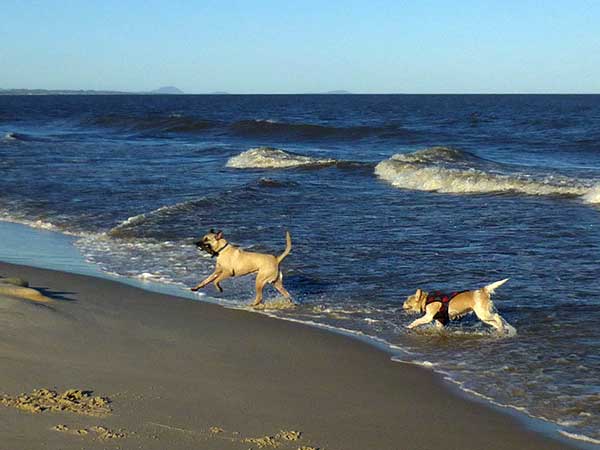
We saw him the other day, and the two chased each other around that yard. The little guy has a tighter turning radius, so it’s not as one-sided a chase as might appear. However, when I noticed Benji grabbing the little guy by his jacket, I decided enough is enough,put Benji on the leash, and continued toward the beach.

The little guy followed. So, next thing I know, he’s followed Benji into the water (Benji loves it when I throw sticks for him, and loves to splash around in the water).

dog-jacket-1

Something in me says that a jacket designed to keep the dog warm in the air might have the opposite effect in the water. Maybe not. It’s probably polyester.

dog-jacket-2

And with all the running, it probably makes no difference. But it’s winter here; this was a t-shirt/thin hoodie/windbreaker day. Not for the first time, I had to ask myself, is this dog in the water with its jacket my problem? Is it my responsibility?

Answer: absolutely not.

A block shy of our exit from the beach, little dog turned tail and headed home.

We’ll see him again.

Gracias por dejar

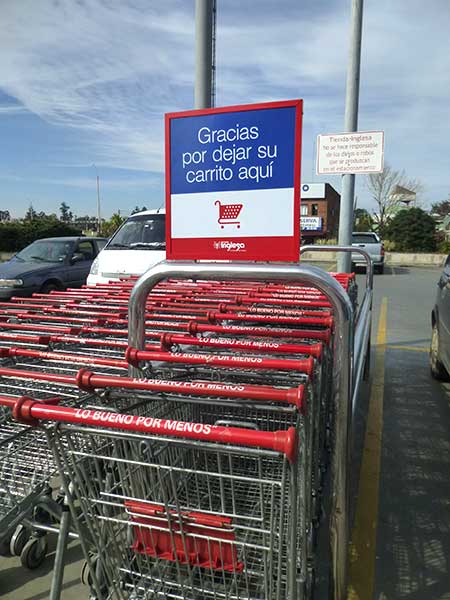
A new sign has appeared in the Tienda Inglesa parking lot in Atlántida.

Shopping cart sign at Tienda Inglesa, Atlántida, Uruguay

In a northern setting, it wouldn’t merit a second glance (except for being in Spanish: ”Thanks for leaving your shopping cart here.”)

However, as I joked to the employee in the parking lot, you can tell the new owners are American.

Klaff Realty, LP, owners of the Safeway and Albertson’s supermarket chains in north America, bought Tienda Inglesa’s 10 stores in March for $120 million. The shift has been subtle but palpable: aisles opening up, less innacessible merchandise cluttering the tops of shelf units.

And now this — thanking customers for not simply abandoning their shopping cart anywhere in the crowded parking lot (often requiring the next person to move it before being able to park).. Wow! Efficiency! Innovation! Think of what could happen next.

Maybe they’ll instruct employees not to block entire aisles with shopping carts as they stock shelves during the busiest periods? Nah, unlikely.

Or teach cashiers that their little bar, referred to up north as a “separator” or “divider,” and sometimes saying “Next Customer,” has a function other than breaking the photo-electric beam that makes the conveyor belt move? Seriously, as we started to unload our shopping cart onto the Tienda Inglesa conveyor belt today, my wife reached for the divider to separate our groceries from the previous customer’s. The grumpy cashier actually grabbed it and put it back, insisting that its function was to turn the conveyor belt on and off.

Perhaps I should take a felt marker and start writing on them ”Próximo Cliente,” No, they’d probably consider that vandalism.


I do, however, find some inspiration in the gringo who got so tired of Montevideo restaurants listing unavailable menu items that he started carrying a Sharpie marker, and crossing them off the menu with indelible ink as they were announced nonexistent by the waiter. So wrong it’s just right!

The Nazca arrays

Just a few days before leaving for Peru in early July, I ran across a fascinating hypothesis and paper by James McCanney. What makes it more interesting is that I wasn’t looking for information about the Nazca lines, but instead checking in on his web site, which I haven’t visited in years.

Here are a couple of photos I took from the air. You can find better on the web.

Nazca lines Nazca lines

As with all the later Nazca designs, they are made with a single line. And no one has an even remotely reasonable explanation for them. Well, of course, except for National Geographic, which dismisses them as ritual footpaths. They stop — just barely — short of calling them temples.

However, McCanney has a different idea, and, like his original explanation of the electric universe, it makes more sense than any official story, and as with the ancient “Inca” stonework, involves technologies far in advance of ours. Start this video at 50 minutes for a his background, then the fascinating next hour.

(With the little lower-right YouTube “settings” gear, you can play it at 1.5X or2X speed.)

youtube

Hint: this is a modern cell phone antenna.

antenna-2

Here is a rundown of various theories about the Nazca lines if you’re interested.


Isals Ballestas, Paracas, Peru

After the drab weather in Lima, we were promised, as we headed south, that 15 minutes outside of Paracas, we’d be drenched in sunlight. Alas, didn’t happen. Blame El Niño.

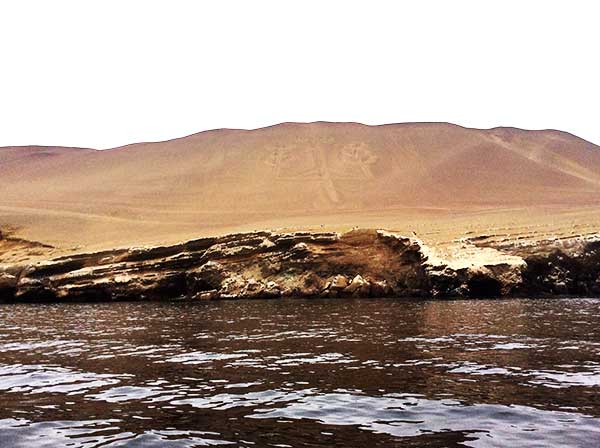
Besides the skulls, when in Paracas a boat trip to the Ballestas Islands is a must. On the way, you pass the Paracas Candelabra, a rather remarkable carving on the Paracas Peninsula that barely shows up when there’s no sun, despite intense photo manipulation.

Candelabra, Paracas, Peru

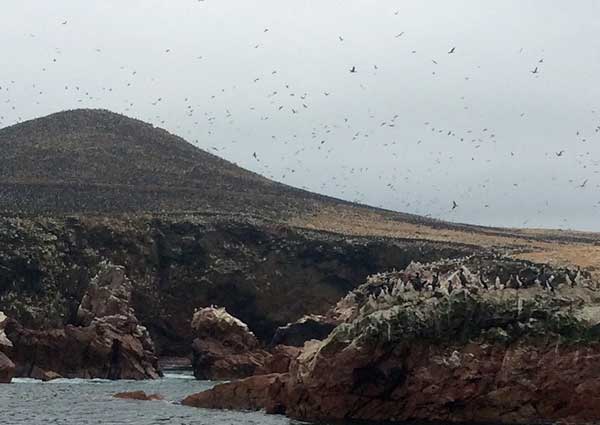
Then on to the islands. And birds.

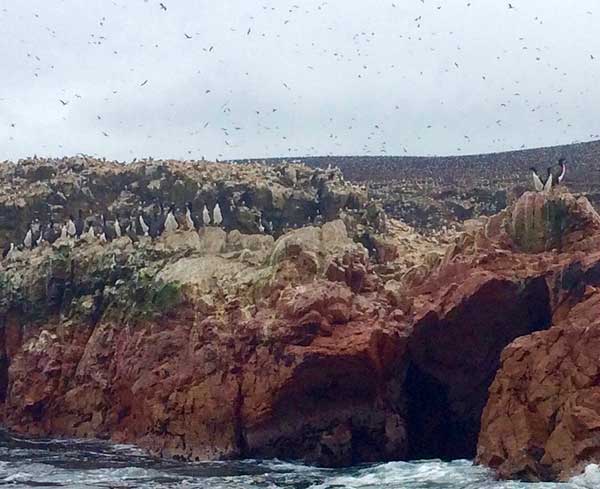
Ballestas Islands, Paracas Peru
Penguins, Ballestas Islands, Paracas Peru

Not all of them fly.

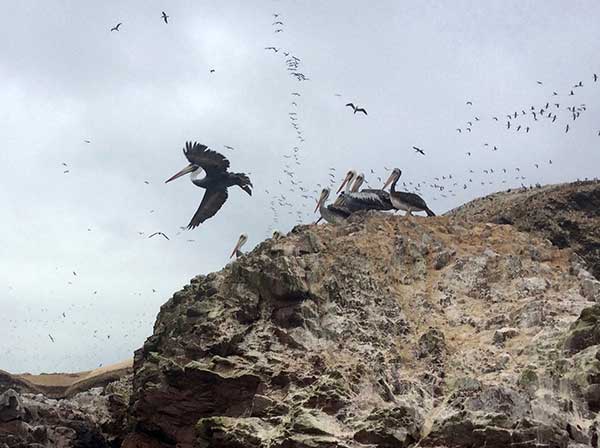
Pelicans, Ballestas Islands, Paracas Peru

But most do.

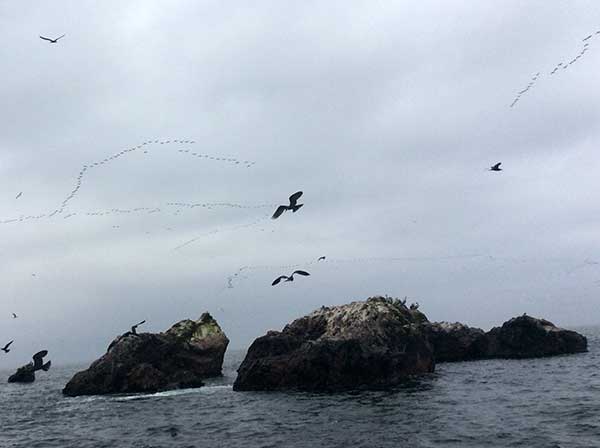
Ballestas Islands, Paracas Peru

And they just keep coming, as far as the eye can see.

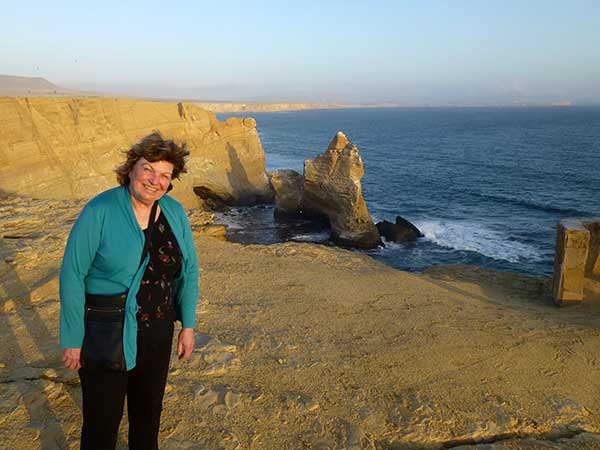
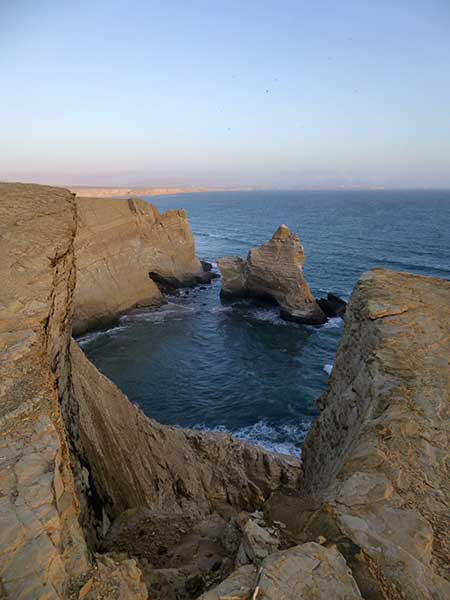
On the peninsula on the other side of the Candelabra, the scenery is quite spectacular.

Paracus Peninsula, Peru
Paracas Peninsula, Peru

And potentially dangerous.

paracas-8

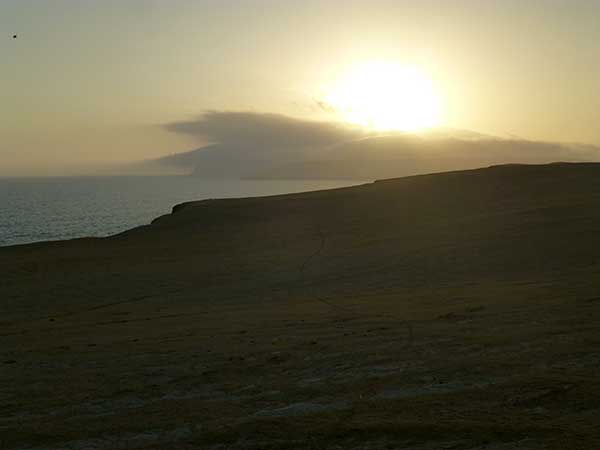
And — lo and behold — the promised sun makes a return!

Lima, Peru — early July

Lima — at least the part worth seeing — is built on a high bluff. If you go between May and October, this is pretty much what it looks like every day. No sun.

Lima, Peru, early July

But you can imagine how exploring on foot gives a good workout. Of course I had to go check out that pavilion on the jetty.

Lima, Peru

Proof! Lots of crabs. And happy seagulls, no doubt. You’ll also see lots of wannabe surfers. I thought I had a picture of them, but the light was so drab I found it difficult to get enthusiastic about taking pictures.

Miraflores, Lima, Peru

Miraflores, where we stayed, is upscale (and has the kitteh park). If you stayed and ate there, and avoided the rest of the city of 10 million, you might be convinced Lima is an OK place.

Huaca Pucllana, Miraflores, Lima, Peru

In the middle of Miraflores, you’ll find the Huaca Pucllana, a massive construction of mud bricks. We took many photos, and most are about as drab as you’d expect when photographing piles of mud bricks in dull light. This particular construction technique, with spaces between the bricks, makes it resistant to earthquake damage.

Huaca Pucllana, Miraflores, Lima Peru

And in places it does indeed look like it’s been shaken around a bit.

Sunset in July, Lima, Peru

Did I say there was no sun in Lima? I lied. This must have lasted a full five minutes.

Lima, Peru: July evening

And then, finally, some interesting light in Lima. Sort of.

Seen at the zoo

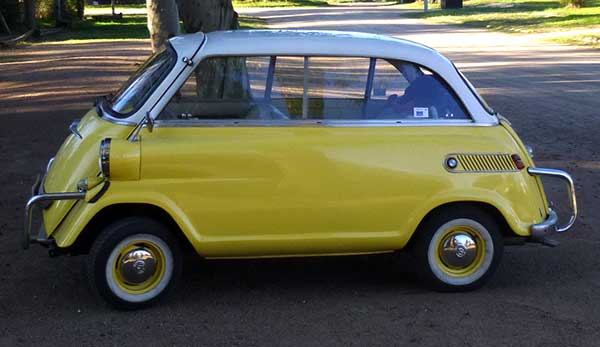
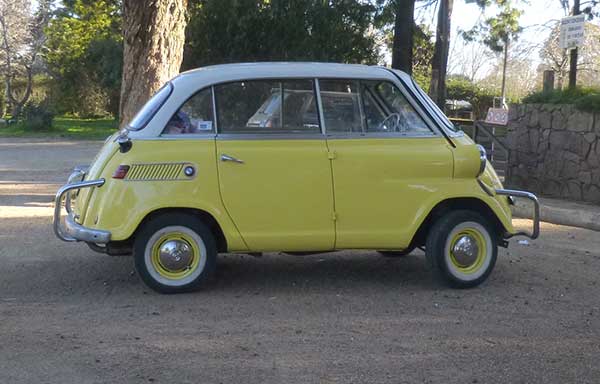
I saw this crazy-looking vehicle parked at our little local zoo today. There is one very subtle clue of the brand in this view.

1959 BMW 600

Can you guess? And hey, where’s the driver-side door?

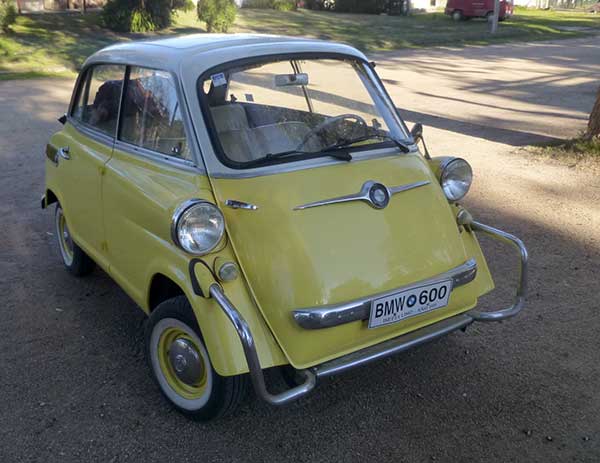
bmw-2

It’s a 1959 BMW? The whole front opens?

1959 BMW 600

And then there’s a little door for the passengers in back? I didn’t notice the door arrangements until just now, looking at the photos. I would have sought out the owner and asked for a demonstration….

Pumapunku, Bolivia

Part of the Tiwanaku complex, Pumapunku doesn’t jump out at you. It’s just scattered rocks, until you look more closely.

Pumapunku, Bolivia

The stones that form the platform are immense, and — as seems to be the theme — quarried and transported from a site improbably far away. Evidence of elaborate and precise machining of the stone is everywhere. This platform is called the temple, which is archeologist-speak for we have no idea what the hell this thing was.

pp-02

Here Yousef Awyan points out intricate and precise stonework similar to what he sees in Egypt.

pp-03

Evidence of machining includes perfectly circular drilled holes. in the background, Pumapunku’s distinct “H” blocks.

Pumapunku, Bolivia

An interesting feature of these blocks came to light last January. Brien Foerster (pictured) had along a British engineer in his 80s (amazing guy who had stopped flying his own helicopter just a couple years before) who had brought a Tesla meter (magnetometer). Lo and behold, new mysteries! Knowing this, many on this tour had brought compasses. in this case, moving the compass inside the “H” recess causes it to point south instead of north!

pp-rods

One person brought dowsing rods, which reacted wildly. One would hold steady while the other spun like crazy. Changing position would cause the spinning one to reverse direction, or stop while the other started spinning.

pp-04

Throughout the site, excavated stones are piled up more or less randomly, further demonstrating that the archeologists remain clueless about their positioning or function.

Pumapunu, Bolivia

And there is much more of the Tiwanaku complex to be discovered. Here Antonio Portugal shows the results of ground-penetrating radar, which reveals promising excavation possibilities that may never happen for political reasons.

In closing, a couple more images from Tiwanaku:

Tiwanaku, Bolivia

pp-06

Amazing stonework — function unknown — from many thousand years ago.