The Yacht Club

We had lunch the other day at a restaurant overlooking the Arroyo Solís Chico, opposite the Yacht Club Parque del Plata, near the statue of Ruperto. Several kids were learning to sail in tiny boats in the mild breeze.

Yacht Club Parque del Plata

You’ve probably guessed this already, but I has to walk around the back to see more. Not a Yacht in sight.

Yacht Club Parque del Plata

Curious to learn more about their activities, I discovered that they have a web site. There are no yachts there either. I’ve written before about the pathetic state of some web sites in Uruguay: take, for example, the national oil company. Try this link: ancap.com.uy. Now type www. at the beginning and hit return. Kinda takes ya back twenty years, no? That’s Uruguay.

But the Yacht Club Solis Chico takes the web to a new level: see for yourself!

The elementary school experience in Uruguay

Newcomers from California have posted a blog entry about their experience with rural Uruguayan elementary school. I’ve posted before about the umm, unusual school uniforms here. Here’s the explanation.

Elementary school uniforms in Uruguay
“The public school uniform in Uruguay has been like this since the beginning of the century, with every child wearing the white dust cover and the blue bow.  The reason for the uniform is to make it almost impossible to make fun or to comment about the quality, level of maintenance, or brand of the clothing underneath. It was a democratic and egalitarian effort to make every child look the same way with non-expensive clothes, and equalize opportunities. That is the spirit even today. The size of the bows, is just a tradition. Private schools do not follow this same tradition, but do each have their own uniforms.” 

We absolutely love the tradition. Our kids don’t feel embarrassed wearing them since all the other children wear them.  They do take them off as soon as we get home, but it’s nice not to have to worry about what they are going to wear at school.

I highly recommend reading the whole article: Escuela Rural on the Waystages blog (waystages.com/?p=106)


20190709 update: apparently a one-year wonder. This of February 2017 appears to have been their last blog entry, celebrated by their last meaningful Twitter post. Their Youtube channel ended shortly after their arrival in 2016. Their Facebook page went cold in November 2017. Well, best of luck to you wherever you are!

Some Atlántida architecture and history

It was a beautiful day Monday for taking pictures.

Atlántida started in 1911 as a summer playground for wealthy Montevideans, and the architecture reflects that.

map

Along the Rambla La Mansa:

House in Atlántida, Uruguay

House in Atlántida, Uruguay House in Atlántida, Uruguay

There are a number of whimsical houses, including this one that I’ve never seen occupied on the Rambla La Brava:

map

House in Atlántida, Uruguay

And then there’s Edificio El Planeta.

map

First, a quick Spanish lesson: el planeta means the planet, and it seems like it should be la planeta. There a few Spanish words that don’t play well with rules.

Built in the 1930s in just one year (did Uruguayans once work fast?), it served as Planeta Palace Hotel until 1954. It looks like a ship preparing to steam out to sea, and was very fancy in its day, with private baths, hot water, and heating (heating? In Uruguay?). After the hotel’s closure, it was divided and sold as  propiedad horizontal (i.e., condos). It was declared a national historical monument in 2005.

El Planeta, Atlántida, Uruguay


Beautiful new winery

Guest post by Syd Blackwell

map, Punta to El Edén

Ruta 12 carves an up-and-down path through the hills of Maldonado, northwest of the resort area of Punta del Este. It is a most beautiful road for a scenic drive. Just four kilometers south of the tiny village of Pueblo Edén, high on one of those hills, is Viña Edén, a winery. The owner is Brazilian, and a passionate oenophile.

The property is huge, but a mere seven hectares are devoted to grapes. The rest has been, and will continue to be, displayed in the natural beauty of this greenest of Uruguayan areas. The views are magnificent. The emphasis here is on quality, not quantity.

We had not pre-booked a visit. We only learned of the winery during a visit to Lote 8, an olive oil farm, located just north of Pueblo Edén. Naturally, we seized the opportunity to see the winery. They are open from 11:00 to 20:30 daily and can easily accommodate unannounced arrivals.

Viña Edén, Maldonado, Uruguay

The road that has been created to reach the operations, is already quite a marvel, as it steeply climbs the rocky hillside. The stunning building at the top is sheathed in a deliberately rusting metal, a very natural-looking colour. The windows are immense, maximizing the views. We were immediately greeted by an employee, on the wide terrace in front of the building that looks across the beautiful landscape.

Viña Edén, Depto Maldonado, Uruguay

We were offered a tasting tour, a tasting tour with a meal, or, a simple tour without tastings or meal. We chose the last. The tours with tastings or meal are, we think, quite expensive. We are used to free tastings at wineries. Our tour cost US$45 for a party of four, with nothing offered but words. At the end of our tour, we received an IVA discount, that reduced the price down to approximately $8 per person. The tasting tour, with snacks, costs $45 per person and the tasting + meal tour is priced at $65 per person. If one were attracted to the menu, and the idea of a chef-prepared mid-day meal, I suppose the last choice is a better value than the tasting tour, where the snacks did not look impressive or plentiful. However, when we had a chance to peruse the menu at the end of our tour, we did not think it remarkable enough to fit the asking price. Of course, we had not tasted the wines that would be offered with the meal.

Viña Edén, Depto Maldonado, Uruguay

The wines they produce are, as is the operation, of unique and excellent quality. As listed on their website, they are: Tannat Reserva 2015 for $1080 pesos (USD 38), Chardonnay 2015 for $810 (USD29), Cerro Negro Gran Reserva 2013, and Methode Champenoise, both priced at $1350 (USD48). Without a tasting, we were unwilling to buy any of these expensive products. However, other visitors at the winery clearly were partaking of both the tasting tour or the dining tour, and were purchasing bottles of wine following their tours.

Viña Edén, Depto Maldonado, Uruguay

The workings of the winery are all sparkling and new. It only opened for the public in this format in December 2016. On the night before our visit, they had a social event with live music at the winery. They are planning on more events in the future.

Viña Edén, Depto Maldonado, Uruguay

We were impressed with the incredible cleanliness and on the emphasis to deliver a pure product with the minimum of evasive processes or ingredients. For example, the flow through the system fully utilizes gravity and not pumps, which they told us, traumatize the wine. They are also completely aware of the soils and climate that contribute to their wines.

While we were not purchasers, the visit was well worth our time. We think this valley and this winery are beautiful. We will bring other visitors.

Further information can be found at the website: https://www.vinaeden.com/

Photos by Syd Blackwell

Boutique olive oil producer worth a visit

Guest post by Syd Blackwell

LOTE 8 – Viví Una Expeeriencia Única

View on Ruta 12, Dep. Maldonado, Uruguay
© Google

If you drive east on the interbalnearia (coastal highway) from Montevideo, then switch to Ruta 9 at Pan de Azucar, you will reach the start of Ruta 12, that runs north towards the tiny village (less than 100 persons) of Pueblo Edén, Uruguay. The vibrantly green hills and valleys along this route are, in my opinion, the most scenic of Uruguay. On one of these hills, just north of the village, you will find Lote 8, a unique experience in olive oil production.

Lote 8, olive oil producer, Uruguay

The operation, owned by an Argentinian family, offers tours, tastings, and, of course, the opportunity to purchase products. As recommended, we pre-booked a tour for our group of four, to ensure we would have the services of Martin, an English-speaking guide. We wished, as their brochure offers, “to enjoy a unique place where nature and passion transform its fruit into true art.” We were not disappointed.

Olive trees, Lote 8, Uruguay

The property is lovely; the vistas superb. Martin began his tour among the olive trees, where the fruit was still green and not yet ready to harvest. He explained two different methods of harvest, one with a finger-like device to strip olives from the branches, and one a shaking device to shake down olives. Matting below the trees catches the harvest.

Olive oil processing plant, Lote 8, Uruguay

Next, we followed the route of the fruit. First to a large grilled square in the floor where the harvest is dumped, and the conveyor that lifts it up to where the leaves and twigs are separated. Then the product moves through other machines that mix it with water, pulverize it into a slurry, and eventually separate out the valued oil. Finally, it is packaged, most in utilitarian bottles for Uruguayan supermarkets and such, and some in specially designed Mexican hand-blown glass bottles, suitable for gift purchases. Other products, such as soaps, candles, and chocolates, made with olive oil, are also available in the gift shop.

Lote 8 olive oil production plant, Uruguay

The buildings, the machinery, the layout, the total operation is just first-class. Great care is taken to produce this oil. Work also continues to add more features, more site beauty, to what is already remarkable. Step out of the processing room door and you look across a lily-pad covered pond, flanked by a bed of lavender, down and cross the grand greenness all around. This is a delight for visitors and workers alike.

Lote 8 olive oil, Uruguay

The main product, La Repisada extra virgin olive oil, has already won numerous international awards, some of which are on display in the gift shop. Each of us purchased items for personal use and future gifts.

We were totally delighted with our experience and would definitely recommend a visit. More information and contact email can be found on their website.


A special thank you to Karen Higgs, who suggested such a visit in her blog, Guru’guay. Also, if you tell them you read Karen’s article [link no longer exists], you are given a discount on your purchases!

All photos except the first by Syd Blackwell.

DTOTB

It’s been a long time since I posted Dead Things On The Beach, but today’s was quite impressive.

Dead sea turtle and dog, Atlántida, Uruguay

As was Benji’s response. Until I got close, I was convinced the turtle was going to move.

As usual, how and why of its demise remain a mystery.


Taco wisdom

When we installed an “inverter” split (DC, variable, no motor noise) in our bedroom, we moved the noisy split (AC/heater/dehumidifier) unit to our dining room. Finally, today, I mounted its remote control to the wall, removing two pieces of clutter from the counter top.

Took me ten years to figure this out.

But that’s not the story. In north North America, hanging something on a wall is pretty simple, dealing with drywall and (usually) wood studs. In south North America, and South America, our home for ten years, you deal with a different situation: plaster and brick walls. In Uruguay the requisite plastic expanding anchors are called Tacos Fisher, and I’ve often found myself sticking wood slivers or broken toothpicks alongside them because the hole ends up too big.

Until I figured it out.

To install a wall anchor, do not drill a hole.

This will be obvious to a machinist, or someone who has worked a lot with metal, but I am neither. You don’t drill a hole: you drill a hole twice, the first time with a smaller drill bit. You then use the proper-size drill as a reamer.

Voilá!

I can’t believe it took me over nine years to figure that out :0

Name that beverage redux

Thanks OSE: Uruguay tap water

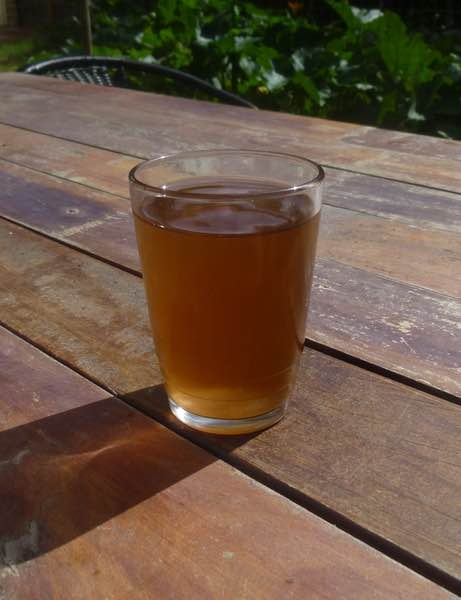
No, it’s not Earl Grey tea. It’s our tap water this morning, following a stormy night. The water will clear up with time. But if you were to visit Uruguay believing the claim that all the tap water is drinkable and see this, you might have second thoughts.

On the other hand, I remember well when a friend in Germany sent us some Heilerde. Maybe a little dirt is good for you?


De-cluttering

I’ve been reading The Joy of Less: A Minimalist Guide to Declutter, Organize, and Simplify, a needful reminder.  We may have moved to Uruguay somewhat minimally — ten suitcases and a pallet with sixteen cartons, a BMX bike, and a floor lamp — but oh my, how stuff has collected since! Some of the ideas in The Joy Of Less I had come up with on my own. In the 1980s, I parted with my yearbook collection and (worthless, seriously) old journals in Germany by putting them in a box with a “dispose” date. In 1997, when my father died, I took all the tools and materials in his workshop I’d known inside and out for over thirty years and laid them out in the “wrong” places, making it simple work indeed to sort trash from treasure the next morning. It was like walking into someone else’s garage sale.

In the past week, several boxes, some with perfectly good stuff, have gone to EMAUS, the local thrift store. For example, the electric buffer I bought, thinking I would assume a more conscientious attitude toward our car’s appearance. I didn’t. A nice hard shell suitcase that became “oversize” after its first trip when the airlines changed their specifications. A heavy-duty hoe that I thought just the ticket for cleaning the ditch in front of our house. Wrong. It’s simply taken up space in the garage for over six years.

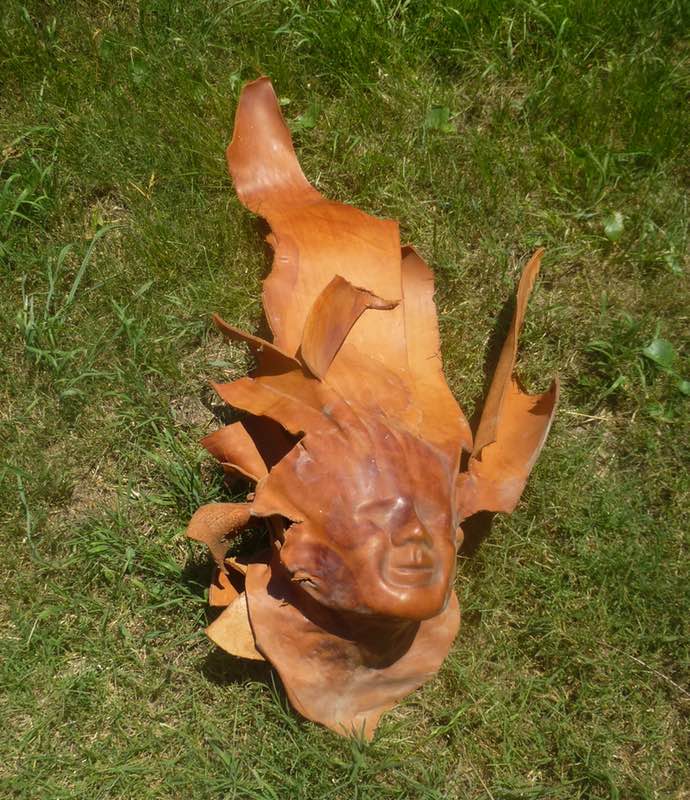
And for almost two years I’ve had the uncompleted, last work of Tex Farrell stored with our suitcases above the stairs. Haunting as it is, and fascinating a glimpse of his technique as it is, there’s no really good way to display it. And what to do with some large pieces of his leather he left? Aha! Knife and straightedge and now we have dog protection for our “new” leather couches, recently purchased from a couple who moved back to Europe.

leather protection for leather couch
OK, not particularly fashionable, but neither is a 4′ x 8′ painting I did when I was 17

But what exactly to do with this?

The last, uncompleted leather work of Tex Farrel

Today I took the scraps from the couch pieces to Carlos, shoe maker and repairer who has a tiny storefront in Atlántida. I also took the incomplete head, figuring he could at least use some of the leather.

To my surprise, he was absolutely delighted to receive it, and explained that it was of his friend Tex’s nieta — granddaughter. It wouldn’t mean anything for anyone else, he explained in Spanish, but it means a lot to me.

Another de-cluttering win-win!