Little brown waves

Little brown ocean waves, Atlántida, Uruguay
I’ve never thought of myself as  beach person. The thought of hanging out on a beach for hours makes me a little numb. That said, I love being able to walk to, and on, the beach daily. During summer – January and February – it has to be early or not at all (and I will find sun-worshippers at 8 AM). Off season any time of day works.
But there remain two issues: 1) the waves are tiny, and 2) they’re often brown.

1) Why are the waves tiny? Theoretically, you could sail in a straight line from Uruguay over 16,500 kilometers before making landfall (and you’ve always wanted to visit Myanmar, no?). That much open ocean and diddly little waves? Why?

Lots of water

2) Brown waves – let NASA tell the story (even if they can barely get within 90 degrees of correctly identifying north).
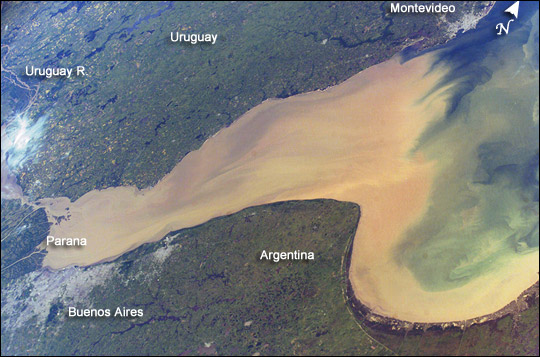
On the day of this photo, we enjoyed blue or green waves ‘north’ (actually east) of Montevideo. A little change in current and winds, and you have brown waves.

Sometimes we have fresh (brown) water; sometimes we have salt water at the beach. So sometimes the fisherman catch freshwater fish, and sometimes saltwater fish. And sometimes the wrong ones get caught in a shift, and their carcasses end up carpeting the beach.

Yes, Virginia, there is no paradise.

Uruguay may once again prove to live up to its official motto of “liberty or death.” Already considered one of the freest countries in the world in terms of economic and political liberties, the Uruguayan government has agreed on draft legislation that will legalize possession and cultivation of marijuana for personal consumption.

Bud, bud, glorious bud.

Meanwhile, prisons in Uruguay are at almost double their capacity, resulting in (politically motivated?) riots and fires recently.

Perplexing pickled peppers

Compared to the north, beef here is local, grass-fed, delicious, and cheap. As a result, we eat more, sometimes as hamburgers. Inevitably, the wife has lamented lack of dill pickles to accompany them. She tried making some. They were close, but not crunchy.

She recently brought home this:

Ajías Catalanes – Catalan chili peppers. They’re hot! They’re great! Who needs dills?

But this raises an interesting question. Uruguayans in general will not touch spicy food. Something with pepper – just a sprinkle of black pepper – is considered picante. Yet they grow hot peppers; you can buy them in the supermarket.

And now we see they pickle them (at the bottom of the label: Industria Uruguaya).

Why?

Besides us, for whom?

Garní in Solís, near Piriápolis

Being the wife’s birthday, we had a ‘splurge’ meal at the Armenian restaurant Garní in Solís, near Piriápolis, where we’ve been going off and on for over a year. It’s about a half hour away.

  • If you don’t know Spanish, the accent indicates the accented syllable, and in Spanish only one syllable is emphasized, no matter how many exist in a word (it can be 7-8 easily)
  • If you don’t know Uruguay, this conversation does not exist: She: it’s my birthday – let’s go out to eat. He: Last time we ate out it was Thai. Do you want to do that, or Tex-Mex, or Chinese, or Italian, or…? It’s more like, what kind of meat do you want with your french fries? So an excellent restaurant with food with different flavors is remarkable.

Though we haven’t been there in a while, Michel, the waiter, knew exactly what we were going to order.

Sitting in their shaded outdoor area a block form the ocean, we started with a meze of tsatsiki, hummus, tabouli and a delicious eggplant concoction, with pita bread and a half-liter of white wine.  We shared a lamb shish kebob and enslada belen, a wonderful mix of eggplant, apples, red pepper, cashews and prunes (I think). And another half-liter of wine.

I got a laugh out of him with my comment (actually no need for Spanish; he speaks English and French as well) comimos como Uruguayos – we ate like Uruguayans! Servings can be HUGE here. He repeated it and got a laugh out of the chef Ani (who also speaks English, and also Armenian and Turkish). We normally don’t eat dessert, but when Michel came out and started talking to us in a low, conspiratorial way, we figured they were going to offer us a free dessert since it was the wife’s birthday, something that had come out earlier in conversation.

No, not that. The entire meal was on the house.

Culture, language, and cooking

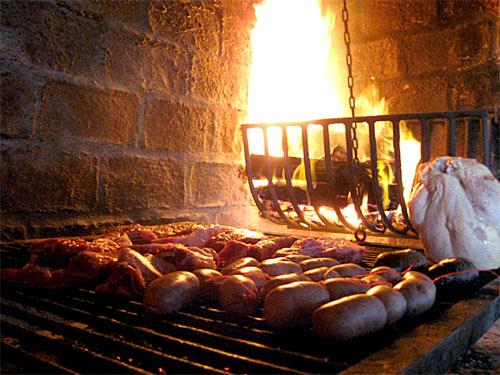
Yesterday, we spent a pleasant afternoon and early evening in the campo, at the chacra of friends, having an asado on their parilla.

campo = the country
chacra = ranch (in their case a bit less than 30 acres (11 hectares)
asado = traditional BBQ, also called parrillada, also the name of various cuts of  grilled meat, including carne de asado, which is ribs cut the ‘wrong way.’
parrilla = grill, adjustable and relatively elaborate cooking part of the parillero, which, when enclosed, is called a barbacoa. (Got it?)

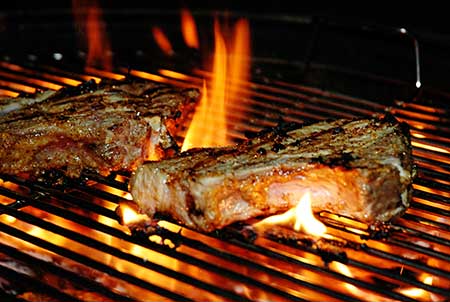
You build the fire in the grate to the side. As embers drop below, you rake them underneath the meat, which cooks slowly. Very slowly.

The wrong way to cook meat, according to South Americans

Key point for Norteaméricanos::

If the flames touch the meat, you’re doing it entirely wrong.


And another nice thing about Uruguay

From George Ure:

I’d write something clever about the primary voting today but just can’t bring myself to waste your time. And I’m gonna puke it I hear another Newt ad.

No Newt ads here. Especially since our only TV is devoted to zombie-killing and we rarely watch it, and the car stereo system has locked us out of it as a security precaution. (More fun tidbits about the Mercosur Chevrolet we’ll save for another time.)

The whistling postman

What does it mean, in February, when you hear someone whistling Christmas carols or Happy Birthday To You?

It means the postman, on his motorbike, is nearby. I thought of this just now because on a mobile loudspeaker somewhere nearby someone is playing Christmas carols: Deck the Halls, We Wish You a Merry…

Death on the Ruta

A friend of my son works in a filling station on a busy intersection of the Ruta Interbalnearia.

Yesterday he was a little shaken, having seen a man struck by a speeding car and killed.

The more I thought about it, the more confused I was. I have nearly hit pedestrians in the same intersection, when they step into the road without looking at either the light, nor to see if vehicles are approaching. The question is, how can you be hit by a car there if you’re paying any attention? Even if the light says ‘walk,’ don’t you still check for traffic?

Apparently not in Uruguay.