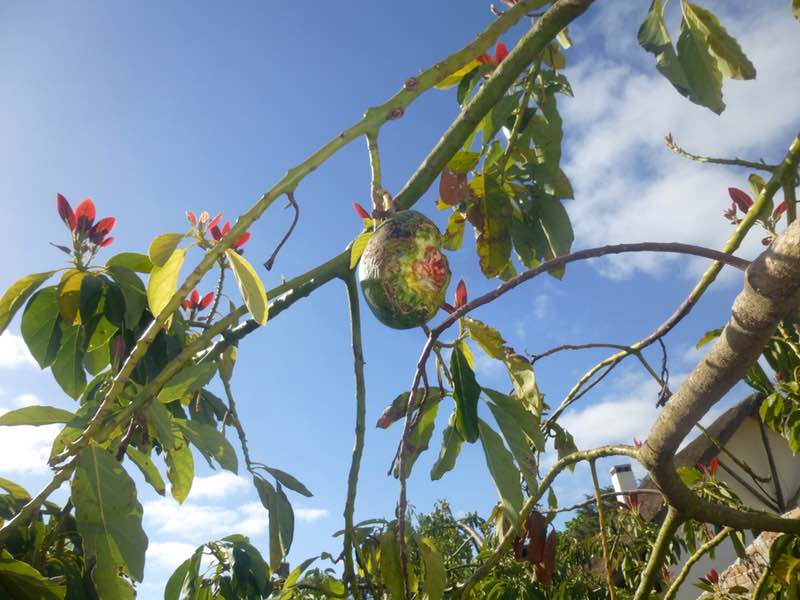
I blogged about the last avocado on the “big” tree a short while ago. Seeing the new red leaves sprouting, we both got the feeling that the “little” tree was ready to be fully harvested, so today I scampered up the ladder and removed the last dozen or so,none of which is particularly visually appealing.
And I find this quite interesting: the last avocado (because I left it there) has been eaten on the limb, the first time (happily) we’ve seen this.
Likewise, as with almost every day the past few weeks, there was another half-eaten on the ground. I left that in place as well, for the critter/s to continue their end-of-season feast.
At least for paltas (avocados) in 2018. I took the last three off the “big” tree, including one that managed to remain hidden and is undoubtedly the record-holder for this year’s crop:
858 grams, or for those of you in Myanmar, Liberia, and the Untied Snakes:
1.892 pounds. Or 1 pound 14.271999979939547 ounces. Or if you want full ‘Murkan, 1 pound 14+34/125th ounces.
6-1/2 x 4.25 inches / 16.5 x 10.8 cm.
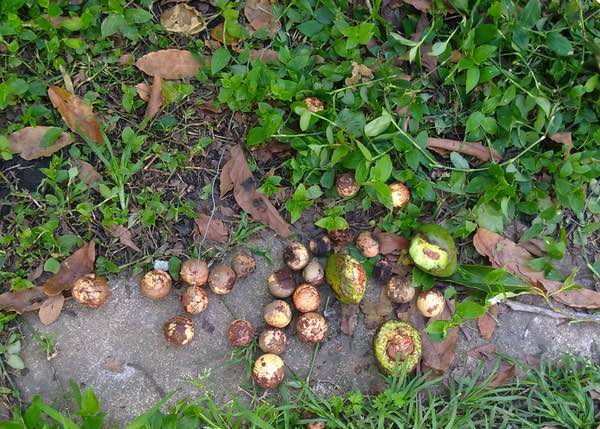
I decided that the overgrown nature of our yard needs to be addressed, and in doing so discovered the extent of the comedreja’s (possum’s) raids.
The tree above this pile still has 30+ smaller avocados. It’s fun to remember two years ago, when our total harvest was 30+ avocados, and the comedreja getting one was devastating! This year we (and friends) have had avocados for almost seven months!
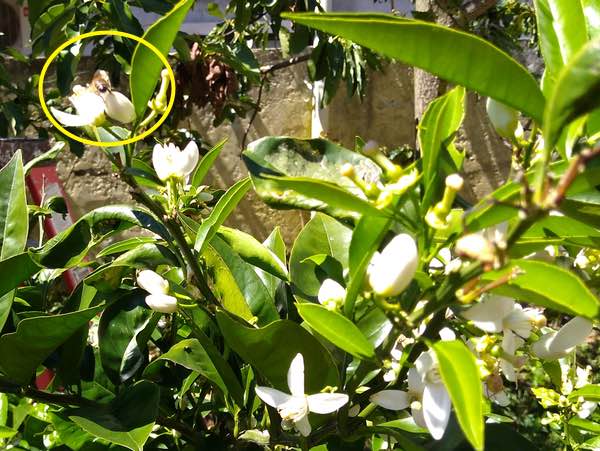
Meanwhile, both small orange trees are laden with flowers. Not very many bees, but some, and doing their job. Hopefully we get more than three oranges next year.
Last couple days, I’ve had to venture past the peaje – tool booth – a couple times, to buy tiles. A phone call confirmed that what I wanted was en stock, and the visit to pay for them confirmed, as last time, that that means “come back tomorrow afternoon after they’re delivered from Montevideo.” That’s OK: it’s not far, and I like the certainty of seeing goods versus waiting around for delivery of – whatever….
And, of course, the odd chance for cultural enlightenment. At the Costa Urbana shopping mall, which sprawls above Avenida Giannattasio and contains perhaps 157 stores selling shoes (I’m not sure an accurate count has ever been done), I saw this appalling Burger King ad, for a quadruple-cheesburger with bacon.
I have noticed that Uruguayans have gotten noticeably fatter the nine years we’ve been here. Still not perhaps up to American Standards, but definitely noticeable. But – I immediately wondered – is this uniquely Uruguayan? Something in me said yes, but that seemed unlikely.
So I went online.
This horrific “flame grilled to perfection” culinary disaster represents the maximum extent of Burger King’s US offerings: a mere 1,480 calories and 2,340 milligrams of salt.
Now let’s look at Burger King’s Uruguay site:
OK, maybe I added something. Click on that, and you can see that they offer more info about “nutrition:” this should be interesting, no?
Ah, yes…
… their further nutritional info is also maybe you’d like some chocolate-cake ice-cream thing or French fries?
The type in red is my addition: also maybe you’d like a trip to the emergency room in an ambulance?
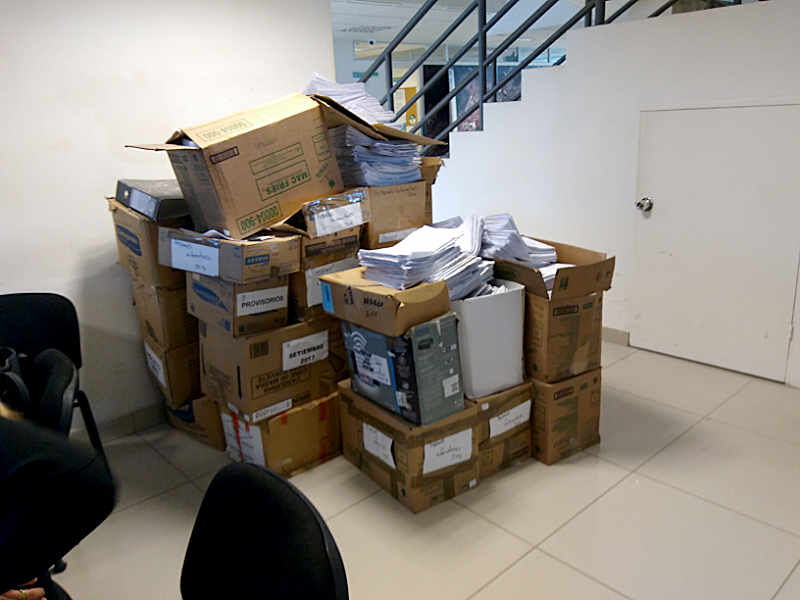
We got our new car three months ago, so this is old news, but as we were getting the license plates I swiveled my chair slight and surreptitiously took this picture.
Umm, maybe they’re – umm, maybe – who the hell knows? Is there information here that a just-another-human bureaucrat can’t access with a few key strokes?
A German friend introduced me to the term “project fatigue,” and it describes perfectly the MEGO (my eyes glaze over) feeling I get with renovations and other work proceeding at glacial (lack of) speed.
Also, when I hire someone to do a job, it is not my job to tell them how to do it. Get on with it!
And so it was that I wasn’t paying particular attention when Martín put the sheetrock ceilings in our little country house a few years ago. He used wood instead of steel framing, which I thought poor judgment. In fact, the first batch of lumber delivered was so warped and twisted he had to send it all back. When I asked, he said that if steel framing gets bent, you can’t straighten it out again. OK, cast logic to the wind:
Why should it get bent in the first place?
What about the natural tendency of lumber to warp and twist – especially the low-grade stuff sold here?
Oh, and what about bugs eating wood, which they really like to do here?
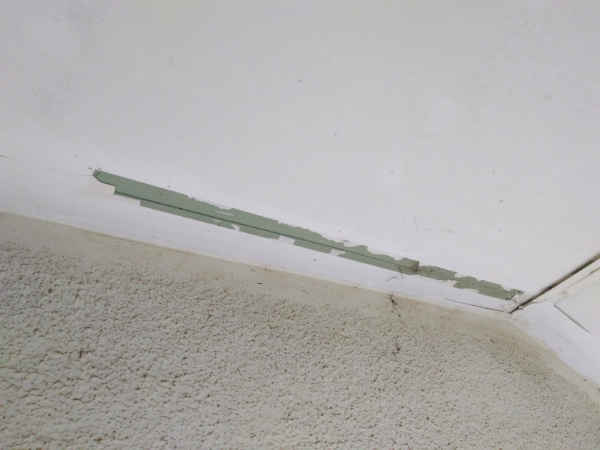
Anyway, I wasn’t there, and wasn’t paying attention, because I would have spotted this immediately. Anyone who has done anything with drywall would. In fact, you would find it incredible that someone would pretend to know what they were doing and do something so wrong.
Here’s one example of what’s happening everywhere:
The long edges of a sheet of drywall are tapered. To cover that joint, you use a 6″ knife and put a thin layer of “mud” (I’ll have to find out what that’s called here), then lay on top of it paper (or plastic mesh) “tape,” then the finish layer of mud on top of that.
What you don’t do is simply put the tape in the joint, and cover it with mud. Which is exactly what Martín – the jack of all trades – did here. What hasn’t fallen down, will.
Unfortunately, this is quite common here. Everybody’s a builder. Everybody’s an electrician. Everybody’s a plumber. If drywall is a solution, everyone knows how to do drywall.
Except that they don’t.
There are exceptions, but after nine years I am still amazed at the general Uruguayan acceptance of mediocrity. Chinese power tools with two-month guarantees come to mind. Vendors who advertise online, and take money for, products they don’t have in stock. Yet another occurrence last couple days: twice charged then revoked charge on my credit card without explanation. But I have an explanation: they discovered they simply didn’t have the product they advertised.
Es lo que hay. “That’s what it is.” Mediocrity. How unfortunate.
Not long ago, we noticed our water bill beginning to skyrocket. We had plumbers here to install whole-house water filters outside. Checking their work, they pointed out a little spinning disk that I had never noticed in the middle of the water meter. It was going spin-spin stop-stop. We had a leak. After a bit of checking, it was clearly not their doing.
After digging a dozen holes along the length of the pipe going to the casita (little house behind), and finding no moisture, I called Enrique, a nice, mellow plumber from Peru. We determined there was a leak underneath the casita (i.e., impossible to fix), so he installed a cutoff valve. At length we discussed how to re-plumb outside, tap into the cold line on the exterior bathroom wall, all without breaking tile inside – we had a plan!
Alas, perhaps Enrique has been in Uruguay too long. I said I’d get back to him when the weather got a little more pleasant for outside work. This has been a mild winter, but it’s still winter. So, sun appears! And no response from Enrique to text messages; phone calls terminated before a chance to leave a message.
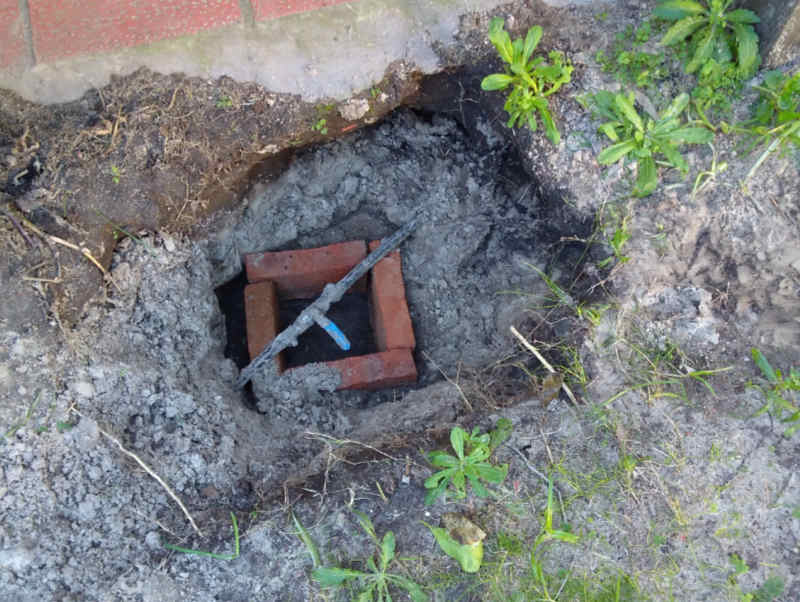
Well, we have other issues with the main house, so I sought the advice of Daniel, the guy who will be solving many of them. I had bought bricks, and was preparing to create a subterranean box around the valve.
This is how you do it, with mortar, and when you’ve built up to ground level there’s a nifty little concrete frame and cover that fir perfectly. But, I thought, if they need to re-route the tubes, maybe I shouldn’t do this first. I explained to Daniel the plan Enrique and I had come up with. He agreed with the overall plumbing plan, but hadn’t answered my question.
So I asked again. Well, he said, if we’re putting a new cutoff valve on the outside bathroom wall, we will simply remove this one.
(See title.)
Anyone need a few crappy Uruguayan bricks and a kilo of Portland cement?
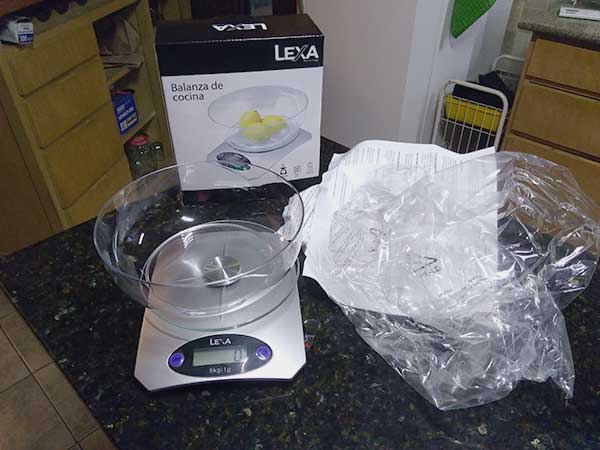
I left my kitchen scale out after making bread recently, unwashed, and some else decided to wash it – not just the detachable measuring cup, but the whole thing. Electronics and warm, soapy water don’t go together well. After a few days, it began to work again, but then simply died for good.
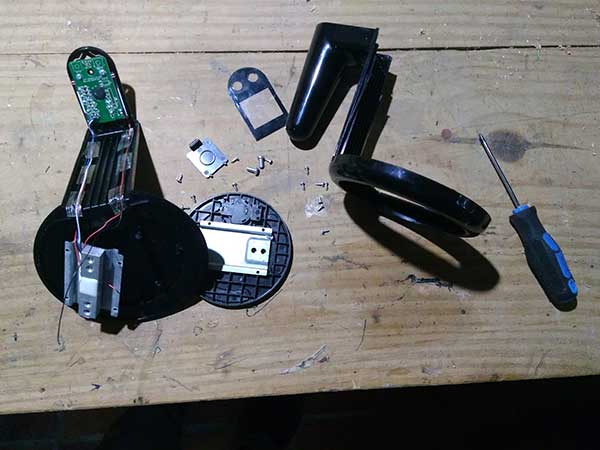
So my challenge was to take it apart without breaking any parts, because that’s what I do rather than simply chuck things. I’m curious about how things work, and how they’re put together. Also whether there might be any parts worth saving.
Despite its apparent simplicity. it was a little tricky –– some well-concealed screws beneath labels and the plastic readout cover. Nothing really useful to save.
I’ve made bagels and pizza dough a couple times since, but I really prefer doing recipes by weight, so have thought about getting another.
I bought this one with points at the Disco supermarket a few years ago, not thinking about the actual cost. Now I see they sell it at Tienda Inglesa for 40 bucks – yikes! They also show one for USD 12 at Tienda Inglesa so maybe, just maybe, I can get them to bring one to our local store. I suppose I could try ordering one online but *shudder* that has not gone entirely well for me in Uruguay (think mattress and oven).
Except for socializing at the weekly feria, I find little fun in trying to find and buy things here. But maybe that’s OK, especially when I reflect on the inordinate amount of stuff we accumulated before moving to Mexico — and that was less than three years after moving ourselves across the country, from North Carolina to Nelson, BC Spokane, Washington.
UPDATE: Yes, this does seem like a rather pointless blog entry, but it reminded me to look at Tienda Inglesa, and guess what?
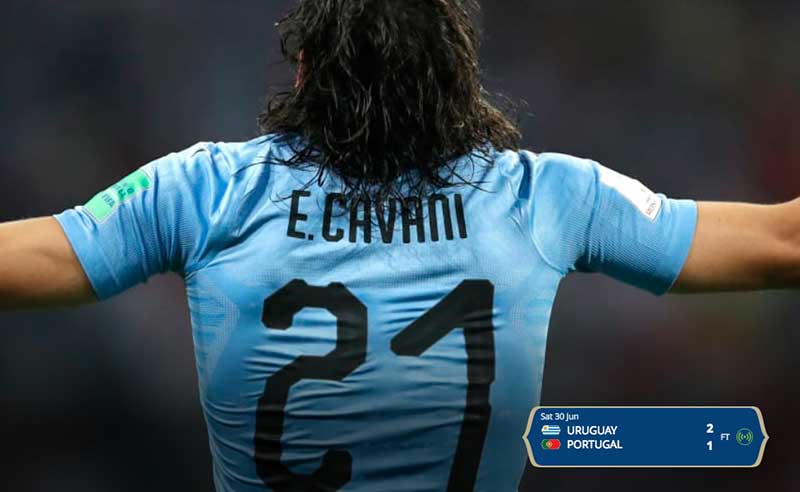
This is the third world cup since we’ve lived in Uruguay. While previous ones have been exciting, I was never impressed with the actual playing. Not so this year in Russia. Today Uruguay beat Portugal to move to the quarter-finals, and though I only watched the second half,* it was fine playing. Especially, from my viewpoint, considering how Portugal’s shots on goal almost all went spectacularly wide or high. The Uruguay defense was fabulous, and both its goals were scored, not by superstar Luis Suárez, but by Edinson Cavani. Of course a joint effort: the two strikers are quite amazing together.
Screen shot from FIFA site
Since I haven’t been walking with Syd lately because of training issues with my dogs, I subsequently took them to our chacra (mini farm) and walked the property. This gave them a chance to run around like crazy in the muddy fields, splash into the stream, and further the transition of our new Renault Duster from “new car” smell to “wet dog” smell. Whatever.
When we returned to Atlántida, I had to go on side streets because the main road was still choked — almost two hours after the game — with cars full of people waving flags and blaring horns.
Uruguay next faces France, the leader in terms of salaries of players on the national team: USD 1.1 billion versus Uruguay USD 330 million or so. France advanced to the quarters after beating Argentina 4-3. I can’t speak for Uruguayans, but I think there might be a little schadenfreude at seeing Argentina eliminated.
When the game started, I was trying to collect yet another Western Union transfer I had sent myself. I heard the first goal — seven minutes in — on the radio while waiting for an inexplicable 15 minute delay from them. Then WU cancelled my transfer inexplicably. And locked me out of their site, and claimed-to but didn’t send me a chance to reset my password. I called them, then emailed a section with no phone access, for an explanation. I hate to come across as a grumpy old bastard, but after the recent experiences with Mercado Libre (previous posts), I’m getting pretty fed up with business that promise but don’t deliver. Add Western Union to the shit list.
Resolving a little plumbing issue in the country yesterday set off a cascading series of Uruguayan plumbing memories.
Some involve sheer incompetence, some … well, let’s start with the incompetence. If you’ve been with me a while, you might remember this gem from jack-of-all-trades Nestor (because anyone in Uruguay who sort of knows one trade thinks he knows every trade). The lower patch fills the first hole he made for the horizontal vent pipe above.
A few years ago, a newcomer trenchantly reflected on Uruguayan plumbing, “Didn’t we see this in Pompeii?”
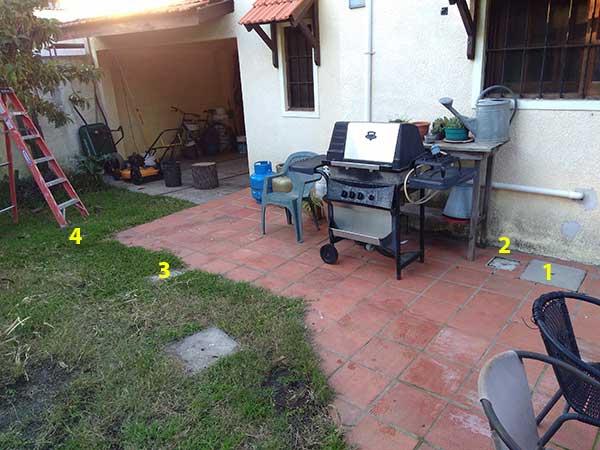
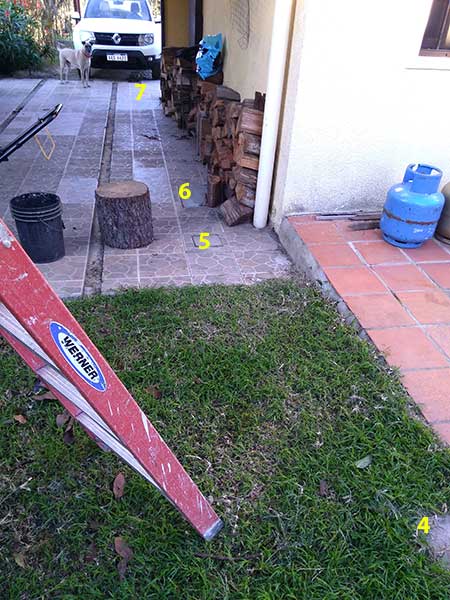
Yes, sweetie, just minus the PVC. Let’s trace the wastewater route from our kitchen. 1) First it goes into the 20 liter grasera that we had to buy to replace an 18 liter, perfectly functional, grasera. 2) It goes into another box. 3) It goes to another box. 4) It goes to another box. All of which are prone to clogging, of course, from grease that escapes the grasera..
Before we get to box #5, I should point out that boxes 3 and 4 should not exist, but this being an owner-built house, the line went from box #2 to the big unmarked concrete top, to a septic tank not in the original plans. We only discovered this when we had to “regularize” our plans three years ago (a process which maybe will be finalized this year?).
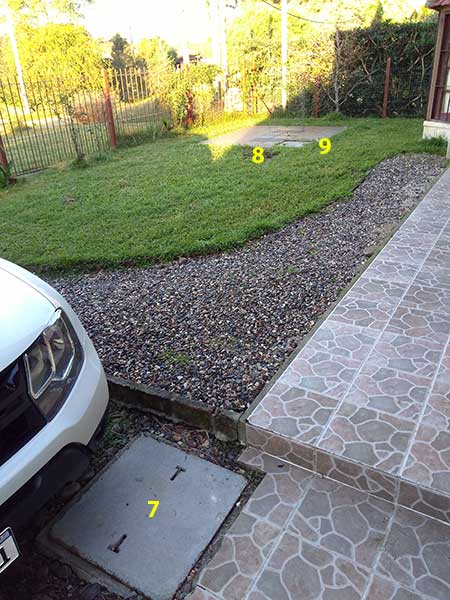
So from there the water goes to box 5, which should have been a right angle turn, to box 6, where the downspout from the upstairs bathroom and pipe from the downstairs one join the party, to box 7 …
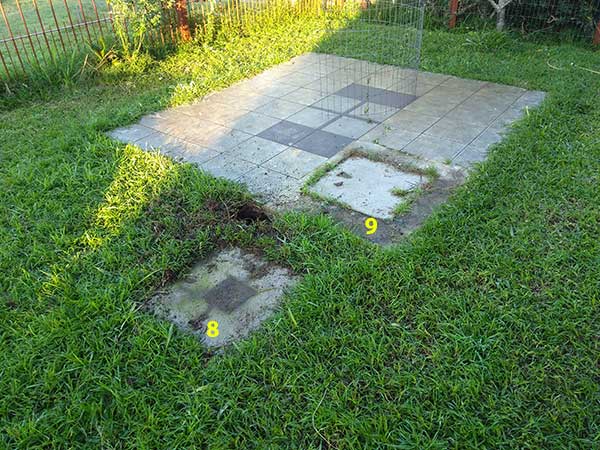
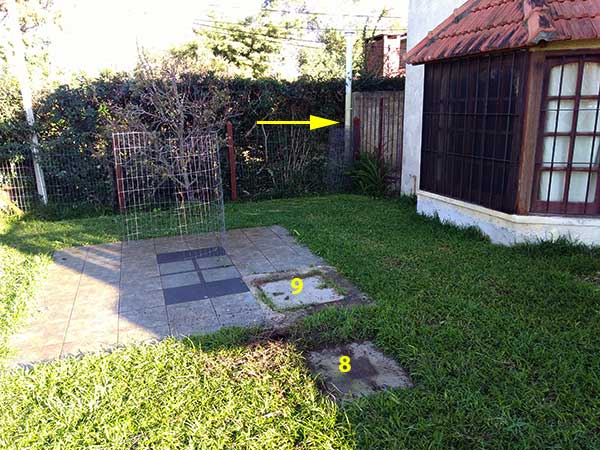
… where it makes another turn to box 8, and finally to (9) the septic tank.
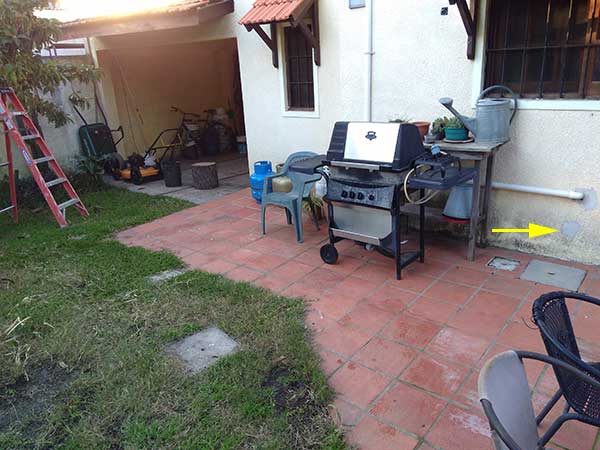
Wherein lie a couple more stories. You’ll notice a dark square in the top of box 8. That is where I filled the hole in it with concrete. When our erstwhile know-everything handyman Martín cleverly used leftover tiles to cover the septic tank, he somewhat less cleverly decided that all it needed was an opening big enough for the “barométrica” (tank pumping) truck’s hose.
When we launched into the above-mentioned “regularization,” we had to pay someone else to undo his handiwork, because an inspector had to stick his head in there to confirm that the septic tank was actually connected to the vent pipe in the corner.
That may seem ridiculous, but the same Martín cleverly solved friends’ hideously-out-of-code plumbing inspection problem by installing a couple of plumbing boxes in the yard that made sense to the inspector, but weren’t actually connected to each other. Or anything else.
We were recently the recipients of a couple of bottles of excellent Swiss white wine (thanks Syd and Gundy!), a Humagne Blanche (fascinating: according to Wikipedia, “the total Swiss plantations of the variety in 2009 stood at 30 hectares (74 acres).” And a bottle ofAigle les Murailles. Both excellent, and mostly unknown outside of Switzerland.
These bottles had corks. I generally do not rue the transition to screw tops for wine, though I admit I don’t completely understand the ecological implications.
So, translate to Uruguay (and notice this has only been a recent issue): a nice Stagnari Chardonnay, produced maybe 45 km (28 miles) away, accompanied by Camembert and blue cheese. Sounds good, eh?
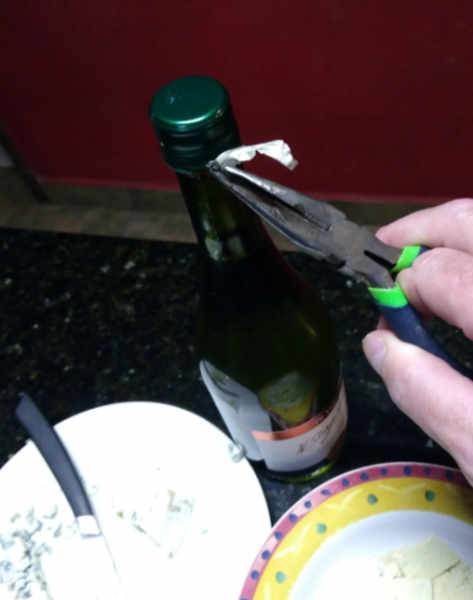
Sorry for the ill-exposed photo 🙁
Well, yeah, except for one thing: can’t unscrew the top because it doesn’t separate from the part below. Hence, we have now as Essential Kitchen Equipment a pair of needle-nosed pliers to tear the top off in, inevitably, a half-dozen or more pieces.
Q: How do you say quality control in Latin America?
A: ¿Qué?