


I asked my neighbor Horacio if he wanted to work on our common fence, figuring he would be flush with cash from the sale of all these trees for firewood. Turns out he was paid in full for them six months ago. He was doing some repairs nonetheless.
An inquisitive old fart with a camera
I asked my neighbor Horacio if he wanted to work on our common fence, figuring he would be flush with cash from the sale of all these trees for firewood. Turns out he was paid in full for them six months ago. He was doing some repairs nonetheless.
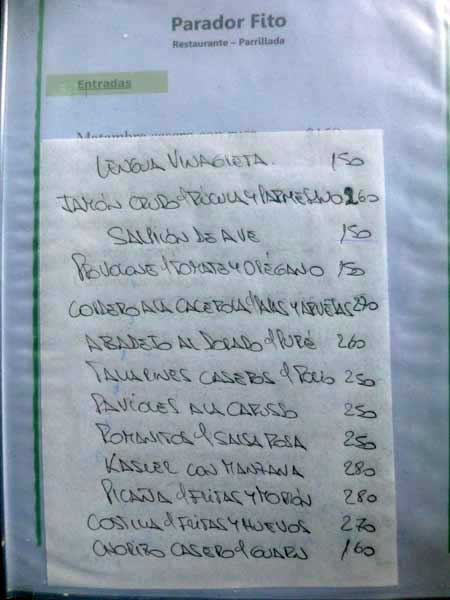
I took this photo a week or two ago. I can pretty much make out what’s available.
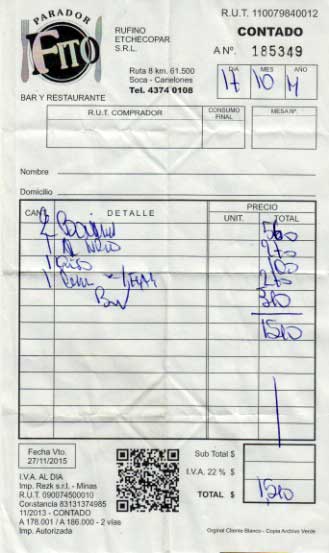
This is the cuenta we got yesterday when we went with friends. I just realized it has nothing to do with what we ordered. Apparently.
An odd sight on the road between La Floresta and Soca (34°43’38″S – 55°40’58″W):


Cold, dreary day. Warm, dreary church.


When we visited Harold and Judith near Soca, we always noticed a very unusual structure, which we assumed was a church.
This weekend celebrating the Día del Patrimonio, many things open to the public that do not ordinarily open to the public, and the dreary weather and prospect of crowds in Montevideo led to the idea of eschewing metropolis in favor of lunch at the Parador Fito on rural Ruta 8, followed by the Día del Patrimonio offerings in Soca, including the Capilla de Soca (page 56 in this thing). Turns out it’s a private family chapel.

Alas, the concrete tetrahedrons, with their bunker-like entrance, exuded anything but welcome. The handwritten cardboard sign said something about sheep (or so I figured, not looking closely since this was not actually the entrance gate, just a nicer view, and I’m used to misspellings in Spanish, especially given Bs and Vs, which are pronounced the same).
So we got to our next destination—I think—the Antiguo Cine, the old movie theater:
El antiguo cine de Soca es un emblemático punto patrimonial, es parte de la identidad local y será recuperado prontamente. The old Soca cinema is an iconic heritage item, part of local identity and will restored soon. (Which probably means, before your last grandchild has shuffled off this mortal coil.)
We went to the location, took a photo of the most likely candidate,

then asked in the nearby bakery, where the best answer seemed to be, sorry.
We then explored another unusual church (see tomorrow) where a couple from Montevideo explained that the Capilla (chapel) was closed because it was infested with bees.
When I got home, I could see in my photo the cardboard sign:

It is not possible to enter. There are ________. Closed.
Ovejas=sheep.
Abejas=bees.
Fortaleza, Brazil: So what do you do when you find you can’t get back up the sandy hill you went down with a full load of passengers to inspect a coconut grove? Unload everyone, throw palm fronds and coconut husks in the worst spots, and stand aside:
Not allowed in the “lost” minivan (we got separated and would never have gotten to our destination but for the satellite link in the accompanying armed escort car):


No, I’m not, though being in Brazil the better part of a week, I learned a few things (I was surprised how much I could understand).
Some, though, required further research: Jogue o lixo no lixo.

The trick is to know that “lixo” has two meanings here: trash and trash.
As in, “Throw the trash in the trash.”
Unhh-huh.
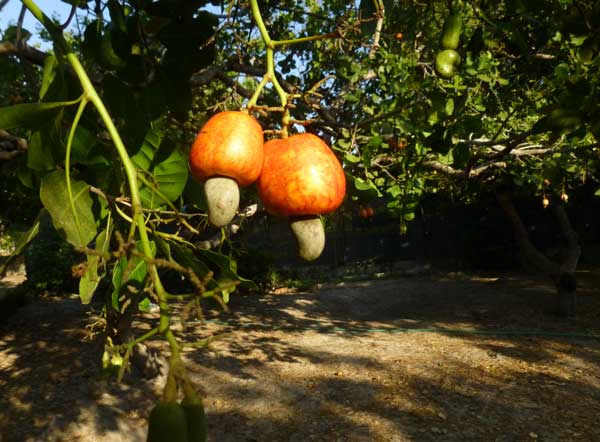
No wonder cashews cost a bit — each of these fruits has one at the end. I picked on and ate the fruit, very tasty. But apparently they can only be eaten (or juiced) fresh. So in most cases the whole fruit gets wasted when the nut is harvested.
Between Fortaleza and Sao Paulo, Brazil:

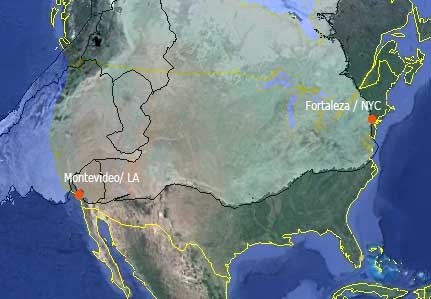
The distance from Montevideo to Fortaleza, Brazil, is almost exactly the same as from LA to New York:
You might recall that I planted fruit trees in the wrong place on our chacra. I finally got around to transplanting them: pathetically poor root structure in the impermeable soil that turns from incredibly sticky mud in the winter to something resembling concrete in the summer.
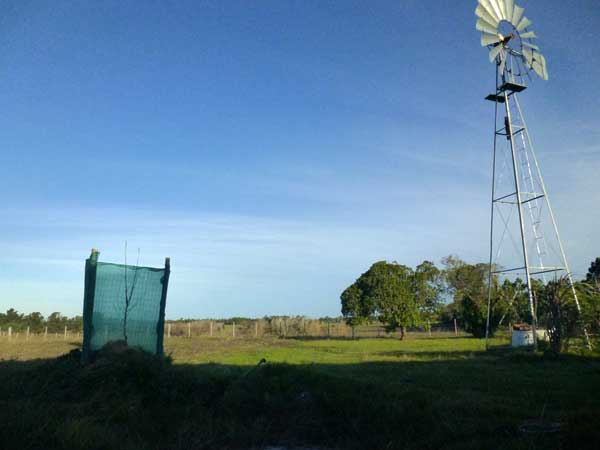
I planted one each on the two piles left from the installation of the septic system, complete with wind protection with fencing and shade cloth I had on hand.
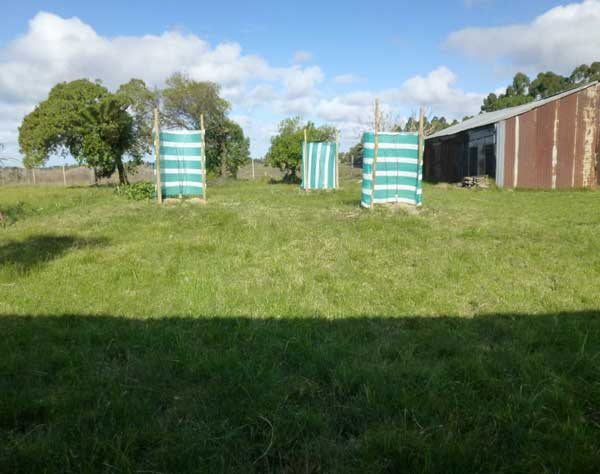
The only other shade cloth I had had stripes, so now we have this jaunty little display in our back yard. But this is by far the wettest year we’ve had here, and particularly bad for mold in houses and plants in the ground. Will they fare better in their new location?
We’ll see soon enough.