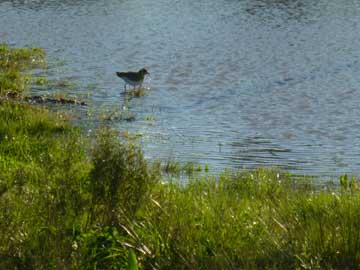
A little less tero-torial now

With the camera I have, very difficult to see subject in bright light

Tero-tero nest, Uruguay

I have not spent much time in the campo lately, and was fully expecting to see the baby tero-teros.

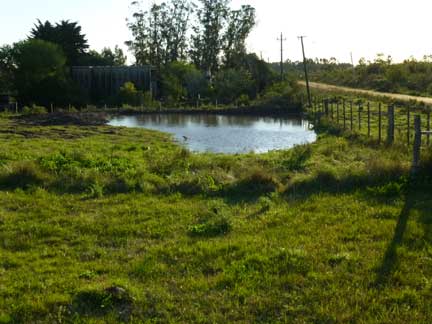
Instead, I was not greeted by noise. The teros, near the tajamar (pond), remained quiet until I approached to check the water level.

Here’s the nest. Empty. No eggs, no shells, nothing. I don’t know what transpired, but apparently we won’t be seeing little teros this summer.
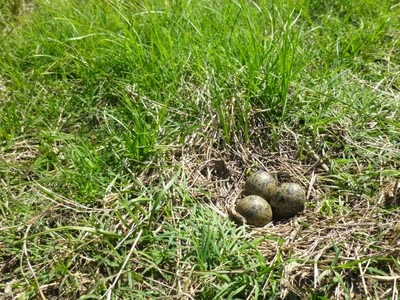
Tero-tero nest, Uruguay

Meanwhile, the water level has subsided in the tajamar with our recent suffocating heat. The grasses I planted to the left are high and dry, but hanging in there (and I learned that the second type of mystery floating plants, which I did not add, were put there by my neighbor Mañuel).

I try to keep my blogs short, so that if one is boring, at least, well, it’s short. But since we’re on the subjects of teros and water, I must relate a revelation: an Uruguayan guy about my age told me that when he was a kid, visiting his grandfather’s estancia (big country place), the teros hung around the water, in the thousands. When they took flight, they formed a cloud that blocked out the sun. With the advent of “modern” (i.e., unsustainable) agriculture, they adapted: so now you see them only in pairs, far from water, near streets, even on Avenida Italia in Montevideo. I never dreamed they could exist in a crowd.

In which I fail a simple technological challenge.

Returning from the beach, I thought I’d use the video on my camera to catch the “mewing” sounds of the frogs. I turned it on, heard better sound further along, turned it off, started it again just in time to catch a raucous call, and a loud bird landing next to another overhead in a dead tree.

When I got home, I discovered that I had turned it off when I thought I was starting it, so missed all the good stuff.

So anyway, here’s the bird:

Fruit we will never eat

The fig tree by the barn has lots of figs on it. The neighbor told me that from his three fig trees, last summer he ate three figs.

The parrots got the rest.

Apparently the introduction of tall non-native trees to Uruguay allowed birds to nest safely above the range of comadrejas (possums). So now the birds are free to ravage crops. Pigeons are equally a problem. Actually, the real problem is that both birds are dumb; were they crows, you could hang a dead one near your crop and the others wouldn’t return.

A friend hunts them, partly as a favor to a farmer he knows. Nail one or two, and there’s barely time to reload before the rest return to the exact same spot.

Bats!

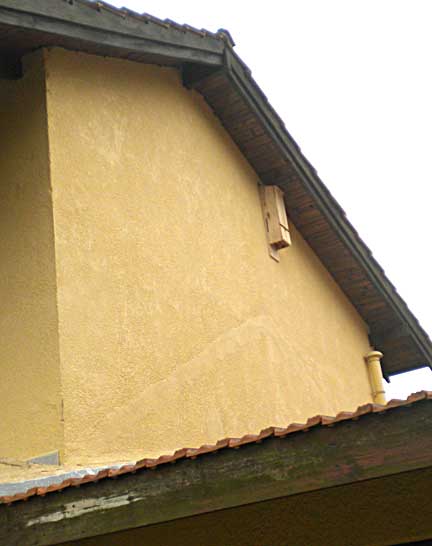
We finally determined that the scratching noises in the roof many mornings just before daybreak are the sounds of bats returning home. Bats are good. Bats in the roof less so.

So how do you get rid of bats yet keep them at the same time? The answer: a bat hotel!

Bat hotel I built for the side of our house, Uruguay

Welcome to the Hotel Murciélago!

I hope.

Frogs

The frogs are back. Some frogs, anyway.

After all the rain, I’ve been hearing them the last couple nights. They sound like frogs, which makes sense.

Except in the previous couple years, they’ve sounded like cats. Mew, mew, mew…. Our German neighbor said that when he first moved here, he enjoyed that sound of nature, but had no idea what it was.

So now we have frogs that sound like frogs, and it’s weird.