The perils of doing the “ecological” thing

metalsmith, Uruguay

Here you see the local herrero, installing the metal gate posts he promised 3-4 months ago. He has a good sense of humor, and we have a running joke about his never getting anything done on time.

I stopped by his shop the other day and spoke with his wife. He wasn’t there. I mentioned there was no hurry, since since several months had passed, though the rotting wooden posts were getting worse.

The next day he showed up, and the day after that the job was done. I know who I’ll talk to the next time I need a response 😉

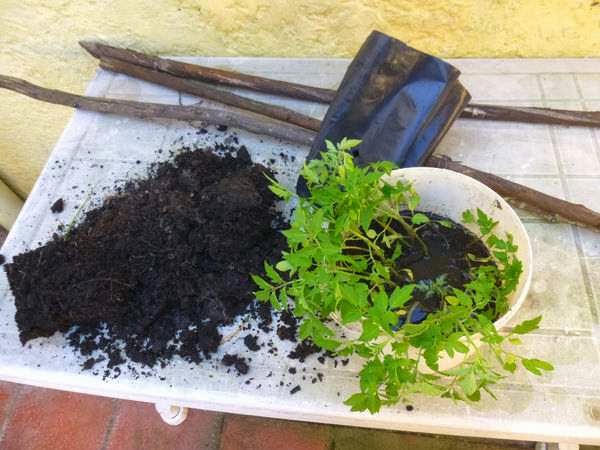
What you see in the foreground are the “ecologically” treated fence posts, that lasted (in sandy soil) perhaps three years.

Curious advertising choice

Olivo, short-lived restaurant in Parque del Plata, Uruguay

Couple years ago, a Brazilian chef opened a slightly upscale restaurant in nearby and otherwise not-upscale Parque del Plata. I took the wife to have lunch there once, and next to the sign showing they were open was a very convincing chain holding the gate locked shut. I doubt it’s still open.

I mention it today because I’m trying to clear my desk of little pieces of paper, mostly presupuestos, or estimates which you get every time you ask a price here, and came across this advertising piece for the restaurant.

Why would someone go to the bother and expense of creating these things, using a defective Google map that shows significant residential areas underwater? Boggles the mind. This mind, anyway.

The sausage machine

Inspired by local expats who have started making sausage, but not by their product or prices, the kid decided to make his own, and diligently cranked and cranked and cranked with a neighbor’s manual grinder. Lot of work.

making sausage, Uruguay

So when we found an electric one at Tienda Inglesa, we said why not and shelled out some bonus points. The kid cranked it up, and it worked like a charm!

poor quality appliance, Uruguay

For an hour. Unfortunately, not completely unexpected with products sold here.

Nesting ice trays

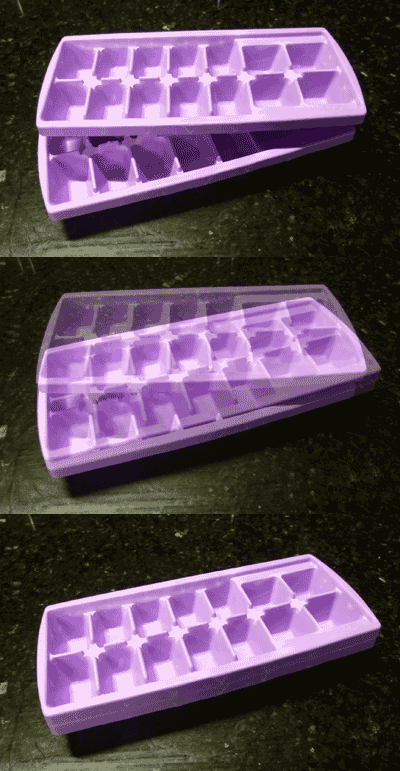
I had never seen anything like this before Uruguay. Obviously, the one time (you learn quickly) you stick a full ice tray into the freezer on top of another freshly placed ice tray facing the same way, you end up with a mess.

So why would someone design something so unpleasant for the user?

  1. Can be shipped in one-third the space,
  2. No one is accountable, and
  3. No one but the end user cares.

I know (from experience with other products) that were I to take this to customer service at Tienda Inglesa to point out the user-unfriendly design, the girls there would simply explain to me how to stack them “properly.”

If you live in Uruguay, you have to get used to the idea that there exists very little expectation that goods will be well-designed, well-made, or durable. The amazing thing about these lavender-colored ice trays, however, is that they haven’t broken, and most of the time ice doesn’t stick to them. Unlike the red and blue ones, which yield shattered ice only with a struggle, and tend to break in short order.

Discovering how well they worked (stacked “properly”), I went back to get more. And found only red and blue ones. And have never seen the lavender ones again.

Have tajamar, seek water

After yesterday’s pozo negro, our friendly backhoe (retroexcavadora) operator started in on the tajamar, or pond (background) in the local lingo, which we hope will fill with runoff water, for which here he’s digging a diversion channel from the road. ‘Tis an experiment; I’m not sure rainwater will be enough, but we always have the windmill, and by now a considerable length of hose, since I planted out fruit trees far from the house.

Backhoe carrying motorbike, rural Uruguay

Last night he parked his backhoe at our neighbor’s, because someone lives there. He left on his moto, and I was wondering about the logistics of that.

Lo me encanta, I said as I watched him strap the moto into the bucket as he prepared to leave. I love it.

Uruguayo, he replied, beaming, of course pronouncing it ur-u-GUA-zho.

Refrigerator redux

magnet-covered refrigerator, Uruguay

In addition to the powerful magnet that came out of a broken chargeable flashlight (upper left), our refrigerator is festooned with magnets handed out by local businesses. The little blue half-garafa (propane tank) I actually found in the street but thought pretty cool. Outside of paper ads, held in place by other merchants’ magnets, there is only one non-magnet on here. Can you guess?

The guys who fix refrigerators. They put on a sticker.

Living in a limited marketplace

refrigerators, Uruguay

People who move to Uruguay from consumer societies tend to get frustrated and complain about the lack of variety, and generally poor – no, make that piss-poor – quality of consumer goods. With reason.

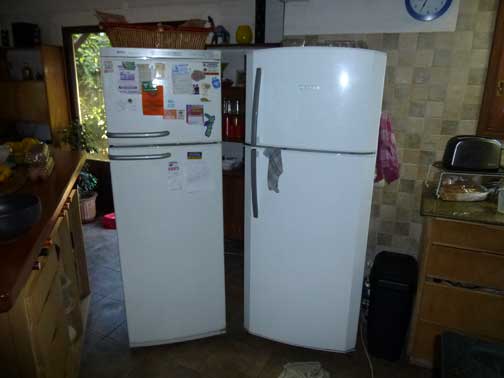
We bought the refrigerator on the right new, the one on the left used from someone now a friend, who we now know spent a great deal of time and effort getting it repaired before selling it (he was leaving the country). Both are products of Bosch, a brand I had considered quality. No longer. Three of the door shelves have on the new one have broken, and it has been the object of a repair visit before.

Last night it stopped working. This morning it started working again, but not before we had brought the other from the casita (little house), and transferred all the contents. And called the repair people, fortunately not early responders so I was able to cancel.

But seeing them side-by-side reminds me of one of the oddities of this limited marketplace of 3.5 million people. Notice how both doors open to the right? So does virtually every other refrigerator sold in Uruguay. Can the hinge side be switched, as in North America? No. Same as with virtually every refrigerator sold in Uruguay. On ours, we could switch the hinge side, but without a way to move the handles, it would be just a bit awkward.

As a result, we designed our still-unfinished kitchen in the campo around a refrigerator whose door only could open to the right. Strange to imagine someone up north doing the same.

Finally, a real load of really dry firewood…

stacked firewood

For the first time in several deliveries of firewood, it actually looks the full amount promised.

firewood moisture

And, to my delight, almost all appeared to be under 20% water. The two observations have an important connection.

Strangely (especially for such a humid area), firewood is sold here by weight. So (keeping it simple) if all the wood were 20% water, you pay for 200 kg of water and 800 kg of combustible material. When I did some readings at woodlots a while back after a couple days of rain, some were showing 35% water. “Oh but don’t worry,” they told me, “it’s just because of the rain. It’s been dried, and it will dry out again in a few days.” Meanwhile please pay the same amount for 350 kg of water and only 650 kg of combustible material.

The logic of which either escapes, or doesn’t concern, them the least.