Uruguayan parking

Uruguayans are horrible drivers

While in Connecticut in September, I picked my brother up at the airport. Driving back, I was amazed at cars driving inside the lanes on the interstate, and signalling to change lanes. Finding myself in the midst of a fairly empty stretch, I said, “I’ll show you how we drive in Uruguay,” and started to switch lanes, but only enough to perfectly straddle the line between two.

“What the hell are you doing?” said my brother – who, for the record, is legally blind.

“Driving like an Uruguayan,” I replied.

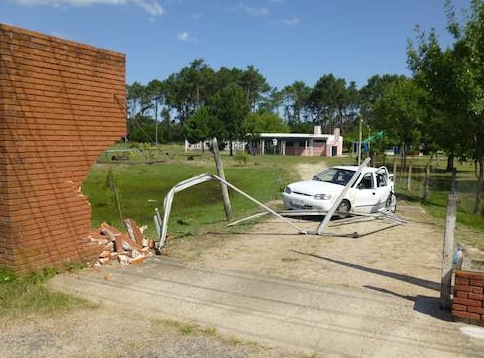
Today, shortly after an expensive car nearly clipped my fender in the process of creating a third lane in the middle of two eastbound lanes (hey, after all, it is Friday of New Year’s Eve weekend and we’ve got to get to Punta del Este!), I saw this car with Punta plates, which apparently left the highway at significant speed to travel so far and do such damage to the entrance of a children’s recreational area.

I don’t know the details, or what other vehicles were involved, but I can say with some certainty what happened was 100% the driver’s fault.

Here come the Porteños

0121206

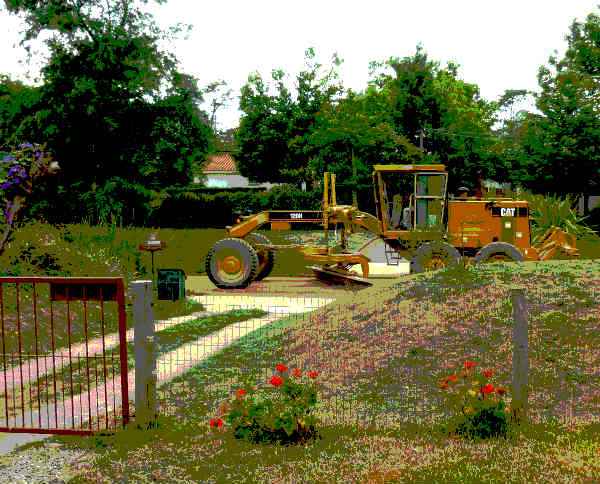
Actually, smells like rain. But the sight of this rig reminds me – despite the un-summer-like weather today – that we will soon be inundated with Argentinians. Summer season starts in a week; continues through March, with another hiccup for Easter.

Can’t subject the visitors with money (they hope this year, given Argentina’s current cyclical economic crisis) to the potholed, rutted roads that tear our vehicles apart the rest of the year….

Since most of the Argentinians come from the port of Buenos Aires, they’re referred to as porteños – best not to their face, methinks.

Escombro

escombro

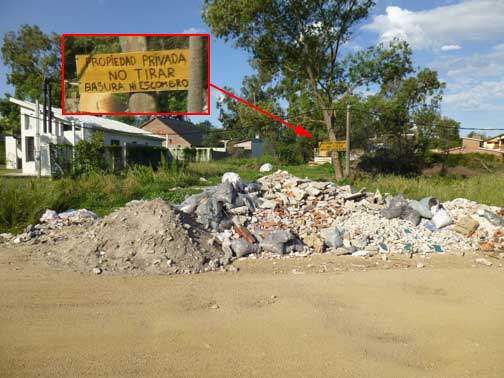
About a month ago, I noticed someone had dumped some construction rubbish in the road near us. Then I saw a backhoe moving it onto the lot, which had clearly been very wet during the recent rains.

And a sign: Se recibe escombro. (Clean) fill wanted. Escombro refers to bits of what houses and such are made of: brick, concrete, tile.

From that, now this ungainly mess, including plastic. And a new sign: Propriedad privada – no tirar basura ni escombro. Private property. Do not dump garbage or construction waste.

More ironic, the rather brutal potholes in the road. In five minutes, someone with a shovel and wheelbarrow could fill them, with the material right there. No one has. I would (did once before) but my wheelbarrow is in the country. One of these days….

Mold

moldy wall in Uruguay

Given a combination of brick walls, poor construction (this is underneath a terrace that ‘sort of’ drains), and warm snaps during cold weather, Uruguay offers the perfect combination for growing mold on walls, shoes, and just about everything else.

Looking at building a house in the country (hey, what’s the problem?), we’re interested in alternative construction techniques.  One is steel framing. They call it ‘dry construction.’ A new and exciting construction technique for Uruguay!

Not everyone, it appears, is convinced. A friend tried to explain the virtues of building with insulation to an architect in Montevideo. He put his hand on the wall, and said that in the winter up north, instead of being cold, the inside of the wall would be room temperature. To which the architect replied, well, you can turn on a heater.

As another friend points out, turning on a heater in a damp brick room is the best possible way to accelerate mold growth.

Another boring blue sky day

blue_sky

View from our ever-cluttered dining room.

Blue sky? Actually the morning dawned dull and gray.

However, weary of looking at the drab wall of the neighbor’s garage, that faces us and that only we can see, I painted it sky blue (celeste) the other afternoon.

Mauro (of the weird haircut and motorcycle accident) cackled in delight as he did when I fixed his motorcycle at the idea of my painting part of the neighbor’s house on a whim.

By noon, by the way, it was a beautiful blue-sky, chemtrail-free sky.

Small and unexciting

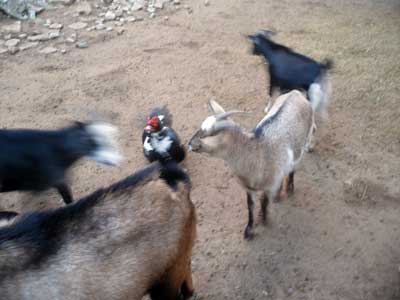
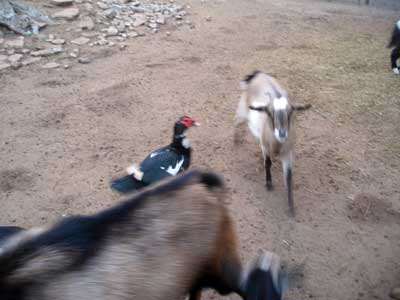
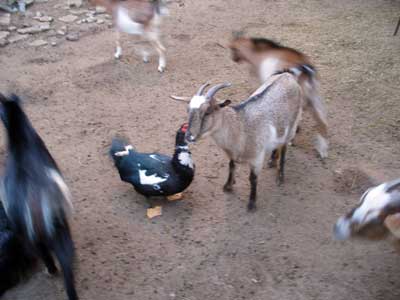
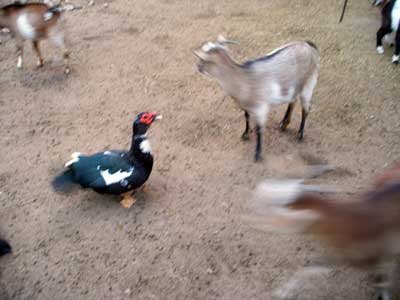
The dogs had fresh bones and did not want to leave the yard. So I walked on my own, pausing longer than usual at the goats’n’geese (and apparently now a duck) enclosure at the local zoo, which the Bradt Urguay Guide (first and only in English) dismisses as ‘small and unexciting.’

Well, yes: I read the headlines. Looming economic, environmental, and political catastrophes on a scale that boggles the mind.

Small and unexciting? I have no problem with that.

Goats and duck in Atlántida, Uruguay zoo