Aloe (pronounced as a Canadian might say, aloe, eh) vera grows in abundance here. Today I saw another first in seven years: its harvest.
Turns out they sell it to a laboratory that turns it into a skin product. For exactly what application I couldn’t catch. Uruguayan Spanish is not generally spoken in a crisp, clear way, and the guy at the truck, while friendly, was a little hard to understand. Anyway, they get USD 0.68 per kilo. Sounds like farmers grow fields of it. It wasn’t clear the connection between these guys and this little stand of aloe, apparently on private property in town, right off the main highway, the Ruta Interbalnearia.
Aloe is all kinds of good for your skin and more. Nice plant to have in the backyard, which we do. Easily planted, like so many things here: lop off a chunk of plant and stick it in the ground.
I spent enough years in the USA to be predisposed to a gung-ho, get-it-done attitude, and a respect for quality products and services, so a couple of things here stand out for me.
Tolerance of mediocrity: Chinese electric hand tools with a two-month warranty that cease operating after three, for example. Well, you might say, it’s poor country. And you’d be right. But you won’t find anyone here who disagrees that lo barato sale caro — false economy: cheap things end up being expensive. *Shrug* Es lo que hay. That’s what it is.
Lack of situational awareness: as with people at peak season who pause in the exit door of the supermarket to have a conversation, or bicyclists, motos, or pedestrians who cross streets without looking. And let’s not forget cars.
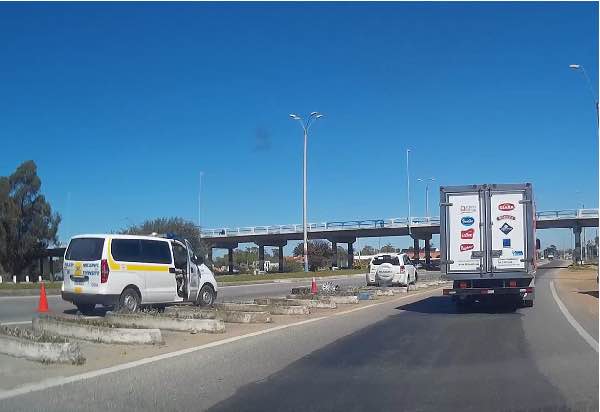
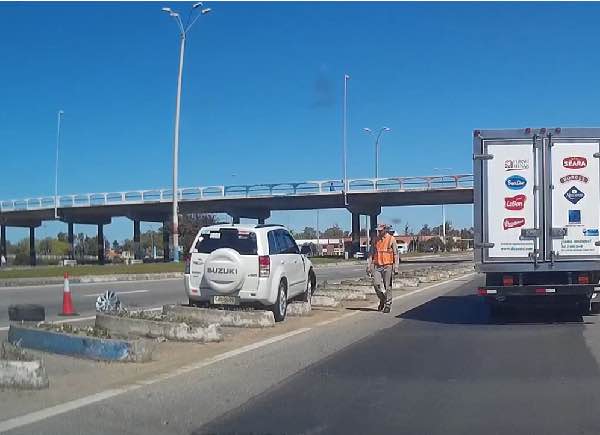
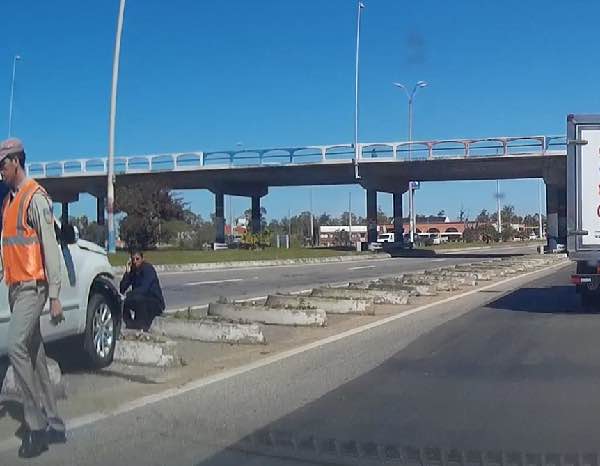
Here’s a photo that presents a lovely illustration of both.
The lady who apparently owns but doesn’t live at the end of Syd’s block had a hissy fit about the growing brush pile on her corner (but on the town right-of-way). She decided an appropriate response involved tearing the pile apart so that brush blocked both streets. Who did what next remains a mystery, but last week we returned from walking dogs to see two guys loading brush into a truck. Leaving Syd’s 5/6ths of the dog pack inside, we walked down to see if they’d be similarly taking away the 2+ year old brush pile next to Syd’s house. They indicated they would. Excellent!
They added that the current brush pile would require a second trip.
What you’re seeing in the photo is, left side, the remaining half of the brush pile. The blue and white stuff beyond is the non-brush trash that they carefully removed from the brush pile. The blue thing beyond that is (and was) an empty trash container that could have easily accommodated the trash they separated from the brush pile. But apparently for them when your job is to pick up brush, it doesn’t include leaving the street clean.
The rest of the story, as you might guess, is that they haven’t been back.
I’m guessing they will. Eventually. Meanwhile, es lo que hay.
It’s a perspective thing — the bucket is over half full.
I haven’t determined exactly how I’m going to incorporate fish waste into my close-to-totally-disorganized garden, but it will have to be dog-digging-proof. I have decided to make a substantial fence. But deciding is short of doing, and we happen to have a puppy who likes to dig — and meanwhile no fence.
Beyond remembered tales of American Indians dumping a fish head or carcass below each corn plant, my fish-in-the-garden story is this: shortly after arriving in Mexico in 2007, I attended an organic gardening class by a massively overweight American woman who happened to be very good at growing things. Actually, exceptionally good. She was also an outstanding cook and baker, and, unh huh, liked to eat. She had a plastic-lined pit in which she made compost tea from fish, and shared her secret source. There was, she said, at the end of a short two-block street that ended at the railroad tracks in Pátzcuaro, a place where they processed fish from the lake. You had to knock on an unmarked door, have containers, explain your request, and then, Hod willing and goods delivered, back out the two blocks, because there was no way to turn your car around.
Sorry, that’s above my pay grade.
She also explained how they cultivated contacts in the daily mercado for composting. They had to they dress down, relate to the locals, develop trusted relationships in order to get the valued vegetable waste. Wow. Heavy social investment.
Reference: there is no way a home gardener can get enough compost from home vegetable waste. You need organic materials from somewhere else.
Anyway, visiting a project of ours on Calle Independencia near the cemetery in Pátzcuaro, I discovered something amazing: garbage trucks appear there every afternoon. Guys with hand trucks and 55-gallon barrels go into the market and bring out the waste. I showed up day after day, with a plastic tub like the one I bought here, and soon they wanted to know before they went into the market: was there was anything in particular I favored? Onion greens? Carrot tops? It was deliciously ironic.
But it got better.
One day, a little truck pulled up. Fish waste. From the fish place. You know, the one where you had do a little ritual of obscure door-knocking and reverse-driving. I said to the garbage kid (remember, I’m an old fart, so everyone is a kid), fish is OK in the garden, eh? and he enthusiastically agreed and personally took my plastic tub to the truck and proudly filled it with fish heads and bones and guts, and placed it in the back of my several-years-old Toyota 4Runner.
Fortunately, I had a plastic-rubber floor liner. Because, in his enthusiasm, the kid had maximally-filled my plastic tub. And despite my caution, over the first tope — speed bump — I heard the flop of a fish carcass. On the next another. No matter. I could always hose that stuff off.
The problem arose — as today — when I realized that I had arrived home shortly before dinner time and actually had to do something with this treasure. In Mexico, it involved feverishly turning over my extensive compost pile, inserting fish waste, re-covering and weighting down plastic sheeting so our animals couldn’t get into it. It worked. And apparently fertilized magnificently, but by then we were the hell out of Mexico. Another story that I probably won’t tell here.
Meanwhile, here, a couple concrete blocks over the bucket this evening. Tomorrow? Stay tuned 😉
Thanks for reading this. Gardening is weird at times, no?
As in 2012, we’ve had some pretty serious wind the last couple days.
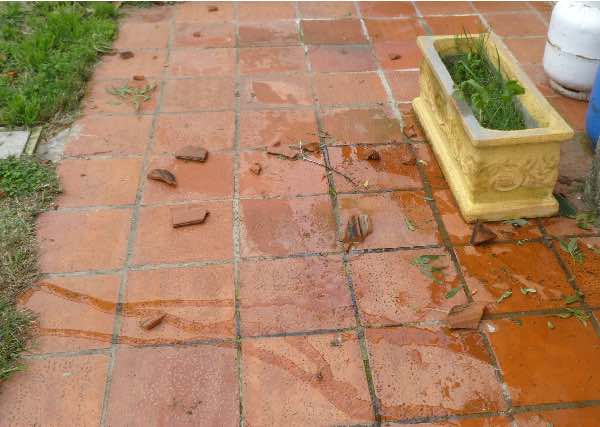
Yesterday evening, between two trips to the garage to get firewood, a couple of clay roof tiles blew off, landing directly where I would have been walking. (I still haven’t replaced the couple from the front that blew off in 2012, given the height of the roof.) I felt a little lucky.
Especially when, from upstairs this morning, we saw that a neighbor has suffered slightly more roof removal.
When we first saw it, the white area top center was a hole completely through the roof.
Not much more visible from the road. I don’t know what the roof was, but obviously not very sturdily built. And equally obviously, not a good idea here to build that way.
The best rule for driving in Uruguay is to try to watch every person and vehicle — pedestrians, bicyclists, motos, and other cars and trucks, constantly imagine the stupidest thing they could do — step into traffic, swerve in front of you without notice, run stop and yield signs — and plan for it.
In this case, I might have been distracted by the conversation and so didn’t see the approaching out the side window. Fortunately, the passenger’s field of view allowed her to see it before it cleared the A-column for my view, and warn me. Locals will recognize the voice 😉
When we bought this vehicle in 2010, the blind spot was one of the more pronounced criticisms I could find online.
The triangle caused by the A-pillar split should be helpful, but since my eye level is near the top, it provides no help. Still, I have most often had problems with the passenger side, so perhaps I had a lapse of attention.
Which — when driving in Uruguay — can prove expensive, dangerous, or worse, as perhaps you can imagine.
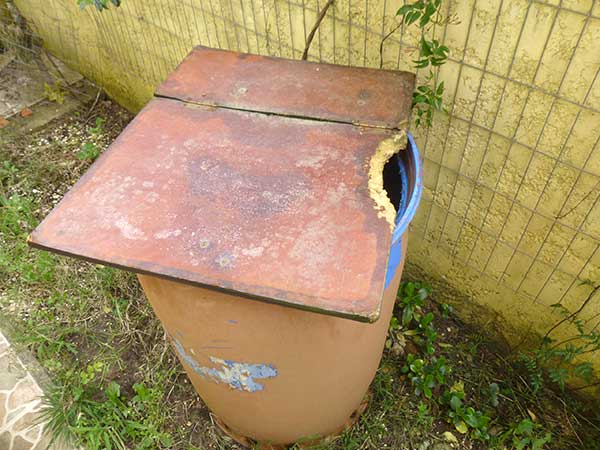
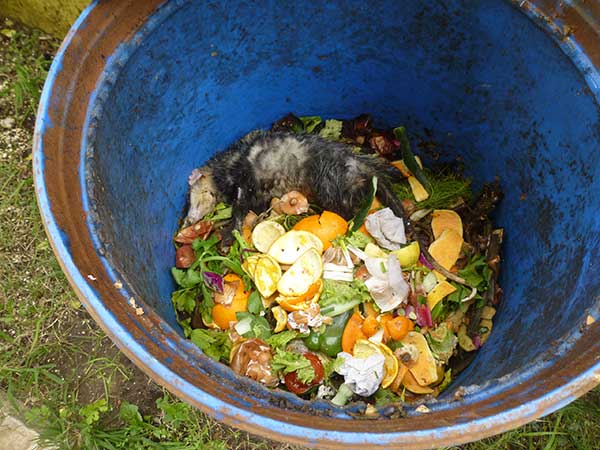
It’s been clear for a while that a comadreja (possum) had been getting into our compost barrel.
Its last visit was indeed its last.
Since lately I’ve only taken compost out after dark (without a light), I don’t know how long it had been there. But I expect I would have heard it moving when I emptied scraps on top of it. The last time this happened, I actually tipped over the barrel so it could escape.
Atlántida can be a (relatively) noisy place — sometimes I refer to it as “Alarmtida.” In addition to regular and specious security “threats“ duly announced by neighbors’ alarm systems, we have weed-eaters, gas leaf blowers, lawn mowers, and chainsaws. The chainsaws have been mosquito-annoying persistent for a couple days. My wife had a revelation today, when all of a sudden her upstairs office lit up for the first time in the winter afternoon sun.
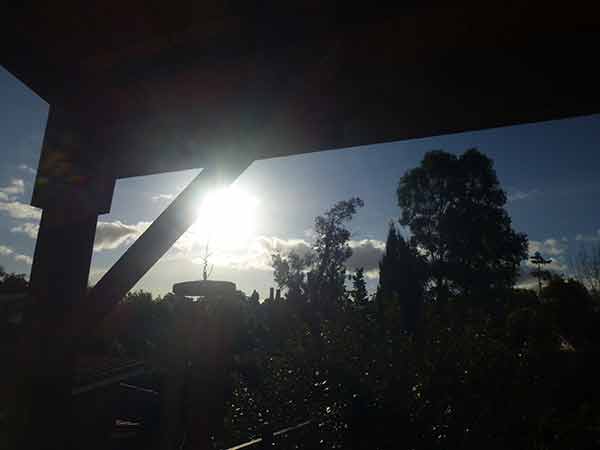
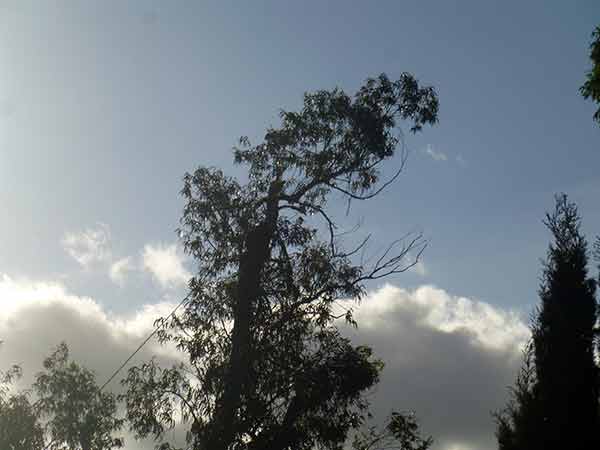
Turns out the neighbors spooked (perhaps) with the latest windstorm, and decided to remove a eucalyptus tree or two towering 40 meters or so to our northwest, where it/they blocked a significant amount of our afternoon sun (when you live in the south, the sun’s in the north).
A little hard to convey in pictures, especially when your point is, “Hey, the sun’s not blocked there anymore!”
From the balcony upstairs, outside my wife’s office window.
Most of the way up the tree in the middle, a guy with a chainsaw negotiated next moves and lowering of cut branches with the crew on the ground.
Seriously, there’s a guy in there somewhere with a freaking chain saw — about where the rope comes up from the lower left. At this point, half the tree horizontally has gone, and probably the top quarter of what remains. The neighbors will have a few years of firewood out of this. Good on ‘em (and thanks)!
The arbor vitae in the foreground doesn’t show from this sunset photo in June 2014.
And because it’s close, looks equivalent in this photo I took tonight. It’s not (notice the twin stumps of the removed tree, just left of it). This represents a huge, and wonderful, increase of light into our back yard. Sun glaring in the kitchen window — a new winter afternoon treat!
The microclimate of our back yard has just changed, for the better in terms of gardening, perhaps more challenging in terms of mitigating summer heat.
I noticed some school girls running up the pedestrian bridge yesterday. That bridge and another are some of a number of improvements we’ve seen in almost seven years in Uruguay. Granted, sometimes nothing is budgeted for repair or maintenance (see here and (yikes!) here). And the engineering — well, perhaps that’s too strong a word — leaves something to be desired.
Early this morning, I took the-dog-that-cannot-get-too-much-exercise with me to leave our car for an oil change. An excellent opportunity to experience that bridge for the first time (and very exciting for the dog!).
Alas, the Uruguayan acceptance of mediocracy rears its ugly head again. Yes, that’s a puddle. On a dry day.
But the bridge appears to be solid, which can’t be said of much of the decades-old infrastructure where I came from. Just before we moved to Uruguay, the History Channel did a 2-hour piece on the infrastructure of the United States. It’s the only long video on Youtube I’ve actually watched from beginning to end in one sitting. Highly recommended: The Crumbling of America.