Dealing with it

The connection between Bangladeshi refugees and Uruguay

When we left for Argentina, I unplugged my wife’s computer backup power supply. The switch jammed, so it had to remain plugged into the wall or go beep every five seconds until the battery ran out. Out of respect for lightning, that’s what it did.

Weeks later, I got around to disassembling it, and discovered that the button got its ‘spring’ from two little plastic hooks, one of which had become displaced. I fixed it.

This morning, faced with the same problem, I took it apart once again and simply tore out the plastic switch. New rules for the UPS: take a pen or finger and push white microswitch directly.

I spare you a closeup of the bar code label indicating country of origin, because after all everything is made in China.

But as our friend Patrick in Colonia explains, the Chinese make top-quality goods for consumers in first world countries. They make second-rate, but more affordable, goods for developing countries.  Then they make crap of such low quality that Bangladeshi refugees would refuse it. And that’s what they ship to Uruguay.

If that’s a complaint, it’s not limited to expats. Uruguayans say the same, in different words: lo barato sale caro – the cheap stuff ends up being the most expensive.

The Wayback Machine

Cold this morning, but we didn’t light a fire since we were out the door to Carrasco, Montevideo, for blood work. The Montevideo airport’s name is Carrasco, but Carrasco is also quite a charming beachside community. Going to the clinic there is a satisfying experience in every way: civilized, professional, pleasant. A total contrast to the dreary clinics in the Ciudad de la Costa, closer to us.

If I had to live in Montevideo, Carrasco would be my choice. Whether or not I could afford it – another issue.

carrasco

Bright, sunny blue-sky day. Almost home, we stop to get gas. No need to get out of the car. Attendant fills the tank, without asking does a thorough job of washing windshield and back window. I usually tip 10 pesos (half a buck). In this case I give him 20. Some attendants ask if you want the windshield done (because they don’t want to expend unnecessary effort); others don’t even bother.

One of my son’s friends worked as a gas attendant for a while. Interesting stories. I know the tips are appreciated, and not always forthcoming.

I ask about a bus company’s location – we know one but not another, and find it challenging to sort out which ones run when to Montevideo. The attendant asks me to pull forward, away from the pumps, and goes to ask another attendant. Comes back with no clearcut answer. But he’s happy to chat, and offer suggestions for ferreting out info I need.

For an American, it’s like going back in time. In a nice way.

Forty five, schmorty five

I called the guy who installed our Ñuke wood stove (two years ago) to clean the stove pipe. He finally showed up.

First he cleaned the stove. Then, unable to cleanly remove the bricks of the upper combustion chamber, he broke them in order to gain access to the stove pipe from the bottom. His cleaning tool: 1/2″ flexible black pipe with some wires stuck in the end.

He couldn’t get it past the second elbow. So they’ll have to clean it from the top. And replace the bricks. Some day.

I asked them why they didn’t use 45° elbows originally, which would have worked a lot better.

They were supposed to be, he replied.

As someone (was it me?) once quipped: How do you say ‘quality control’ on Latin America? – You don’t.

When the rain comes

When the rain comes, they run and hide their heads. They might as well be dead.

~ Rain, John Lennon

It rained much of the night, and the morning was unpleasantly rainy still. Our son went to catch a bus to his class in Montevideo.

There were no buses.

No strike, no holiday; simply no buses on the road in ugly weather.

My wife called the friend who agreed to translate for her at the hairdresser. Let’s do this another time, the woman said, it’s ugly today. This despite door-to-door transportation.

Perhaps the bus drivers knew no one would go anywhere, so they stayed home too.

My best guess is that people here have learned to avoid the risk of getting wet, and consequently chilled, because homes here aren’t built to be warm. There is evidence that this has a historical basis (1897):

In the winter, their surroundings are equally pretentious, but very uncomfortable, for the houses of Montevideo are as frigid as the white marble in which they are finished. The people believe artificial heat unhealthy, and in this city, which is as large as Washington, and quite as cold, there is not a furnace or a steam-heating plant. During cold snaps, a hostess often receives dressed in furs, with her hands in a muff and her feet on a hot-water bottle, and gentlemen and ladies come to state dinners in over-coats and fur capes. Source

Little brown waves

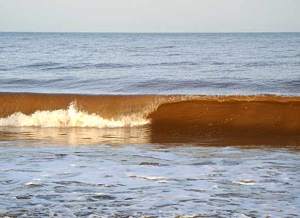
Little brown ocean waves, Atlántida, Uruguay
I’ve never thought of myself as  beach person. The thought of hanging out on a beach for hours makes me a little numb. That said, I love being able to walk to, and on, the beach daily. During summer – January and February – it has to be early or not at all (and I will find sun-worshippers at 8 AM). Off season any time of day works.
But there remain two issues: 1) the waves are tiny, and 2) they’re often brown.

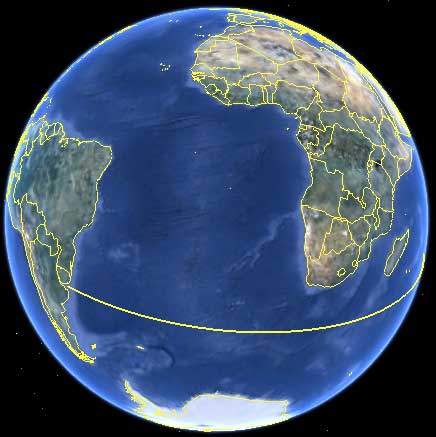
1) Why are the waves tiny? Theoretically, you could sail in a straight line from Uruguay over 16,500 kilometers before making landfall (and you’ve always wanted to visit Myanmar, no?). That much open ocean and diddly little waves? Why?

Lots of water

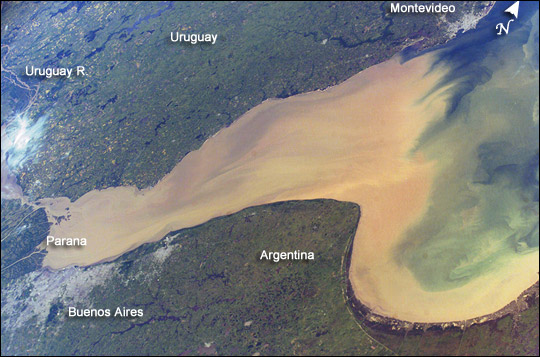
2) Brown waves – let NASA tell the story (even if they can barely get within 90 degrees of correctly identifying north).

On the day of this photo, we enjoyed blue or green waves ‘north’ (actually east) of Montevideo. A little change in current and winds, and you have brown waves.

Sometimes we have fresh (brown) water; sometimes we have salt water at the beach. So sometimes the fisherman catch freshwater fish, and sometimes saltwater fish. And sometimes the wrong ones get caught in a shift, and their carcasses end up carpeting the beach.

Today’s project: build an ugly table

Beautiful San-Diego-weather kind of day.

Today’s project: turn remains of crappy wooden gate we replaced into a table to replace the crappy plastic one we bought.

No, I have no dark stain to finish it (and no buying any: it’s Sunday). Yes, it is ugly. However, it also has significantly more weight than the plastic one, so that when bearing things like wine glasses that can easily topple, it is less likely to end disaster because of a dog fumbling about underneath.

The dog in the door, indicating that it’s time to walk to the beach, will no doubt put it to the test given the next opportunity.

Chimney sweeps

They didn’t come last Saturday. Weather or something.

Today showed up mid-afternoon. Cleaned inside Argentinian Ñuke wood stove, scraping off chucks of oxidized metal – a.k.a, rust – broke bricks to secondary combustion chamber because something wasn’t removable to allow access to stove pipe. Their weapon, a half-inch black flexible pipe with wires stuck through the end (read: brush) unable to clear second bend in stovepipe, advertised as 45 degree elbows but instead 30 degrees.

Investigated rooftop; decided they’d come back tomorrow to replace broken bricks in stove (how?) and next week to clean chimney from (precarious) above.

Ya veremos – (now) we will see.

Sorry if a bit incoherent. Es lo que hay –  that’s how it is.

Hospital elevators

We went today to visit Mauro of the motorcycle accident in the hospital, who sports a large and ugly scar from having his spleen removed – Frankenstein-style stitches from his navel up (to remove the spleen – ?). He’ll be there another few weeks.

We had to take a couple elevators to find him. The elevators are the type with a single, automatic door and buttons you push to go to the desired floor. You know, like in a hotel – ? Seen them before?

An additional feature in each elevator is a chair with a person in it to push the buttons, taking up perhaps 20% of the floor space. As a result, a wheel chair would not fit in the elevator.

But, a full time job for a few more people. Welcome to Uruguay!


Later: told Santiago* about the elevator operators, adding es Uruguay.

Soy Uruguayo, he replied – ¿Me lo vas a decir a mi?

Or roughly, Hey, I’m Uruguayan – YOU’RE going to tell ME about it?

*masseur: 1-hour+ ~$30