Oh yes, you want to hear more about Migración. You know you do.

Yesterday I shed light on one of the more stunning displays of Uruguayan bureaucracy.

Thinking they opened the door at 8:00, and got there early. At 9:00, after over an hour and a half of standing in the cold, windy street, we were rewarded with number eight.

TA DA!!!

Presenting an official translation of a document which it was not good for the notary to have seen, and not good enough for the notary to have described, I was assured that everything now is in order for a final decision on my son’s (home with broken ankle) 42-month-old, 75+ page residence application.

Umm, except they also said that last August, only to discover in October that “just one more document” was needed. Which had been requested by the uppy-ups in a letter from the previous January, and managed to remain completely invisible in the file during our reviews in May, June, July, and August.

Three months from now, we will be able to check on the status using the computer at their office (not online; why would you want to check conveniently?). If/when approved, we can then go early in the morning to wait in line to get a number to wait my turn to get approval to make an appointment to wait in line at the office that issues cédulas (ID cards).
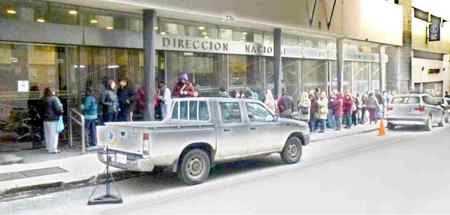
Migración: wait in line to get a number to wait your turn

The frustrations of the residency process in Uruguay
Please arrive 3 hours early to get in line to get a number to wait your turn to find out that “just one more thing” is needed for you residence application.

It seems that everywhere you go in Uruguay, you take a number. And wait: the bank. The hardware store. The vegetable stand in the féria (street market). Welcome to Uruguay: please take a number. Though it takes some getting used to, in general the system works well.

When we started our residency process, there was a number dispenser on the wall of the residence section. When you went in, you took a number.

One day it was empty, and you had to wait in line at the reception desk, to be given a number based on which of the two number dispensers you would have previously used (the office has a residence section and a gratuitous-paperwork section). Often as not, you could explain by simply pointing to the appropriate empty number dispenser.

Then one day they only gave out numbers at 12:45 for the residence section that opened at 1:00. With no room for a line (the reception desk meanwhile giving out numbers for the gratuitous-paperwork section), a crowd gathered, more or less keeping track of who was before whom before piling into the reception desk line at 12:45 .

Now they give out only 100 numbers a day, starting at 9:00, and open the residence section at 11:00. Why not give out numbers at 10:45 for a section that opens at 11:00? Well, because the inevitable long line for residence-section numbers blocks the main entrance, hence access to the gratuitous-paperwork section, which opens earlier than the residence section.

And to think: I never saw a line at the (now empty) number dispenser on the wall of the residence section. I have pointed out before that many things seem to be improving here (and will post one again tomorrow). Unfortunately, the bureaucracy at Migración is not one of them.

Those puzzling 9s of Uruguay…

What is it with the way people write 9s in Uruguay?

I’ve mentioned it before. These recent examples came from two hardware stores:

Somebody’s got to be teaching kids in school to write 9s backwards.

Further confusing the issue, some Uruguayans write 9s correctly.

What decides how you’re going to write a 9?

Are both equally acceptable during early school years?

Curious minds want to know.

Strange handwritten numbers in Uruguay
Now can we talk about those 2s?

See a pattern here?

Argentina

• Population: 40 million

• Possible license plate combinations: 13.8 million

• Possible license plates/person: 3.45

Chile

• Population: 19 million

• Possible license plate combinations: 32.8 million

• Possible license plates/person: 1.73

Uruguay

• Population: 3.5 million

• Possible license plate combinations: 138.2 million

• Possible license plates/person: 39.5

Quick tour of the volunteer garden

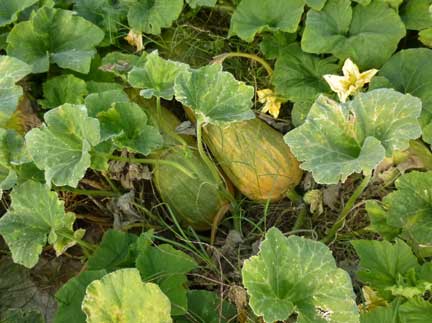
A couple of large zapallo (squash), each about 16″/40cm long:

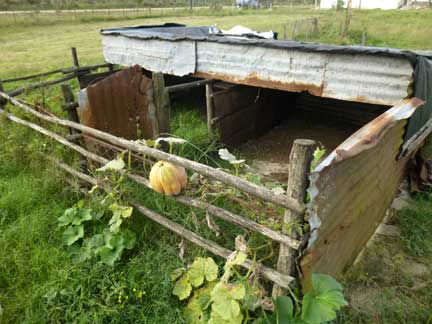
 One I only spotted from the road the other day, growing behind the chiquero (pigpen; unoccupied). It had wedged itself into the fence; I removed it, maybe damaged stem. If so, it becomes dinner.

 Finally, two of the loofahs (which I did  plant), joined on the left by an even larger zapallo, which I didn’t.

On the dissection table

When a piece of equipment dies, I always try to see if I can repair it, and if not, disassemble it as thoroughly as possible. We got this heater second-hand a few years ago, and I had the idea to pre-heat the infrared sauna with it, which worked brilliantly.

Once.

Obviously the second time it overheated, but peering into it I could find no sign of a fuse, so moved onto phase II.

Long story short: the fuse is very well concealed, and NOT designed to be serviceable. The two motors and the heating element still work just fine, so maybe I’ll look into temperature controllers at dx.com [deal extreme, since defunct] if I ever need to heat a chicken incubator.

Or something.

In which I become an herbalist

Ten days ago I posted a short video about comfrey.

Five days ago, my son stumbled steps in the centro (at 5 AM, ahem), creating what turned out to be a nasty fracture of the tibia that required surgery and several screws.

x-ray of broken ankle
Did I mention nasty?

He spent three nights in the hospital, during which he spent some money for outside food and TV rental in his double room. Retrieving him, I paid 719 pesos (USD 38.45) for at-home anti-coagulent, antibiotic, and pain meds, and 1,410 pesos (USD 75.40) for 15 daily in-home visits to administer the anti-coagulent shot. That was it.

What would this cost in the USA, $25-30,000?

Today I made a poultice for the first time, using comfrey I transplanted from a friend’s place over a year ago. He said it felt good!

Also interesting: we’ve been here over three and a half years; he’s only had medical insurance in the last six months or so.

Uruguayans make Mexicans look like Americans

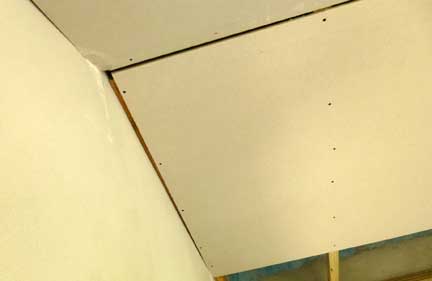
Ahh, I know what you’re thinking. In fact, this apparently sloppiness involves a remodel job in our very crooked little farmhouse. The piece to the right is the ceiling; the top piece slants up to it. It will all look just fine tomorrow. Oh no, that’s Labor Day: Thursday. Or Friday.

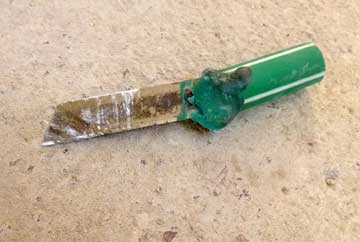
As I watched Martín cutting sheetrock (yeso, pronounced jeso), I marveled at this knife. Turns out he bought a cheap one (made guess where?) that fell apart after three days. So he melted a piece of thermofusion water pipe around the blade to make a handle.

When we lived in Mexico, I thought the Mexicans were the ultimate do-anything-with-nothing people. Compared to the Uruguayans, though, they’re like USA-Americans hopping into their Dodge 350 to go to Home Depot to buy yet another specialized electric tool….

Truckin’

Long day yesterday with my son in the emergency room—badly broken ankle from early morning wandering around with his friends in town. At dusk on the way back, I spotted this truckful of girls. Technically a horrible photo, but then it captures what I wanted. Obviously enjoying themselves!