Crazy gringo burns curupay as firewood

We inherited a piece of curupay lumber when we moved here. A meter long, perhaps 2″x3″, it weighs much more than any unsuspecting person would imagine. Curupay is used for beams, and though it has about the highest heat output of any wood here, its price is such that you’d be crazy to burn it. Unless, of course, you happen to have had incompetent local aluminum door installers destroy your floor and the frame of the wooden door they removed.
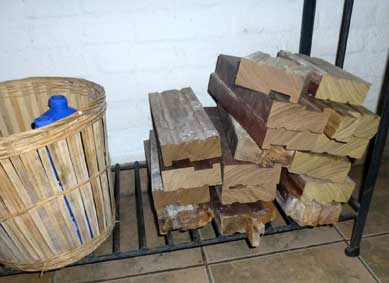
curupay wood

The pieces have sat, undisturbed, in our carport for a very long time. I tried cutting one with our crappy little German circular saw, which basically burned its way through the board, but my new table saw zipped right through them.
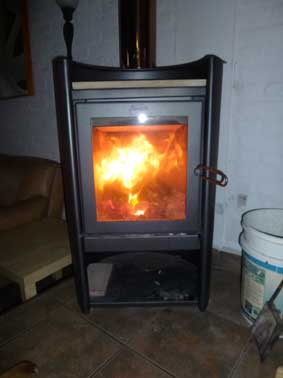
curupay board burning in wood stove

This is what just one of those pieces looks like burning. I’m scared to put in more than one piece. You can feel the heat across the room. Especially nice on a cold day like today, in a typically uninsulated Uruguay house.


 

Garam Masala!

A frequent discussion theme among expats is the number of things not available in Uruguay. Long-handled shovels. Even something as simple as a bevel gauge and rafter square, which a friend carried down from the States not long ago. But checking out a local friend’s recommendations, I found both in two different stores in Montevideo.

And so it was with Garam Masala: we thought it had to be brought in, since Uruguayans for the most part consider anything more than salt and pepper to be excessively strong flavoring. Imagine my surprise when I spotted it on a spice rack at our rural carnicería (butcher’s)!

curry powder

(From Hindi: गरम मसाला, garam (“hot”) and masala (spices).

curry powder illegible packaging

And, in true Latin American form (I noted this in Mexico as well), the graphic design renders the type almost illegible. But hey, garam masala is garam masala, whether you can read the packaging or not!

Baipa!

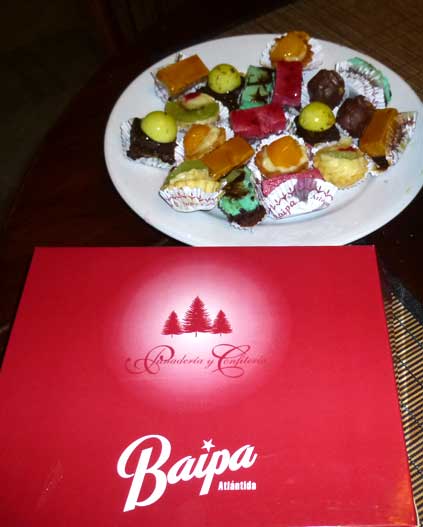
Went into Baipa for the first time since September 12, 2011. I remember the date well because we had guests from Punta del Este with whom we had a meal, visited the incredible vivero (nursery) Pacha Mama, and then introduced them to the this-could-be-Europe bakery Baipa. I told them it would be a year before I’d permit myself there again. 22 months: I’m feeling righteous 😉

So, invited to their place, we were instructed to bring goodies from Baipa. While waiting for my number to be called (welcome to Uruguay, please take a number), I told my wife to decide what she wanted, which turned out to be a bit of a challenge, given the sheer bulk of some of the other customers. Seriously, so big around that one could block the view of an entire display case.

Regulars, no doubt: or addicts. No doubt I”ll see them or some similar the next time I go to Baipa—which will not be before July 14, 2014.

Maybe.

Día del Padre

diedelpadre

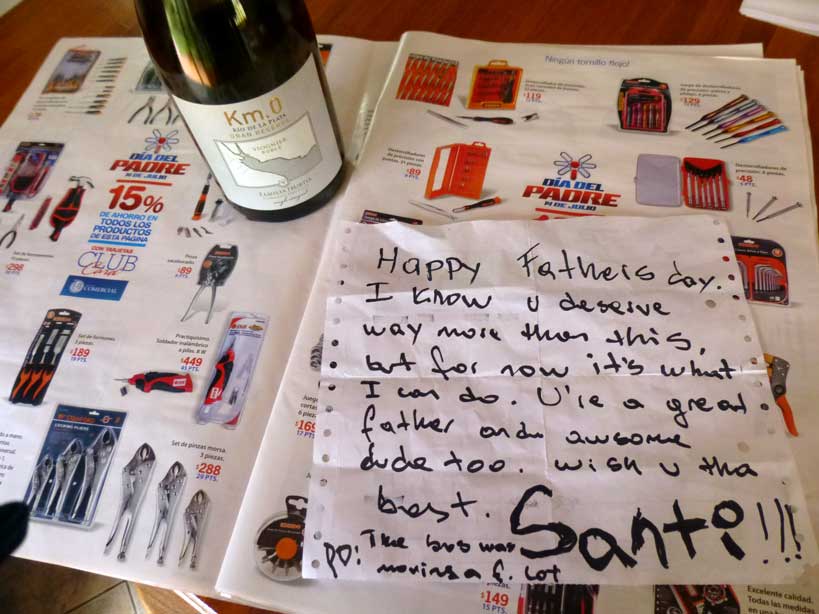
Father’s day meant to me finally, a circular from Tienda Inglesa whose front pages are filled with cool stuff instead of women’s clothes and processed food products.

It took on new meaning when Santi arrived waving a paper, which I took to be a bill he’d seen in our mailbox. But no, instead he gave me a father’s day note and a very nice bottle of wine I’d never had before. Sweet! (The P.D. says The bus was moving a lot [when he wrote the note].)

Particularly unexpected since he has a father and father-in-law living nearby. But that’s Santi; he bought a Hibiscus for my wife on mother’s day.

¡Que humedad!

First time we came to Uruguay from Mexico, we were amazed to wake up to passport covers curled by the humidity. Where we lived in Mexico,  March was so dry it might have been called Parch. It was refreshing; our skin felt moisturized.

It has a down side, though. In many parts of the world, locals build houses adapted to the environment. Not in Uruguay: a typical house is a single wall of brick, stucco, and no insulation, as if the objective were to grow mold. Ironically, now mostly-eschewed traditional building with adobe rarely has problems with moisture, as long as the walls are protected.

Today, the temperature is almost balmy, but the humidity continues to be incredible. They’re reporting it at 88%, which I’m tempted to disbelieve. I delivered the bases for some kitchen cabinets to the chacra, and almost got stuck just inside the gate.*

humidity

I’ve never had this happen before. Our mason has had a tough time the last few days; each coat of paint on the kitchen light fixture I’m making takes a couple days to dry.

* Called a potera; were I to bring that gate 10km to town, it would become a portal. Go figure.


Rodrigo’s back!

I hear a yell from my wife upstairs, and look to see Rodrigo, who left for New Zealand over 18 months ago, strolling up the driveway! Seems he likes surprises; he told no one but his brother (since he needed a ride from the airport) that he was arriving. Serious noise at his parents’ house: what are you yelling about, his mother demanded of his sister, who saw him first.

New Zealand gives out 200 work permits per year for Uruguayan kids; he left last year ahead of the others. Great joy to see him back.


Elsewhere in the news, we had chivitos today. Big deal? At Marcos, yes. Big. When we moved to Uruguay, I promised myself I would not have a chivito more than once a month. This is my first (I think) this year. What’s a chivito? Watch (note: since posting, blocked in Uruguay; requires VPN…or just have fun searching chivito on your own!)

¡Cinco!

After almost four years here, I finally saw it: five people on a motorbike, an entire family.

Configuration: kDkM&i — kid in front, Dad driving, kid between, and Mom clutching an infant behind.

No helmets, of course. (To their credit, they weren’t on a fast/busy street, unlike the ones I showed here and here.)

Remember, here you often see cars like this. And if you want to see for yourself how ridiculous the prices for used cars can be, spend a few minutes rummaging around Mercado Libre…U$S means US dollars, simply $ means Uruguayan pesos, currently 20/USD. When we moved here in 2007, I sold my used Toyota 4Runner which, at best, might have fetched USD 7,500 in the US. Here, I found the equivalent listed for USD 32,500.

Helps put into perspective the otherwise insane thought of a young family of five on a motorbike, especially when you reflect on the difficulty of earning a living.

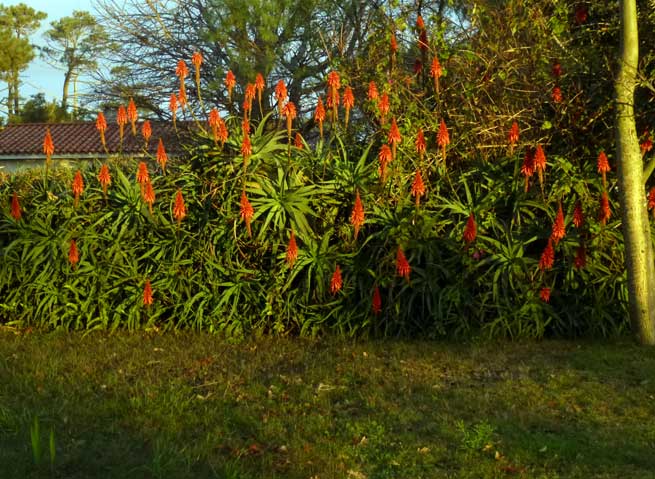
Aloe!

Even underexposing two stops, can’t do justice to the brilliance of
these aloe plants cross the road, glowing as the sun descends
toward its local disappearance at 5:43 PM. Four days past the
 winter solstice, nice to know that each day will be a little longer now.