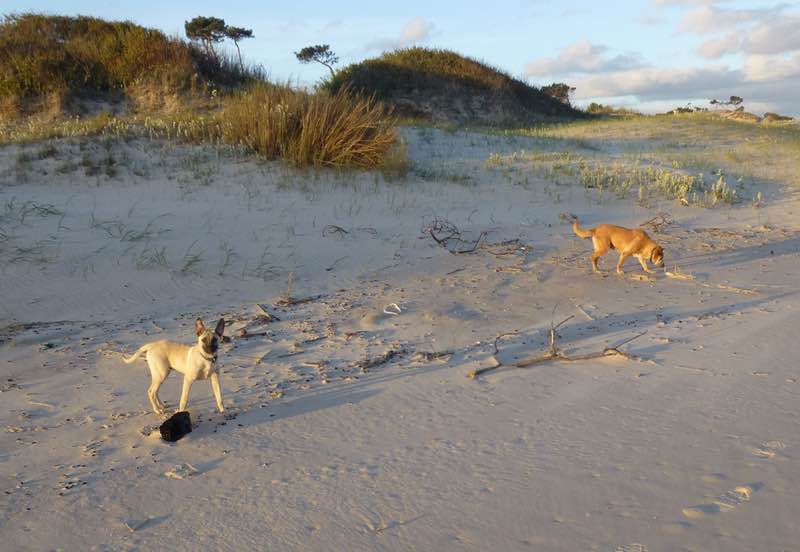
Gita (origin Doguita, “little dog”), on the right, finds it a challenge navigating the boardwalk to the beach with continual flank assaults from the enthusiastic puppy.
Settled down, they have friendly a tug-of-war with a stuffed bear. Which, ironically (or not), was a gift from a cleaning lady to the third, and smallest, dog Bandito, the Shit-Zoo (Syd will appreciate this spelling).
I’ve spoken of our trash collection system before.
Last night, for the third time, our closest container was burned. Yeah, it makes some kind of great sense to collect trash in flammable containers.
Just as it makes sense to purchase for Uruguay trash containers from a country with absolutely no UV problem: Germany. Plastic doesn’t fare well here.
However, the irony—or synchronicity—in this current destruction is that my wife took a shovel yesterday to remove the body of a dead possum (comadreja) from the road, and threw it in that container.
So the little critter got a proper cremation.
Well, almost. From the attention our garbage-hound Gita gave today, apparently there are some Cajun tidbits still edible by her standards (shared by almost no other living thing besides ants and bacteria).
At some point, we realized that the Disco “Hypermercado” gives a 10% discount for ten bottles of wine. In general, Disco has little to recommend it beyond perhaps-lower prices than Tienda Inglesa. But for a deal on wine, it’s fine. Unlike Tienda Inglesa — which has thicker bags — the cashiers at Disco put three, not two, bottles of wine in each thinner plastic shopping bag.
So what happens when you buy nothing but ten bottles of wine?
Three bottles in the first bag. Three bottles in the second bag. Clearly what remains are four bottles. Two more bags. So — ?
Three bottles in the third bag. One bottle in the fourth bag.
This is not an isolated incident.
Why would a cashier not put two bottles in the last two bags? What am I missing here?
This is what happens when you stick the bottom of a head of bok choy / pak choi in dirt and let it go. It didn’t make another head, but we did harvest quite a few leaves before it bolted. The bees love those flowers. Next: collect seeds ….
Those are heads of lettuce either side of it, from seedlings courtesy of our friends Don and Jan.
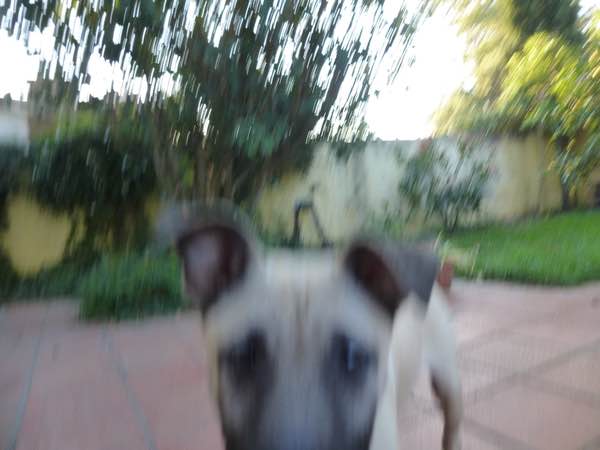
If you’ve ever tried to take a picture of a puppy, you’ll understand this photo viscerally.
No image manipulation involved. We seem to have settled on his name as “Benji,” which was the name of the beautiful but personality-challenged dog we rescued (with permission) from our troglodyte property-squatting neighbors.
Suggestion inspired by our Uruguayan-American friend Isabel, who recalled that I once said all dogs in Uruguay were named Benny, because when owners call them they say ¡vení! (come!), which seems to be a Rioplatense Spanish conjugation. (If you can clarify, please do!)
We’ve had several days now of persistent, on-shore wind. Here in Uruguay, off-shore points to Antarctica. Yeah, it’s been chilly. And I’m finally feeling righteous about finally having a proper winter jacket! (Purchased last November in Miami, when we were heading into summer here.) And so, for the first time in six years, we had a wonderfully mild winter, one that barely required a winter jacket.
I’m not implying causality, for the record. But, erm, uh … Uruguay, thank me if you will. It’s been pleasant, no? But this cold wind….
The Rambla (beachfront road) in Parque del Plata has always had a ridiculous stretch that half-fills with sand during the winter. Prior to tourist season, a front-end loader and dump truck appear, scoop up the offending dunes and deposit them upstream in the Solís Chico river, making a nice little beach for the locals. Which can then wash back down the river, into the sea, and — OK, let’s not go there.
This year, they have their work cut out for them, thanks to these cold southern winds.
OK, you can’t see it, but the sign says “Calle Cerrado,” which means … well, it’s not the name of the street.
Meanwhile, the dune — above the boardwalk built to prevent further erosion of dunes — has gotten high enough that today I walked through the neighboring gap instead. Sort of like the gap where they built the boardwalk. But, hey.
Today I approached through the gap to the right, rather than expend the effort to surmount the dune formed above the gap the boardwalk was built to “solve.”
Except for a 6-month amazing stint in Lincoln City, Oregon (1986-7), I have never lived near a beach, until the last six years, and the constant changes fascinate me.
Unlike my father, I’m not an engineer. Nor as smart. But I don’t think I’m thus unqualified to ask, what exactly are we not “getting” here?