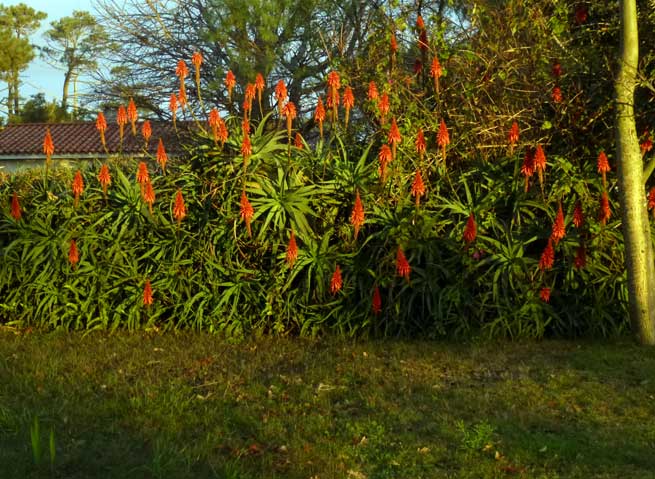
Aloe!

Even underexposing two stops, can’t do justice to the brilliance of
these aloe plants cross the road, glowing as the sun descends
toward its local disappearance at 5:43 PM. Four days past the
 winter solstice, nice to know that each day will be a little longer now.

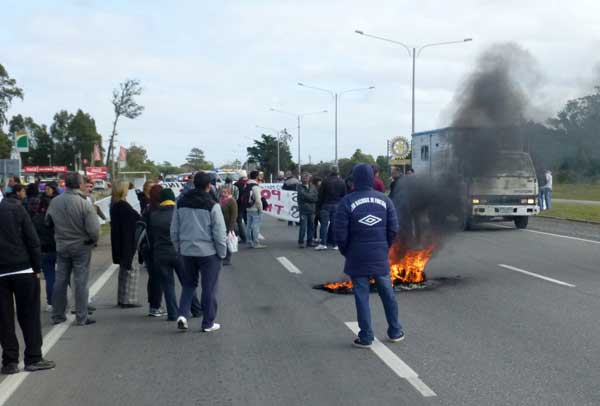
En conflicto

Sceneon the Ruta Interbalnearia today.

A worker earns 11,000 pesos per month, the Secretary General 97,000.

Sounds like a reasonable ratio of CEO-worker pay.

But:

132,000 pesos = US$6,600/year.

Sueldos de hambre (starvation wages) indeed.


I got it! Well, sort of.

This morning I got a number for my son to see the doctor who bolted his leg together a month and a half ago, for next week. When he was released from the hospital, they told me to do a followup in a month.  Except they didn’t bother to explain exactly how. So when the time came, I went to the local clinic, who told me a number to call for an appointment, which I did.

Time out: the number they give out is 1920 1212. Since all phone numbers in Uruguay have eight digits, you might imagine this is the number to call. You would be wrong: in the event you’re not in Montevideo. You have add a 2 in front, making it a nine-digit number. This is apparently so obvious that they don’t bother to tell you, and wonder why you’d ask.

No appointments were available, they told me. Call back May 30—at 6:30 AM. 6:30 AM? Right. Well, I got around to it a few days later than that, at which point there no appointments available; call back June 13 at 6:30 AM. Someone tipped me off I could arrange it online, where the system also indicated that the next appointments would be available June 13 at 6:30 AM.

I set the alarm and got up at 6:15 this morning. At 6:33 their system went live and I got #1, meaning that a week from now, we will be the first served at 6:00 PM and perhaps home in time for supper. Twelve hours later (now), all slots are full; please come back on June 20th at 6:30 AM

God only knows what it must be like to try to phone at 6:30 AM: they list 100 specialties. Assuming 50 appointments needed per specialty per week (and each has numerous doctors), that means potentially 5,000 or more incoming phone calls on one line before 7 AM.

I don’t want to be judgmental about a system despite it’s being seemingly designed to make life difficult for patients, but one does have to wonder who exactly thought making every appointment for every location of a hospital for for an entire week at the same time was a good idea?

Oh wait—maybe they hired someone from Migración….
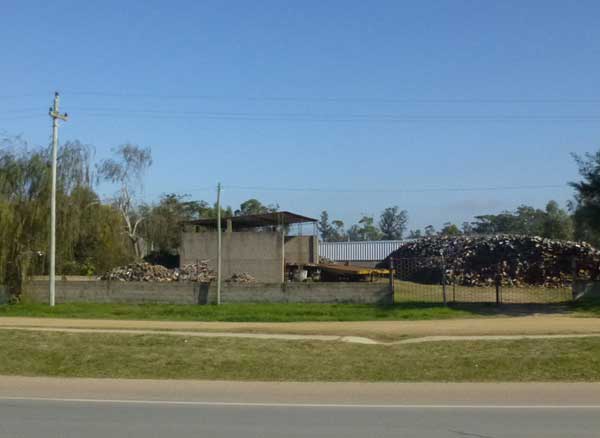
Need firewood? Go away.

firewood

When we got our first wood stove, I saw several places on very busy roads, with massive piles of firewood (leña), apparently for sale, unattended, and no way to contact the seller. Surely they would paint a phone number on the wall, at least?

After a few years here, despite some excellently run local businesses, the simple act of procuring materials often seems like a game of “catch me if you can.” Still, I think might suggest a sign if I meet the owner:

Marketing in Uruguay

The harvest

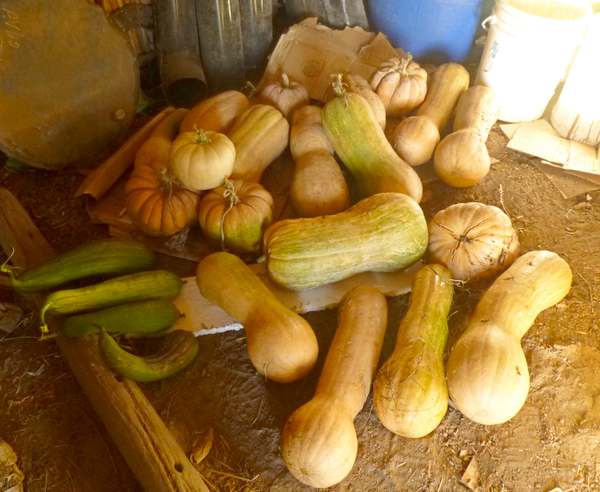
The younger brother of our albeñil (mason/contractor) said the yellow squash and pumpkins should be brought in before the last rain, so I did last week. Except for the six in the foreground I found today. Yes, you would think they’d be hard to miss.

These all came from volunteer plants. I know of about a dozen more smaller, green squash still on the vine.

The green ones lower left are loofahs, which I did plant, from a loofah I bought at Tienda Inglesa that had plenty of seeds inside. When they dry out completely, the skin will crack off easily. I hope. I tried to speed the process using heat on the first I picked. Wrong.

A new bridge

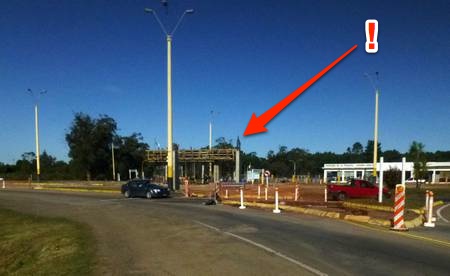
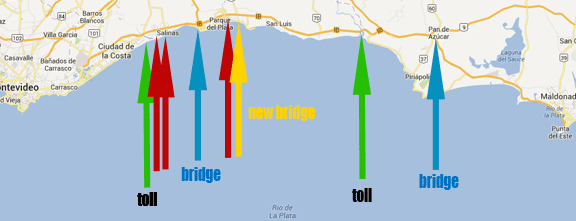
Venturing east recently, we noticed some odd construction: in La Floresta at Ruta 35, what had been traffic lights in the middle of nowhere had become a roundabout. Turns out they’re building a traffic overpass, only the third between Montevideo and Punta Del Este, and replacing one of only four traffic lights between the mandatory toll stops.

Why there? Ruta 35 does not have that much traffic. However, examining the traffic lights (red arrows) from left (Montevideo) to right (Punta del Este):

  1. Neptunia: nothing but a small residential area on the north side.
  2. Salinas: the town’s iconic arch wold need to be removed.
  3. Parque del Plata: nothing but a small residential area on the north side.

In La Floresta, no problems, wide open, through road to Soca and beyond.

So they’re building it there because they can. That’s good news for anybody wanting to hit the road east, because after the Parque del Plata light (new since we moved here) things are pretty wide open. Unfortunately, the space west of Parque del Plata is not wide open, and heavily populated, but the people racing between Montevideo and Punta act as though it’s their god-given right to drive as fast as they can past things like this and this and this.

Punta del Este license plates begin with B. Montevideo license plates begin with S. BS drivers are not the only offenders (BA also comes to mind: Buenos Aires), but it was not a local car in this scene.

Oh yes, you want to hear more about Migración. You know you do.

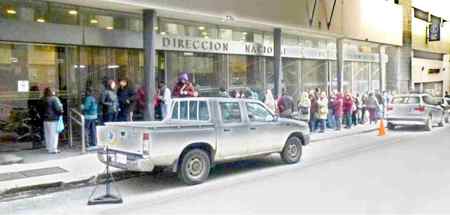
Yesterday I shed light on one of the more stunning displays of Uruguayan bureaucracy.

Thinking they opened the door at 8:00, and got there early. At 9:00, after over an hour and a half of standing in the cold, windy street, we were rewarded with number eight.

TA DA!!!

Presenting an official translation of a document which it was not good for the notary to have seen, and not good enough for the notary to have described, I was assured that everything now is in order for a final decision on my son’s (home with broken ankle) 42-month-old, 75+ page residence application.

Umm, except they also said that last August, only to discover in October that “just one more document” was needed. Which had been requested by the uppy-ups in a letter from the previous January, and managed to remain completely invisible in the file during our reviews in May, June, July, and August.

Three months from now, we will be able to check on the status using the computer at their office (not online; why would you want to check conveniently?). If/when approved, we can then go early in the morning to wait in line to get a number to wait my turn to get approval to make an appointment to wait in line at the office that issues cédulas (ID cards).

Migración: wait in line to get a number to wait your turn

The frustrations of the residency process in Uruguay
Please arrive 3 hours early to get in line to get a number to wait your turn to find out that “just one more thing” is needed for you residence application.

It seems that everywhere you go in Uruguay, you take a number. And wait: the bank. The hardware store. The vegetable stand in the féria (street market). Welcome to Uruguay: please take a number. Though it takes some getting used to, in general the system works well.

When we started our residency process, there was a number dispenser on the wall of the residence section. When you went in, you took a number.

One day it was empty, and you had to wait in line at the reception desk, to be given a number based on which of the two number dispensers you would have previously used (the office has a residence section and a gratuitous-paperwork section). Often as not, you could explain by simply pointing to the appropriate empty number dispenser.

Then one day they only gave out numbers at 12:45 for the residence section that opened at 1:00. With no room for a line (the reception desk meanwhile giving out numbers for the gratuitous-paperwork section), a crowd gathered, more or less keeping track of who was before whom before piling into the reception desk line at 12:45 .

Now they give out only 100 numbers a day, starting at 9:00, and open the residence section at 11:00. Why not give out numbers at 10:45 for a section that opens at 11:00? Well, because the inevitable long line for residence-section numbers blocks the main entrance, hence access to the gratuitous-paperwork section, which opens earlier than the residence section.

And to think: I never saw a line at the (now empty) number dispenser on the wall of the residence section. I have pointed out before that many things seem to be improving here (and will post one again tomorrow). Unfortunately, the bureaucracy at Migración is not one of them.